One of 20 self-guided London walks on this site. See every walk, from the South Bank to Hampstead Heath.
In this guide
Notting Hill’s colourful houses are on the residential streets around Portobello Road, not on it. The best of them is a cluster of four streets (Hillgate Place, Farmer Street, Hillgate Street and Jameson Street) two to three minutes from Notting Hill Gate station, which most visitors walk straight past. Almost everyone looking for the pastel terraces goes to Portobello Road itself, walks its length, photographs some painted shopfronts and leaves slightly puzzled.
This guide is a route through the eleven streets that actually have the colour, in walking order, from Notting Hill Gate to Ladbroke Grove. It also covers where the cherry blossom is, if you are here in spring.
It is deliberately only about the houses. For the market, the antique arcades, Golborne Road and where to eat, see our Notting Hill area guide — the two are designed to be walked on the same day.
💡 The Short Version: Start at Hillgate Place — two minutes from Notting Hill Gate and the prettiest of the lot, with a fraction of the crowd. Lancaster Road has the strongest colours and the most photographers. Lansdowne Road and Elgin Crescent are the grand pale stucco version. And Portobello Road itself is shopfronts, not houses — which is why so many people leave disappointed. Go there for the market, not the colour.
The route
Map of the walk, numbered in walking order
Loading the map…
Open the whole route in Google Maps → — all eleven streets in walking order, set to walking directions. Notting Hill Gate is two minutes from the first stop and Ladbroke Grove about eight minutes from the last. About 3.5km, or two hours at a photographing pace.
| # | Street | What to look for |
|---|---|---|
| 1 | Hillgate Place | The best of the four, and the one to see first |
| 2 | Farmer Street | Blue, pink and cream in a row |
| 3 | Hillgate Street | Long view down the pastels |
| 4 | Jameson Street | Pink corner house |
| 5 | Portland Road | Painted shops and houses around Clarendon Cross |
| 6 | Lansdowne Road | Bigger, grander, softer colours |
| 7 | Elgin Crescent | Butter yellow and powder blue stucco |
| 8 | Stanley Crescent | The cherry blossom street, in spring |
| 9 | Denbigh Terrace | Pink, blue and cream in a tight row |
| 10 | Lancaster Road | The postcard row: the strongest colours of the lot |
| 11 | St Luke’s Mews | Cobbled mews, and the Love Actually pink house |
Start with the four streets nobody visits
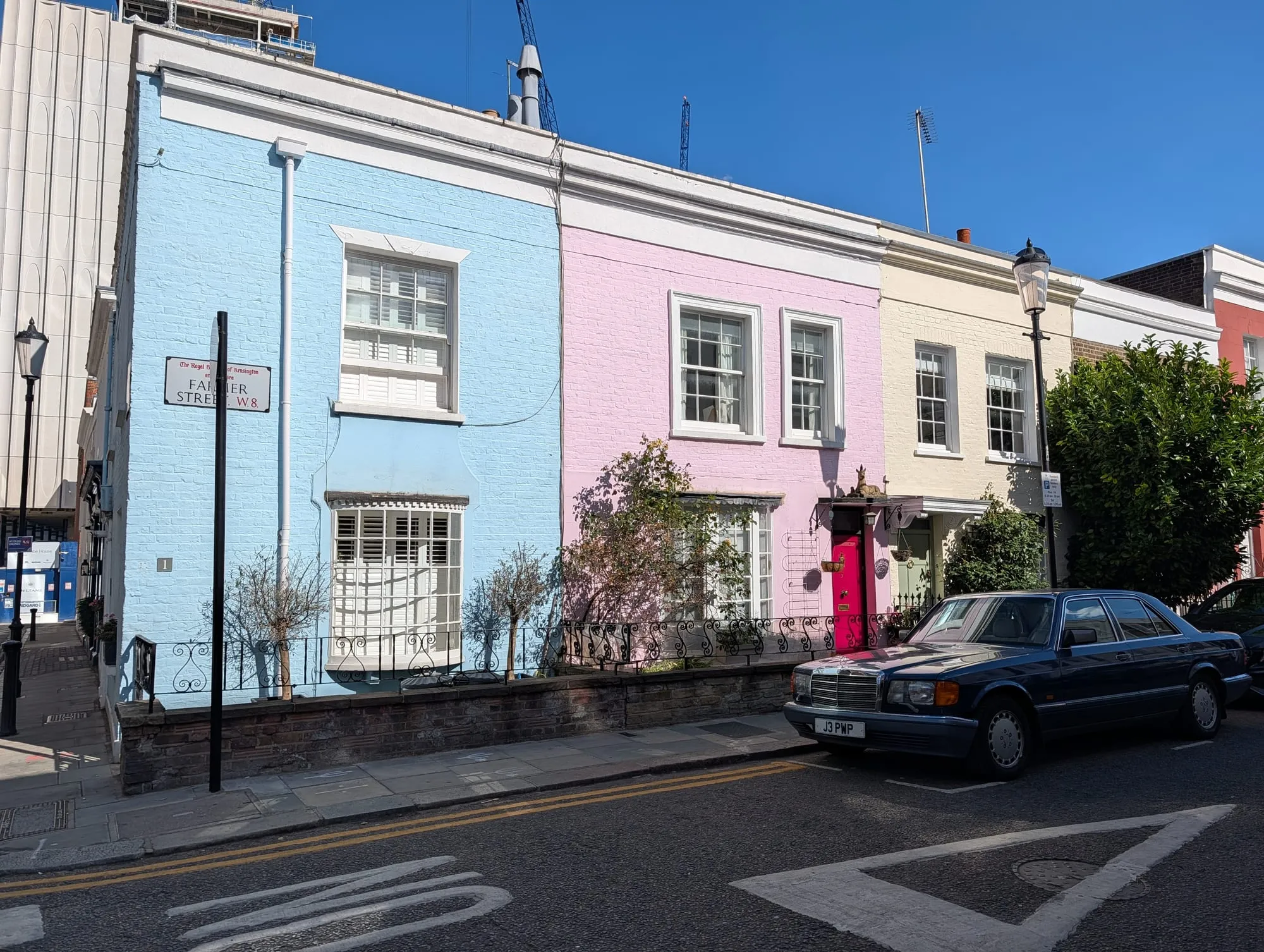
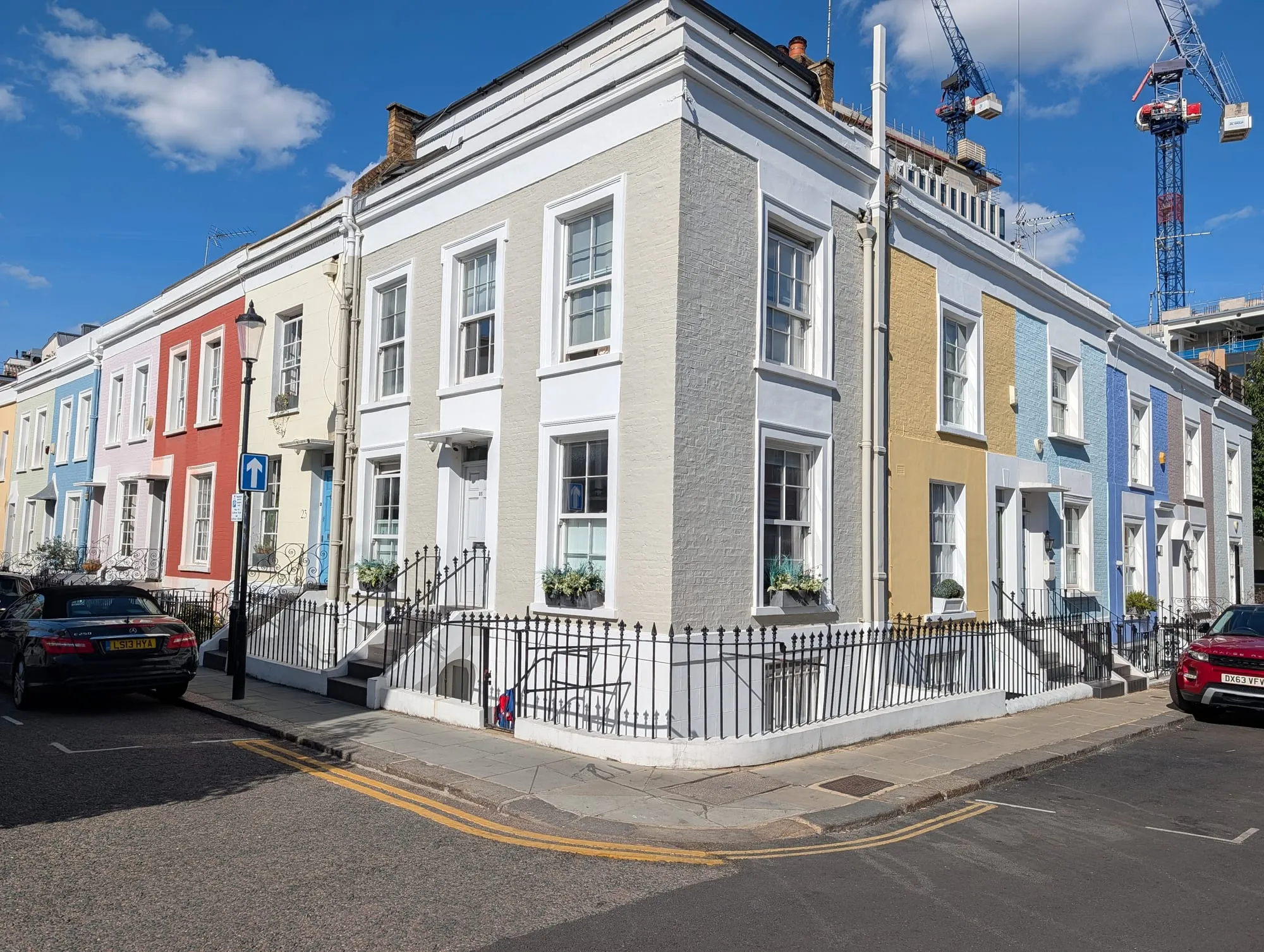
Hillgate Village is the name for a pocket of four short streets — Hillgate Place, Farmer Street, Hillgate Street and Jameson Street — immediately south of Notting Hill Gate station. The houses are small, two and three storeys, and painted in flat blocks of colour: pink, sage, butter, powder blue, a deep coral.
They are smaller than the stucco terraces elsewhere in Notting Hill because they were not built for the same people. The streets were laid out on a former brickfield from 1851, and more than two hundred narrow houses went up within a decade, most of them shared by several working households. In the 1870s one observer called Johnson Street, now Hillgate Street, “a dingy, ill-favoured slum”. The colour works because of the scale: on a three-storey cottage a strong colour reads as cheerful, where on a five-storey stucco terrace it would read as a mistake.
The practical point is that they are two minutes from Notting Hill Gate station and almost empty. Portobello Road is a fifteen-minute walk north and takes essentially all of the foot traffic. On a Friday afternoon in September there were two other people photographing here; the same afternoon on Lancaster Road there were about thirty.
1. Hillgate Place
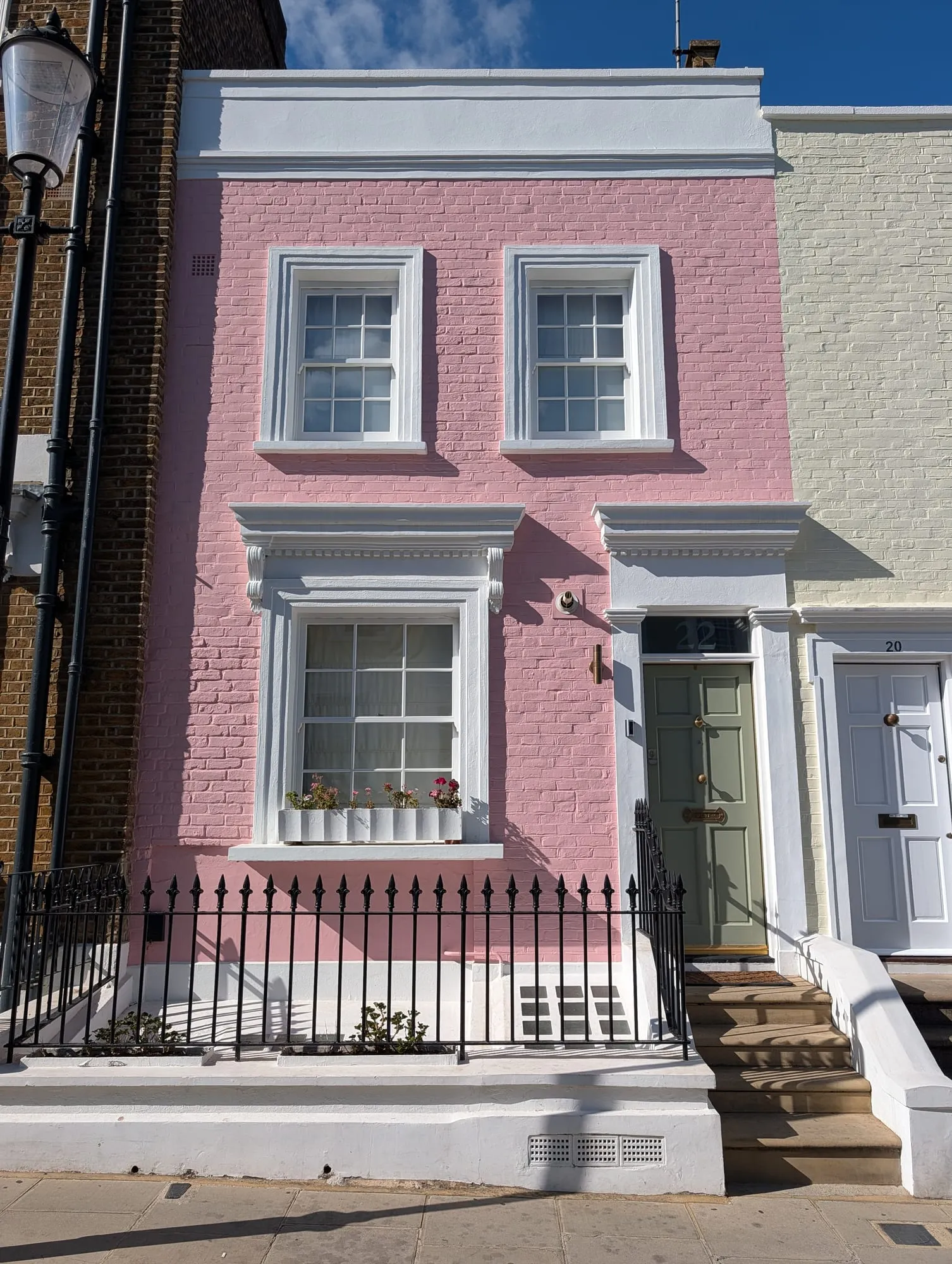
The best single street of the four, and the one to walk first. It bends, which means the colours stack up in the view rather than running away from you in a straight line — the reason it photographs better than streets with more dramatic individual houses.
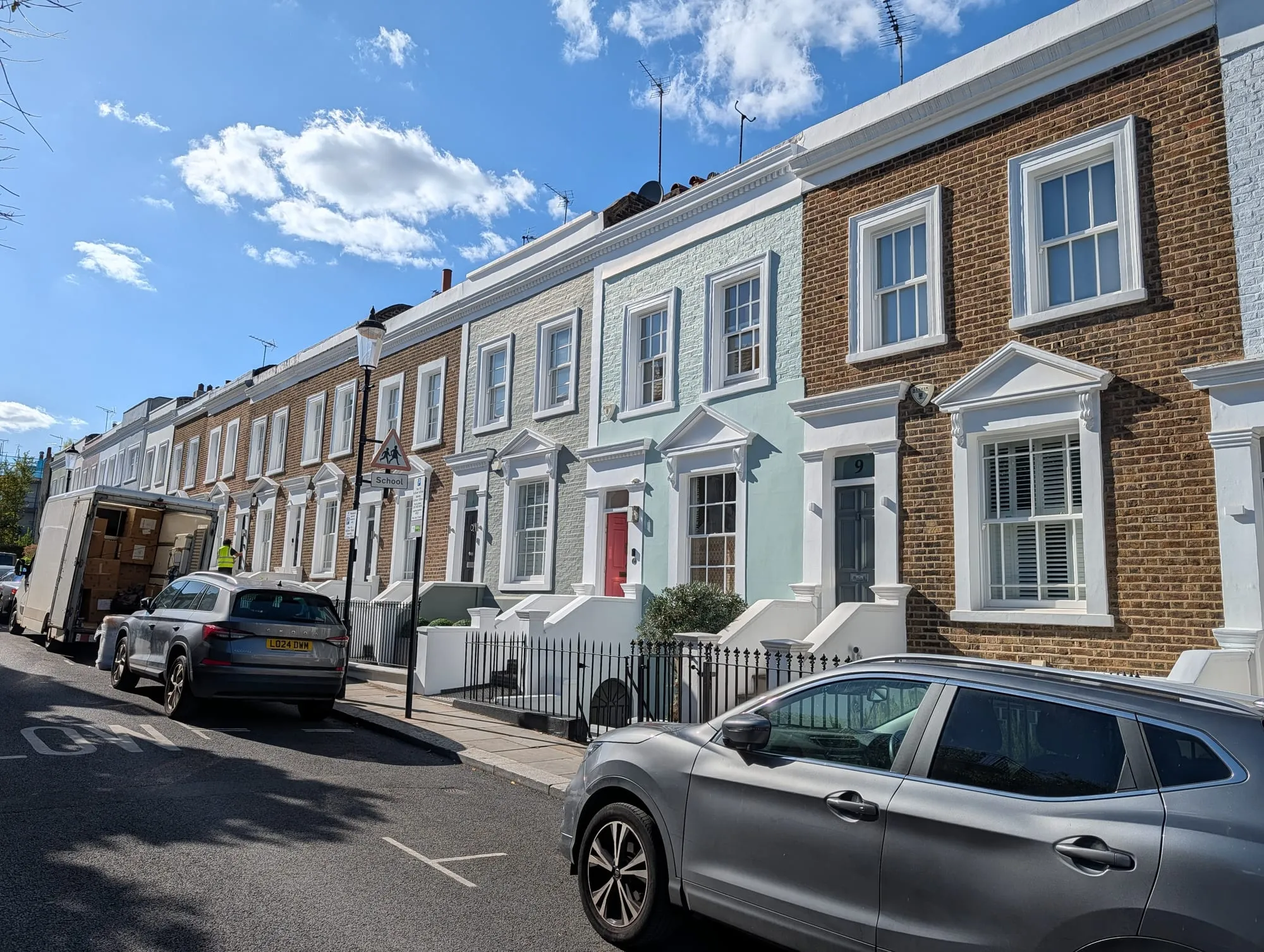
Walk it in both directions. The north side and the south side are painted quite differently, and the corner where it meets Hillgate Street stacks four colours into one frame.
2. Farmer Street
The blue-pink-cream run near the top is the most photographed thing in Hillgate Village, helped along by the residents’ habit of parking interesting cars outside it. One house is covered almost entirely in ivy that has been cut back around the windows, which is either the best or the worst house on the street depending on your feelings about ivy.
3. Hillgate Street
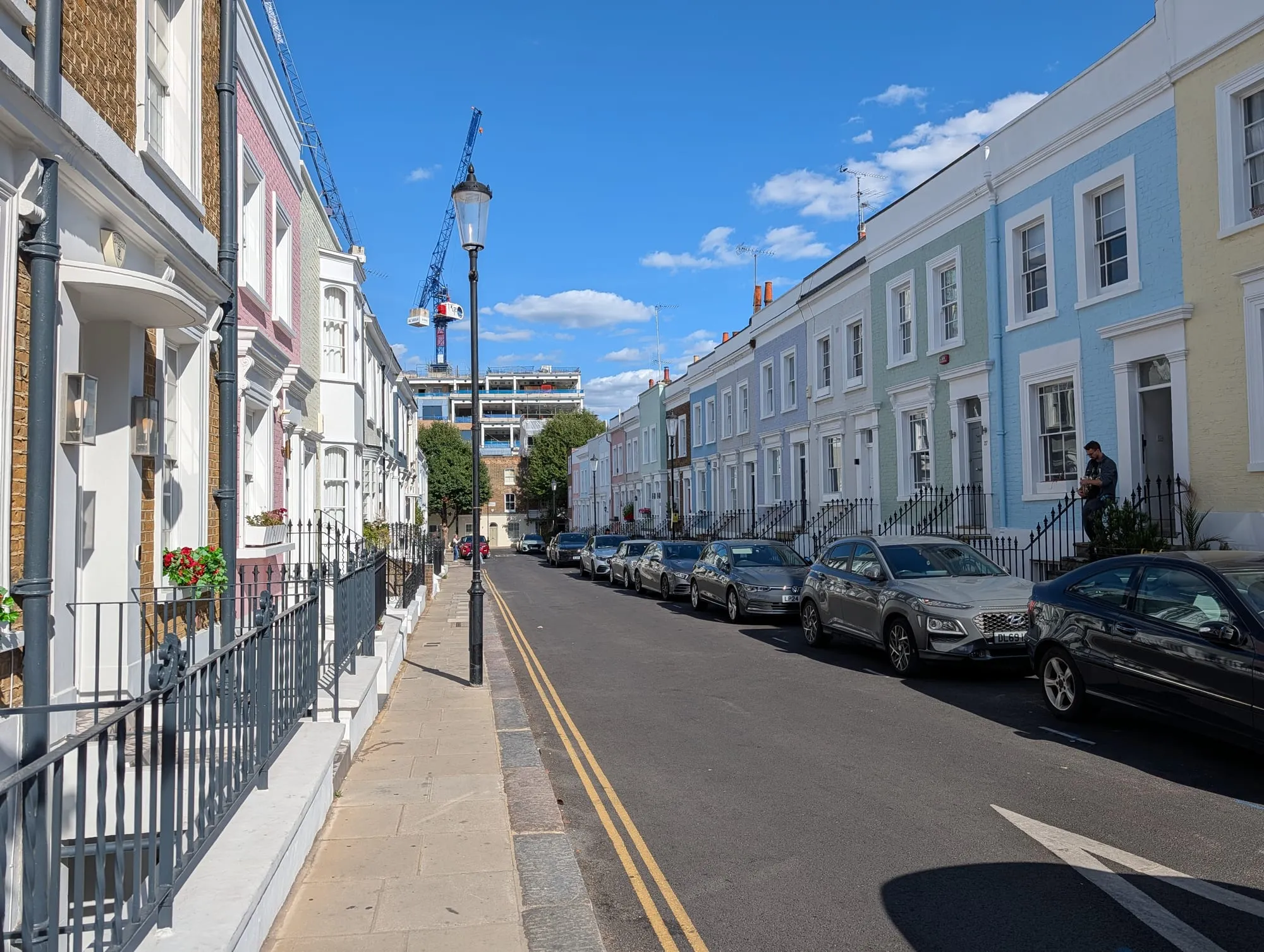
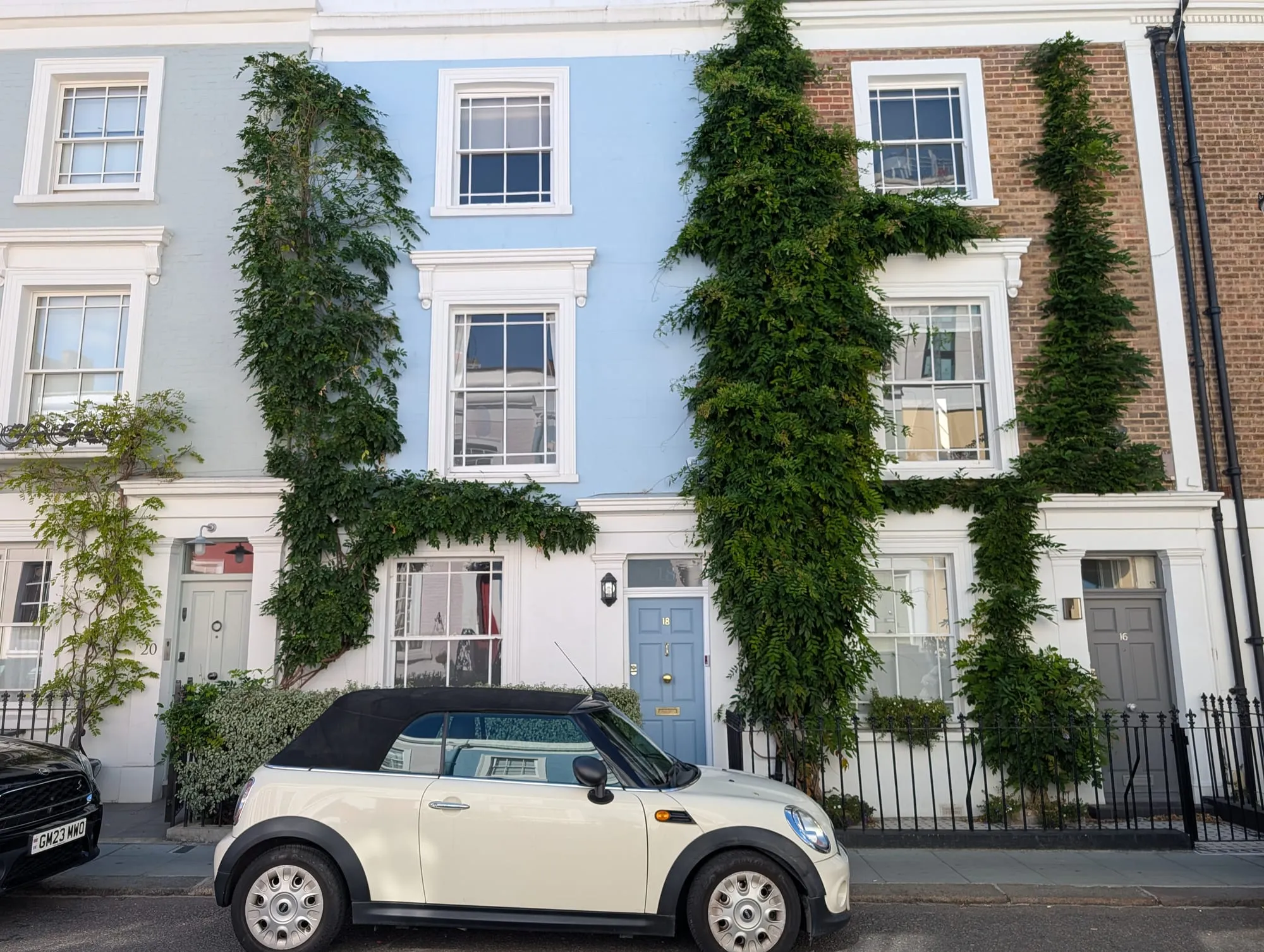
The long view. Hillgate Street gives you the most houses in one frame of anywhere in this guide, running downhill with the colours in sequence. There is a construction crane on the skyline at the far end, which you will either crop out or decide to keep in.
4. Jameson Street
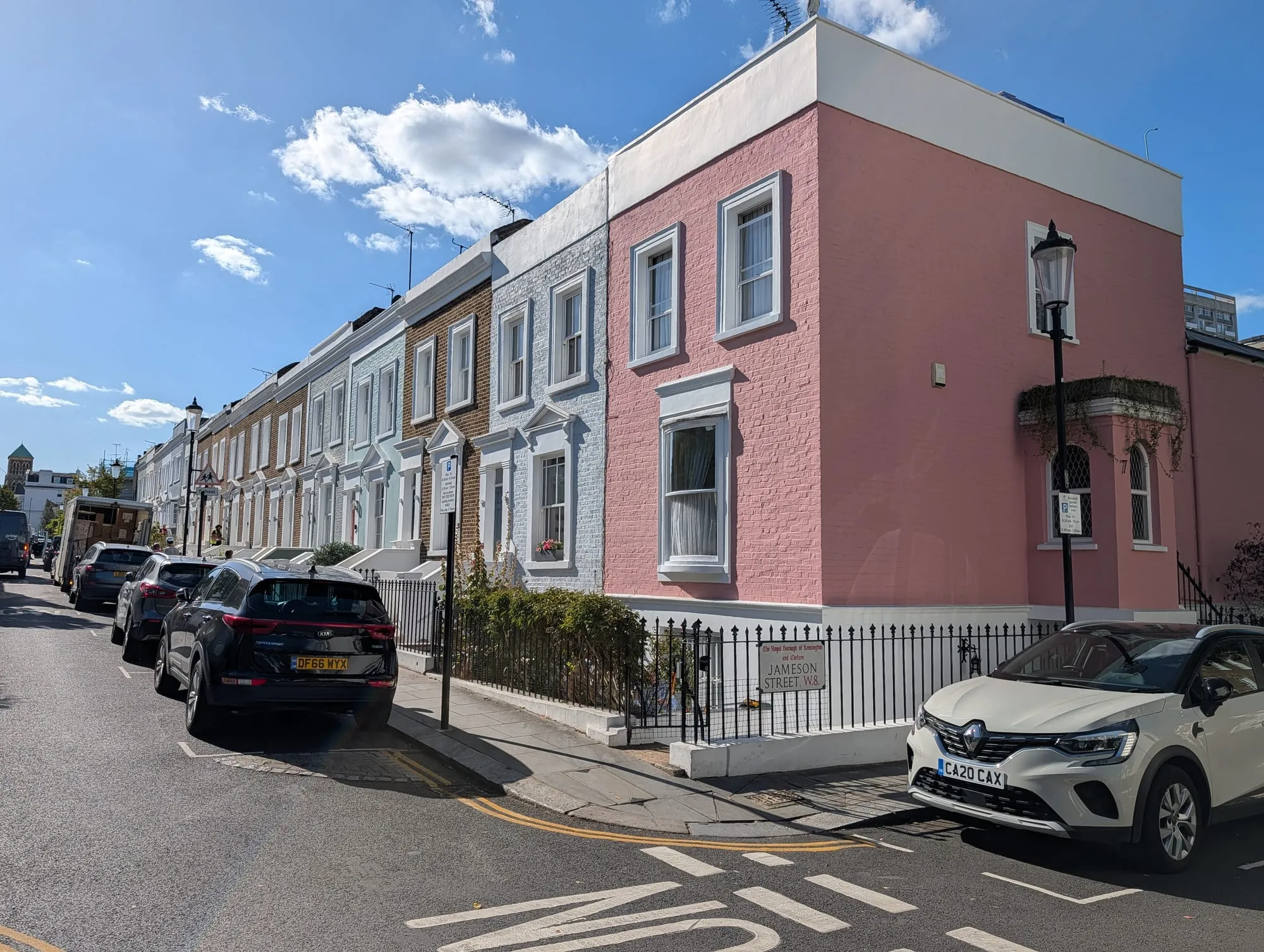
The shortest of the four and the quickest to walk. Its corner house is a strong flat pink against a grey terrace, and it closes the loop back towards Notting Hill Gate.
5. Portland Road
Ten minutes west of Hillgate Village and a different kind of colour: Portland Road runs down to Clarendon Cross, where a cluster of painted shopfronts and small houses sits around a junction with no through traffic and no market. It is the quietest thing in this guide.
Worth the detour mainly if you want somewhere to sit down. Clarendon Cross has a couple of cafes and the pace drops the moment you turn off Holland Park Avenue.
Then go north for the grand version
The colour changes character about ten minutes’ walk north-west. The houses get bigger, the paint gets paler, and the effect is less village and more Kensington.
6. Lansdowne Road
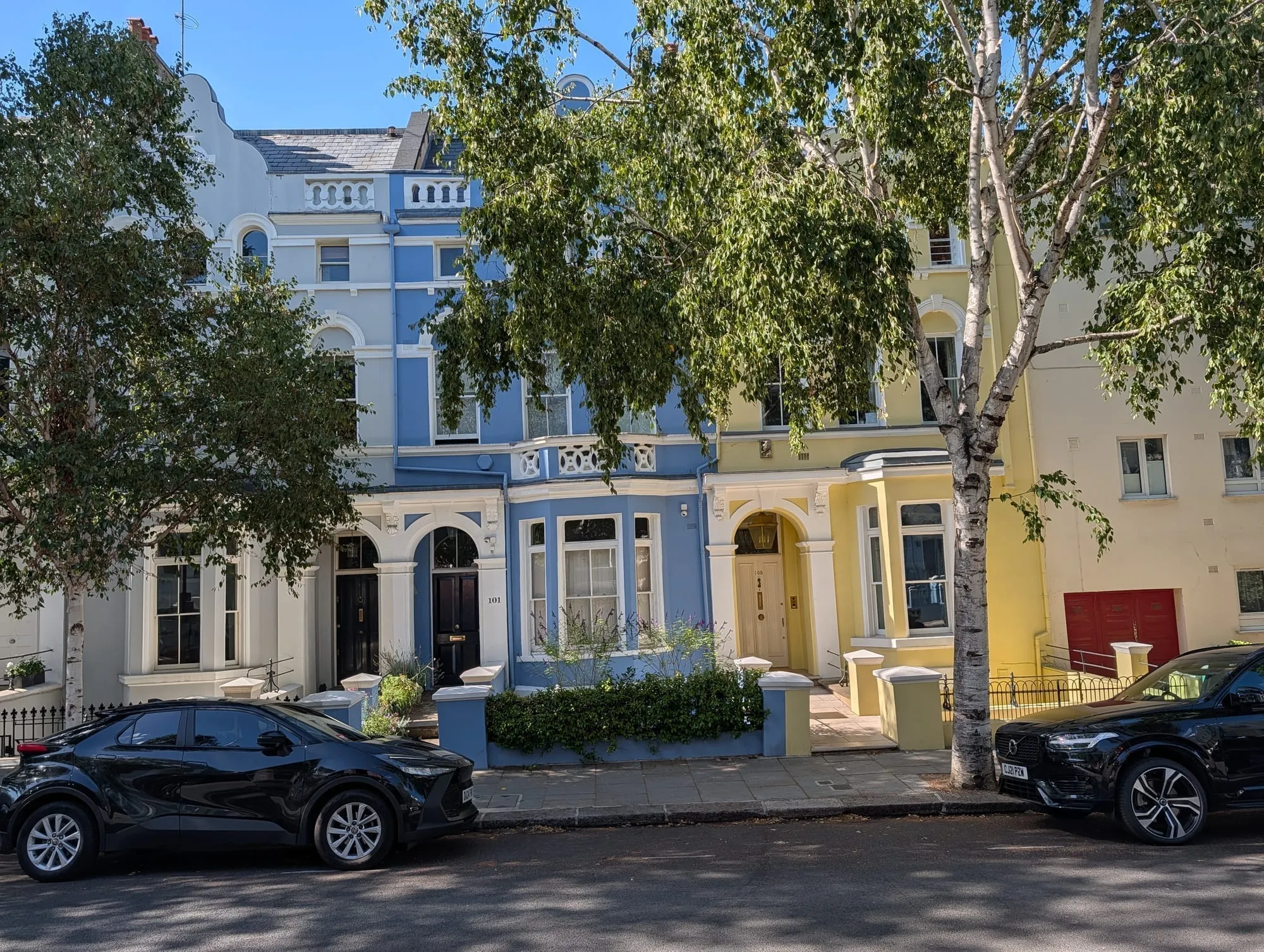
Wide, tree-lined, and expensive-looking in a way the Hillgate streets are not. The houses here are four and five storeys with proper porticos, painted in muted creams, yellows and blue-greys. It is the version of Notting Hill that estate agents photograph. Worth walking for the contrast more than for the colour — after Hillgate Place the palette feels almost restrained.
7. Elgin Crescent
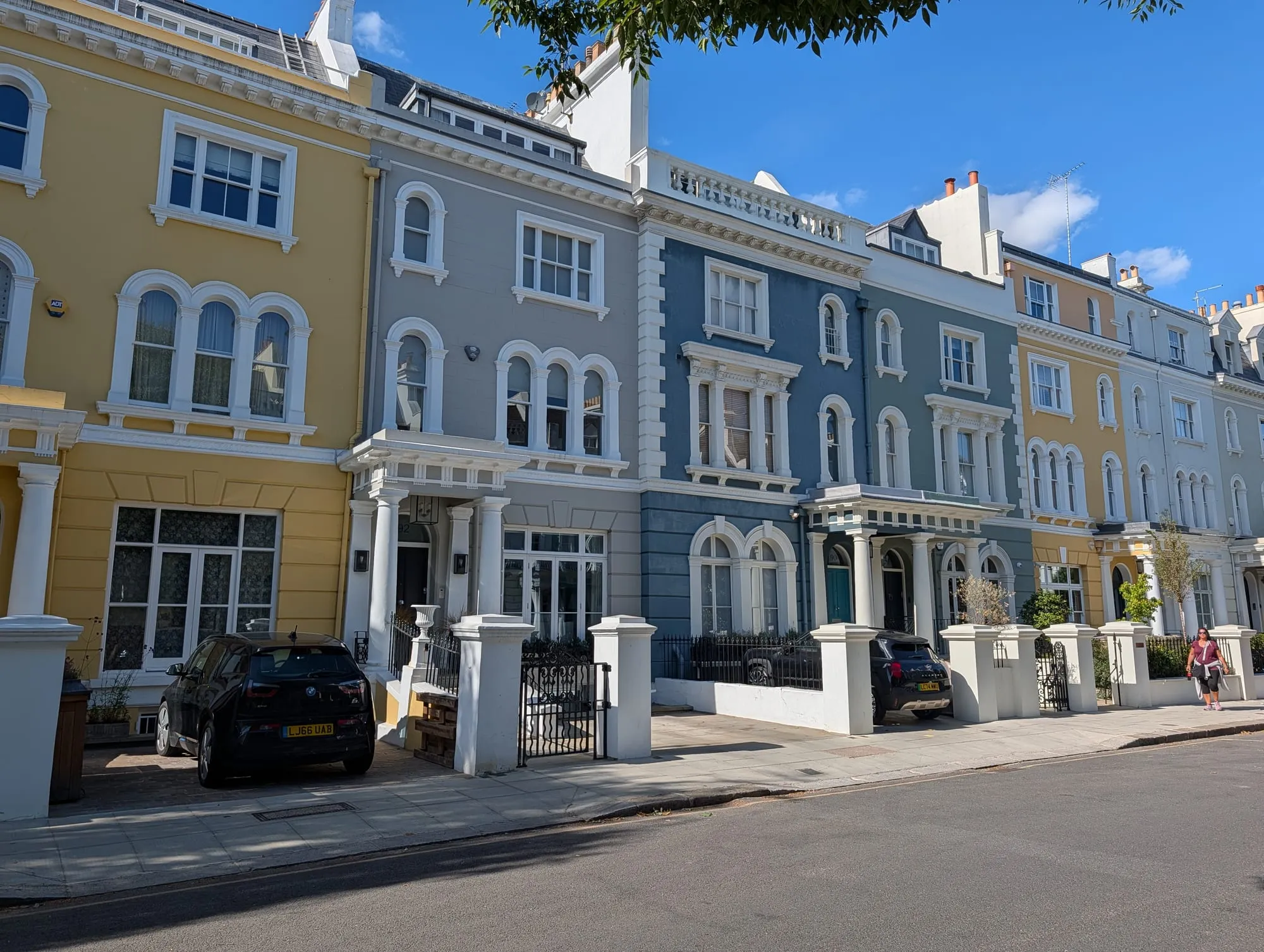
The best of the grand streets. Elgin Crescent curves, so the pale yellow and powder blue frontages come at you in a sweep, not a line, and the houses are tall enough that you get the colour and the sky in the same frame. If you only walk one of the northern streets, walk this one.
8. Stanley Crescent
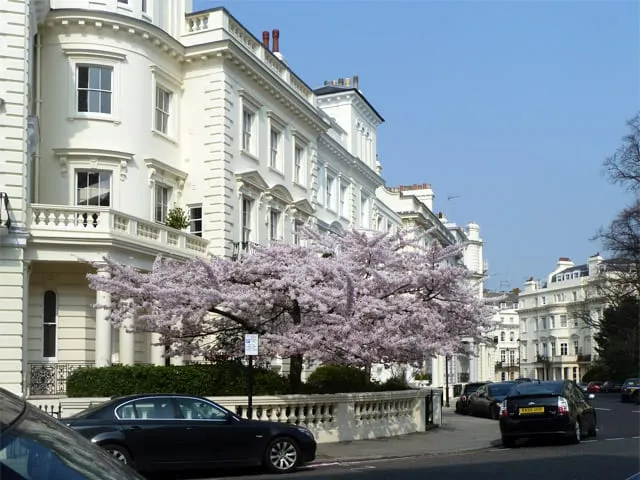
Cherry blossom on Stanley Crescent. Photo: Robin Webster, CC BY-SA 2.0.
White stucco rather than paint, so for most of the year this is the least colourful street here. For about two weeks in spring it is the most. See the blossom section below before you plan around it.
9. Denbigh Terrace
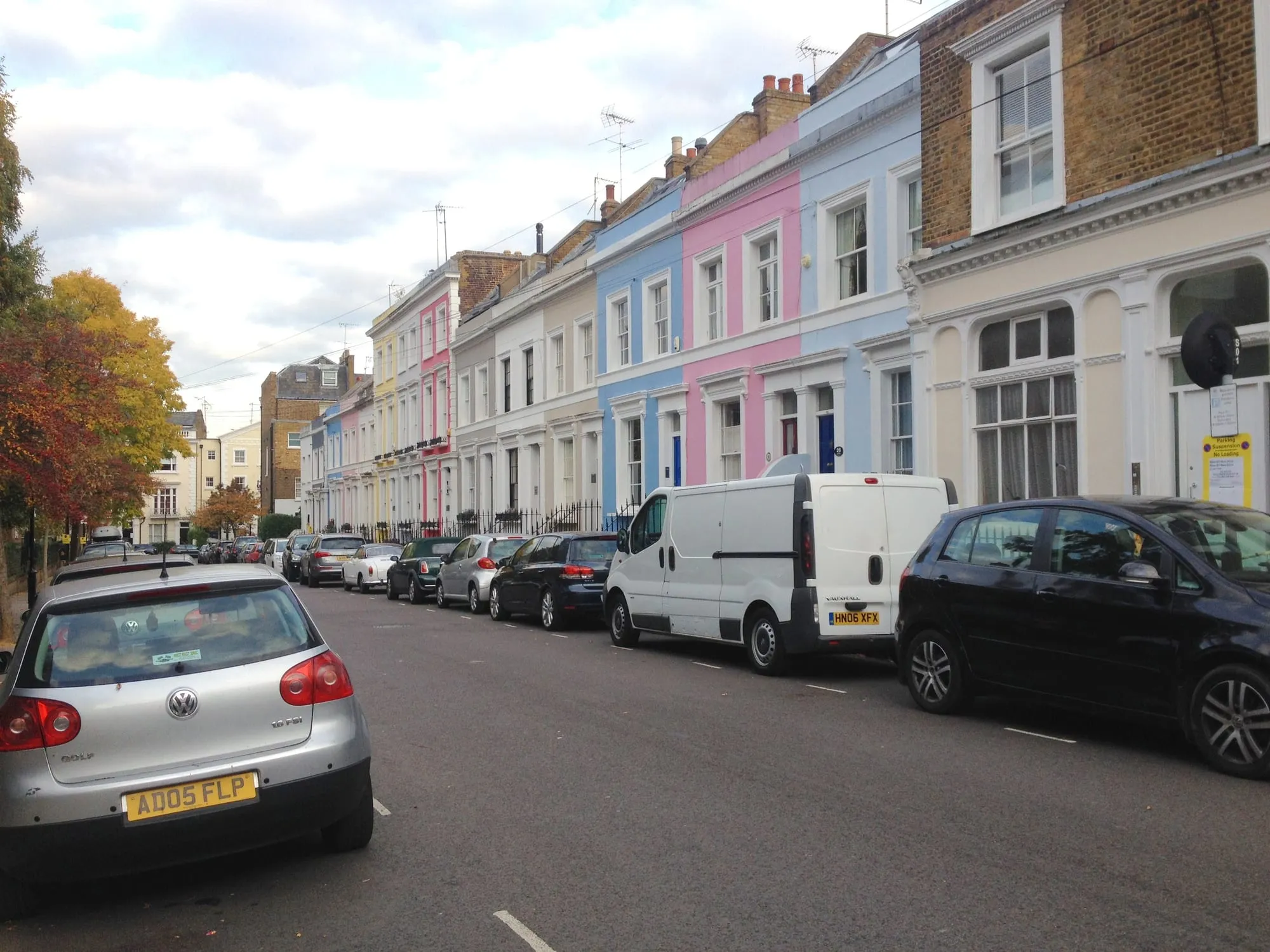
Denbigh Terrace. Photo: Chris Whippet, CC BY-SA 2.0.
A short run of houses packed tightly in pink, powder blue, pale yellow and cream, a minute off Portobello Road. Because the terrace is narrow and the houses are three storeys, the colours stack vertically as well as along — you get more of them in a frame here than anywhere except Lancaster Road.
Finish on the strongest colour, and a mews
10. Lancaster Road
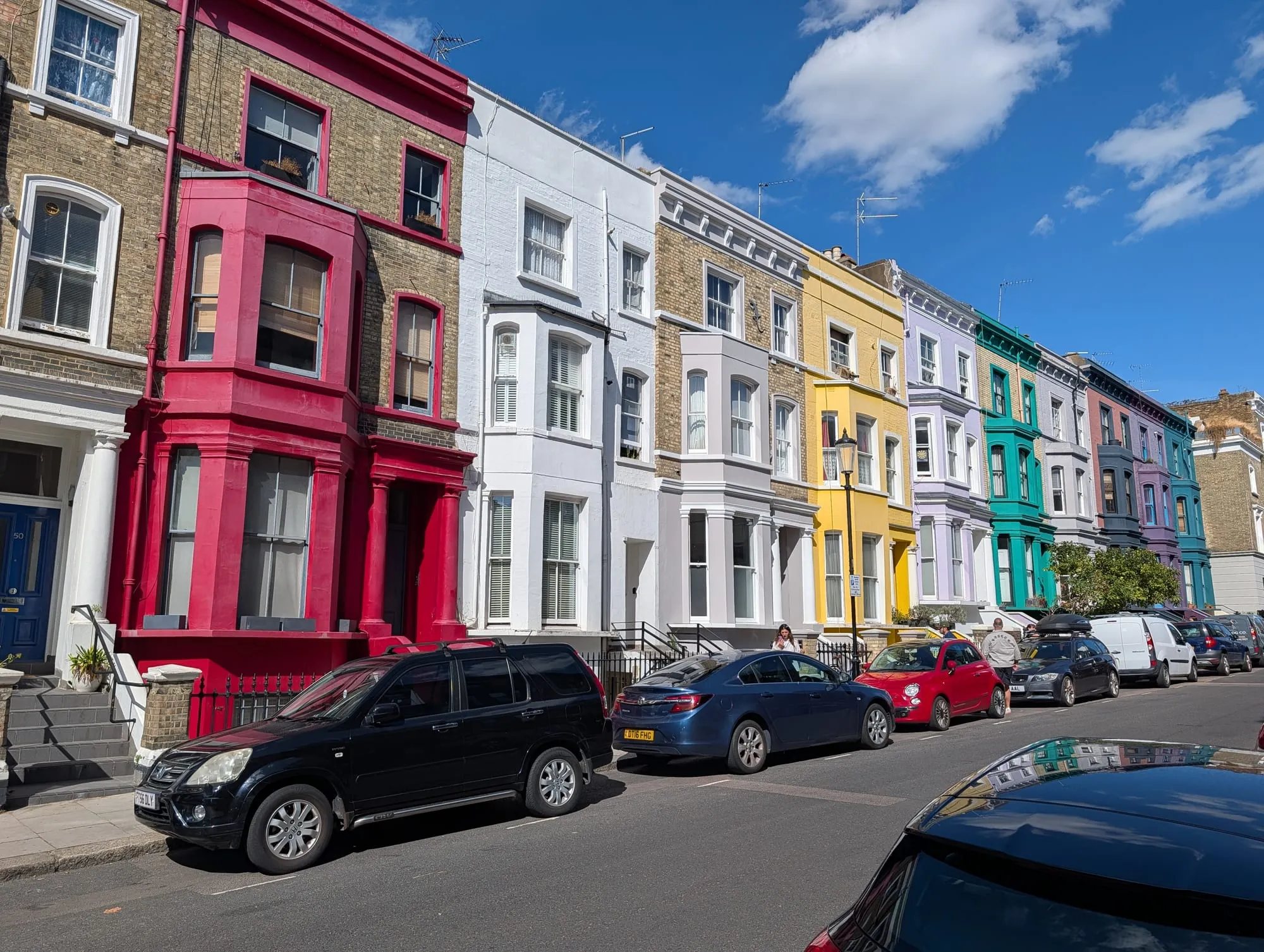
The postcard row, and the strongest colours in Notting Hill: a deep raspberry pink next to white, next to a mid blue, next to a green. This is the terrace behind most of the photographs that make people come to Notting Hill in the first place.
It is also the busiest spot on this walk by some distance, and the place to mind the etiquette below. Expect other people in your photograph and expect to wait for a gap. Ladbroke Grove station is four minutes away, which makes this the natural end of the route.
11. St Luke’s Mews
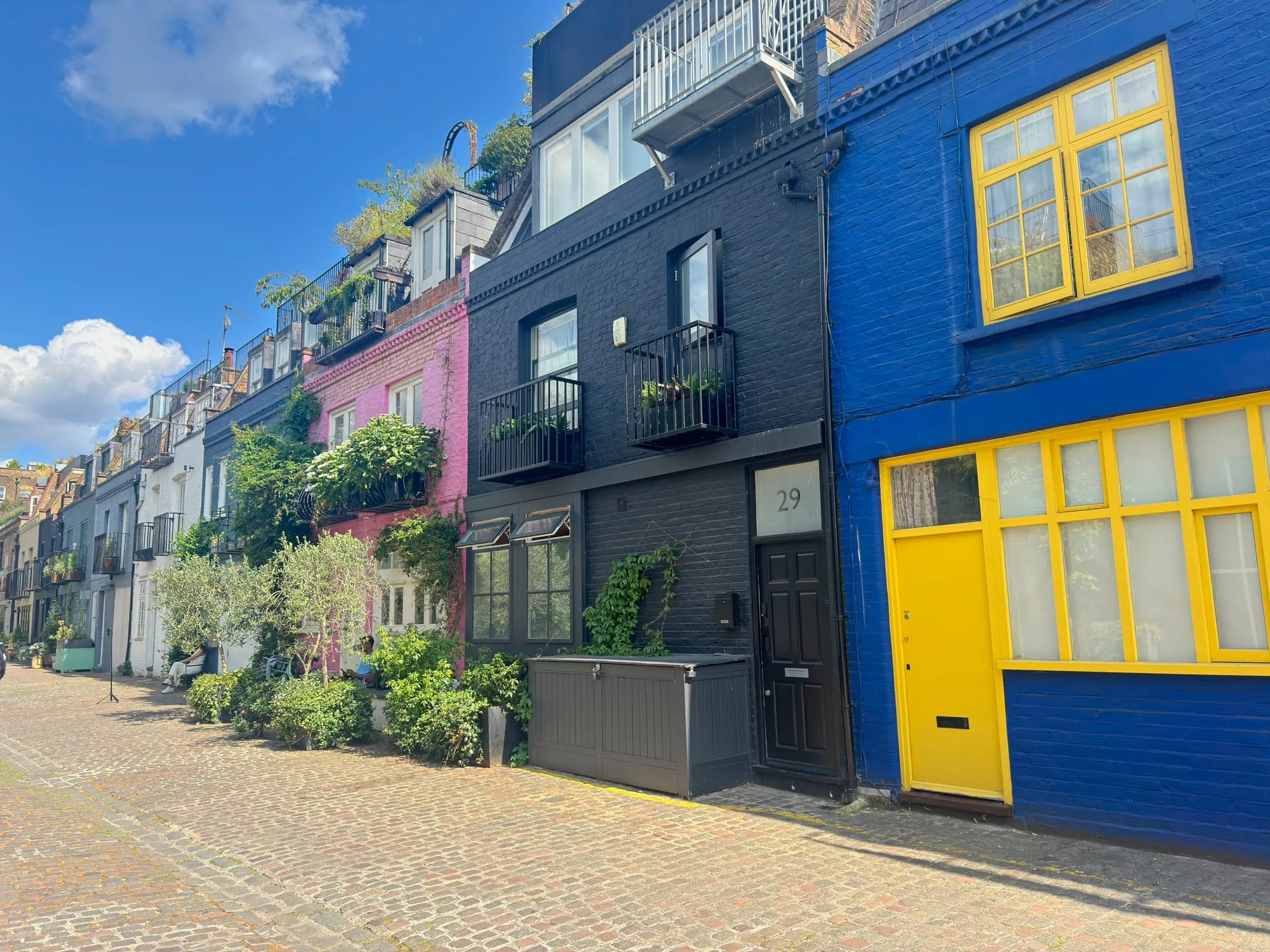
St Luke’s Mews. Photo: Bex Walton, CC BY 4.0.
Three minutes east of Lancaster Road, off All Saints Road, and the only cobbled mews on this walk. The colours are the boldest in Notting Hill — a full cobalt blue with yellow window frames, a strong pink, a mint green — and the cobbles and the narrowness do most of the work.
The pink house at number 27 is the Love Actually doorstep, where Mark holds up the cue cards. That gets it a steady trickle of visitors on top of everyone photographing the mews itself, on a street with no pavement and no room to stand back.
The etiquette, which is not optional
These are people’s homes. Every street in this guide is ordinary residential housing with residents who did not ask to live on a photography trail, and there has been real friction in Notting Hill about it — front steps used as seating, doorways blocked, whole terraces treated as a backdrop.
Three rules cover almost all of it:
- Photograph from the pavement. Not from the steps, not from the porch, not leaning on the railings.
- Do not block a front door. If someone is trying to get in or out of their own house, move first and take the photo afterwards.
- Keep the noise down, especially early. The best light and the smallest crowds are both in the morning, when people are asleep behind those windows.
Some residents have painted their houses deliberately drab in response to the attention, which tells you how far this has gone.
If you come in spring: the cherry blossom
Notting Hill’s blossom is good and almost all of the attention lands on one street.
Stanley Crescent is the one. A run of cherry trees in front of white stucco, and in the last few springs it has drawn crowds heavy enough that residents have gone to the press about it — people setting up tripods for hours, blocking the pavement, and in at least one reported case getting changed in the street between outfits. It is a residential crescent, not a park.
Go early on a weekday and stay on the pavement. If there is a queue for a tree, that is when to walk to one of the others rather than join it.
Because there are others, and they are the reason this section is not just one street:
- Lansdowne Road and Elgin Crescent have blossom along their front gardens and far more room to stand.
- Kensington Park Gardens, which meets Stanley Crescent at its western end, has trees along the same terraces without the reputation.
- Ladbroke Square and the crescents off it are dense with mature trees, visible over the garden walls.
On timing: London’s cherry blossom is usually at its best from late March to mid April, and the peak lasts one to two weeks. It moves by a fortnight either way depending on the winter, so treat any fixed date as a guess — the trees on the ground are the only reliable forecast. Magnolias come slightly earlier on these same streets, and wisteria follows in late April and May.
If you are chasing blossom, not houses, the parks and gardens guide covers where else in London to find it, with room to stand.
Getting there and when to go
Start at Notting Hill Gate (Central, District and Circle lines) and finish at Ladbroke Grove (Circle and Hammersmith & City). Walking it the other way works equally well but ends with the quietest streets, which is an anticlimax.
Weekday mornings are the quietest. Saturday is Portobello Road’s full market day, which is worth seeing on its own terms but pushes crowds out into the surrounding streets. Friday has some of the antiques dealers and is busy but manageable. Sunday is the quietest of the weekend.
On light, this route was walked on a clear early September afternoon and the frontages on the Hillgate streets and Lancaster Road were lit from about two o’clock onwards. In midwinter, when the sun stays low, the narrow streets are in shade for much of the day.
The whole route is free, outdoors and step-free on pavements throughout.
What to do with the rest of the day
You finish at Ladbroke Grove, which is the top of Portobello Road, so the obvious continuation is to walk back down it.
- The Notting Hill area guide — the market, the antique arcades most visitors walk past, Golborne Road and the Churchill Arms.
- London’s best markets — where Portobello sits among them, and which days each one actually runs.
- Free things to do in London — this walk is one of them.
- The best parks and gardens — Holland Park and the Kyoto Garden are fifteen minutes south of where you started.
Common questions
Where are the colourful houses in Notting Hill?
Spread across eleven streets, none of which is Portobello Road itself. The four best are Hillgate Place, Farmer Street, Hillgate Street and Jameson Street, all within three minutes of Notting Hill Gate station. Lancaster Road has the strongest colours and the most photographers; Lansdowne Road and Elgin Crescent have larger, paler stucco houses.
Are the colourful houses on Portobello Road?
Mostly no, and this is the most common mistake. Portobello Road has painted shopfronts, which photograph well but are not the pastel terraces people arrive looking for. The houses are on the residential streets either side of it, and on Lancaster Road at the northern end.
Do people live in the colourful houses in Notting Hill?
Yes. Every street in this guide is ordinary residential housing, not a set or an attraction. Residents have had a difficult time with photographers sitting on their steps and blocking their doorways. Photograph from the pavement, do not use their front steps, and keep out of the way of people coming and going.
What is the best time to photograph Notting Hill's houses?
Early morning on a weekday is quietest by a long way. Portobello Road's market days — Saturday especially — bring crowds that reach the surrounding streets, and the Hillgate streets are narrow enough that a few people fill them. For light, early afternoon put the sun on the frontages on the September walk this guide is based on.
Where is the cherry blossom in Notting Hill?
Stanley Crescent is the best known and by far the busiest — residents have complained to the press about the crowds it draws. Lansdowne Road, Elgin Crescent, Kensington Park Gardens and the crescents around Ladbroke Square all have blossom with far more room to stand. Peak is usually late March to mid April and lasts one to two weeks, moving a fortnight either way with the winter.
How long does the walk take?
About two hours at a photographing pace, covering roughly 3.5km from Notting Hill Gate to Ladbroke Grove. Walked briskly without stopping it is closer to 50 minutes, and the first four streets alone take about twenty.