One of 20 self-guided London walks on this site. See every walk, from the South Bank to Hampstead Heath.
In this guide
Oscar Wilde, Mark Twain, Bram Stoker and George Eliot all lived within about ten minutes’ walk of each other, and most people walking through Chelsea have no idea. The plaques are on ordinary house walls on ordinary streets, and there is no signage telling you they are there.
This is a route through them. Eleven numbered stops from Cheyne Walk to Belgrave Square, about 4km and two to three hours, and the plaques themselves are all free because they are on the outside of buildings.
There are 184 blue plaques inside the square this walk covers, 163 of them marking where somebody lived, worked or died. No route can take in all of them. This one takes the ones you would stop for, and adds the handful of places worth going into along the way.
For the wider areas — the shops, the pubs, where to stay — see the Chelsea area guide and the Belgravia area guide.
💡 The Short Version: Go on a Wednesday — it is the only day all three ticketed stops are open. Start on Cheyne Walk, which has the densest plaque run in London, and finish at Belgrave Square. The best single street is Tite Street, where Oscar Wilde and Peter Warlock are thirty metres apart. Everything on the walk is free except the Physic Garden and Carlyle’s House. And these are people’s homes — photograph from the pavement.
The route
Map of the walk, numbered in walking order
Loading the map…
Open the whole route in Google Maps → — all eleven stops in walking order, set to walking directions, which is the version to put on your phone.
| # | Stop | Cost | Open |
|---|---|---|---|
| 1 | Cheyne Walk | Free | Always |
| 2 | Carlyle’s House | £12 | Wednesdays only, pre-booked |
| 3 | Chelsea Physic Garden | £15 | Closed Saturdays |
| 4 | George Eliot, 4 Cheyne Walk | Free | Always |
| 5 | Tite Street | Free | Always |
| 6 | Mark Twain, Tedworth Square | Free | Always |
| 7 | Bram Stoker, St Leonard’s Terrace | Free | Always |
| 8 | Royal Hospital Chelsea | Free | Closed Mondays |
| 9 | Sloane Square & Saatchi Gallery | Free | Daily |
| 10 | Ebury Street | Free | Always |
| 11 | Belgrave Square | Free | Always |
| + | Alexander Fleming, Danvers Street | Free | Always |
1. Cheyne Walk and Whistler
The densest run of plaques in London, and the place to understand why this walk exists at all.
Cheyne Walk faces the river, and for a hundred years it was where painters and writers went when they could afford to. James Abbott McNeill Whistler is at number 96. Along the same terrace: J. M. W. Turner, who died here under an assumed name; Dante Gabriel Rossetti, who kept a menagerie in the garden including a wombat; and, at number 4, George Eliot — stop four, because it is worth its own.
Look up rather than ahead. The plaques are at first-floor level and the houses are otherwise unremarkable, as the scheme intends.
⚠️ These are private homes. Every house on this walk except Carlyle’s is lived in. Photograph from the pavement, do not stand on anyone’s steps, and do not ring the bell to ask.
2. Carlyle’s House, Cheyne Row
The one house on this walk you can go inside, and the reason to make this a Wednesday.
Thomas Carlyle lived at 24 Cheyne Row from 1834 until his death in 1881, and the house is kept by the National Trust more or less as he and Jane Carlyle left it — her writing table in the drawing room, the sound-proofed attic study he built to escape the neighbours’ chickens.
⚠️ It opens on Wednesdays only, 11am to 4.30pm, and all visits are pre-booked timed entry. £12 adult, £6 child, under-5s free. Turning up on a Thursday gets you a plaque and a closed door.
3. Chelsea Physic Garden
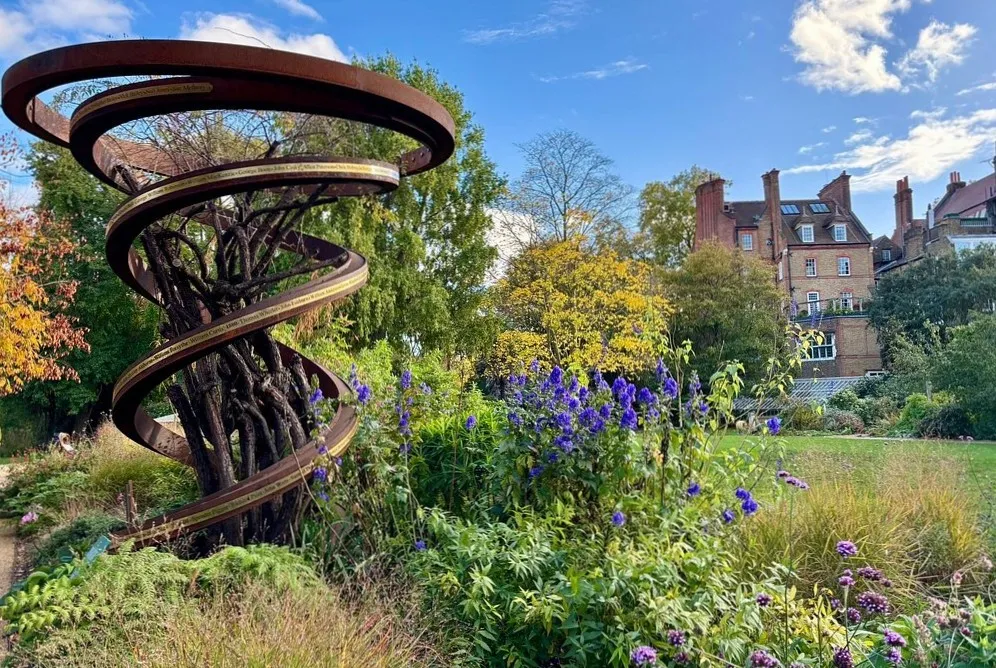
The Chelsea Physic Garden.
Four acres of walled botanic garden, founded in 1673 by the Society of Apothecaries to grow medicinal plants — the second-oldest botanic garden in Britain, and completely invisible from the street.
It is the one green stop on the route and it is a garden, not a park: glasshouses, a rock garden built partly from Icelandic lava, and beds arranged by what the plants are for rather than where they come from.
⚠️ Open Sunday to Friday, 11am to 5pm, last entry 4pm — closed all day Saturday, which catches people who assumed a garden opens at weekends. £15 adult, £6.50 for ages 5–25, under-5s free.
4. George Eliot on Cheyne Walk
Number 4, and the inscription is the interesting part: “George Eliot 1819–1880 novelist died here.”
She moved in with her new husband in December 1880 and was dead within three weeks. Most plaques say lived here; the handful that say died here are doing something different, and this is the sharpest example on the walk.
5. Tite Street: Oscar Wilde and Peter Warlock
The best single street on this route. Two plaques about thirty metres apart, and a third era of the same address.
Oscar Wilde lived at 34 Tite Street from 1884 until his arrest in 1895 — the house where he wrote The Importance of Being Earnest, and the house whose contents were auctioned on the pavement to pay his costs.
A few doors along, Peter Warlock — the composer born Philip Heseltine, dead at thirty-six in 1930 of coal gas in a room with the cat put out first. Tite Street was an artists’ street by design: John Singer Sargent painted here too.
6. Mark Twain on Tedworth Square
“Samuel L. Clemens, ‘Mark Twain’ 1835–1910 American writer lived here in 1896–7.”
A one-year plaque, and the year was a hard one. Twain came to London after his daughter Susy died of meningitis while he was abroad, and he was bankrupt from a failed investment in a typesetting machine. He spent the year in this square writing Following the Equator to pay the creditors off, and did.
7. Bram Stoker on St Leonard’s Terrace
Dracula was written from this address. Stoker was Henry Irving’s business manager at the Lyceum, doing the novel around the day job, and the house looks exactly like every other house on the terrace.
This is where the walk’s argument lands: four writers whose names everyone knows, in four ordinary houses, inside a ten-minute square.
8. The Royal Hospital Chelsea
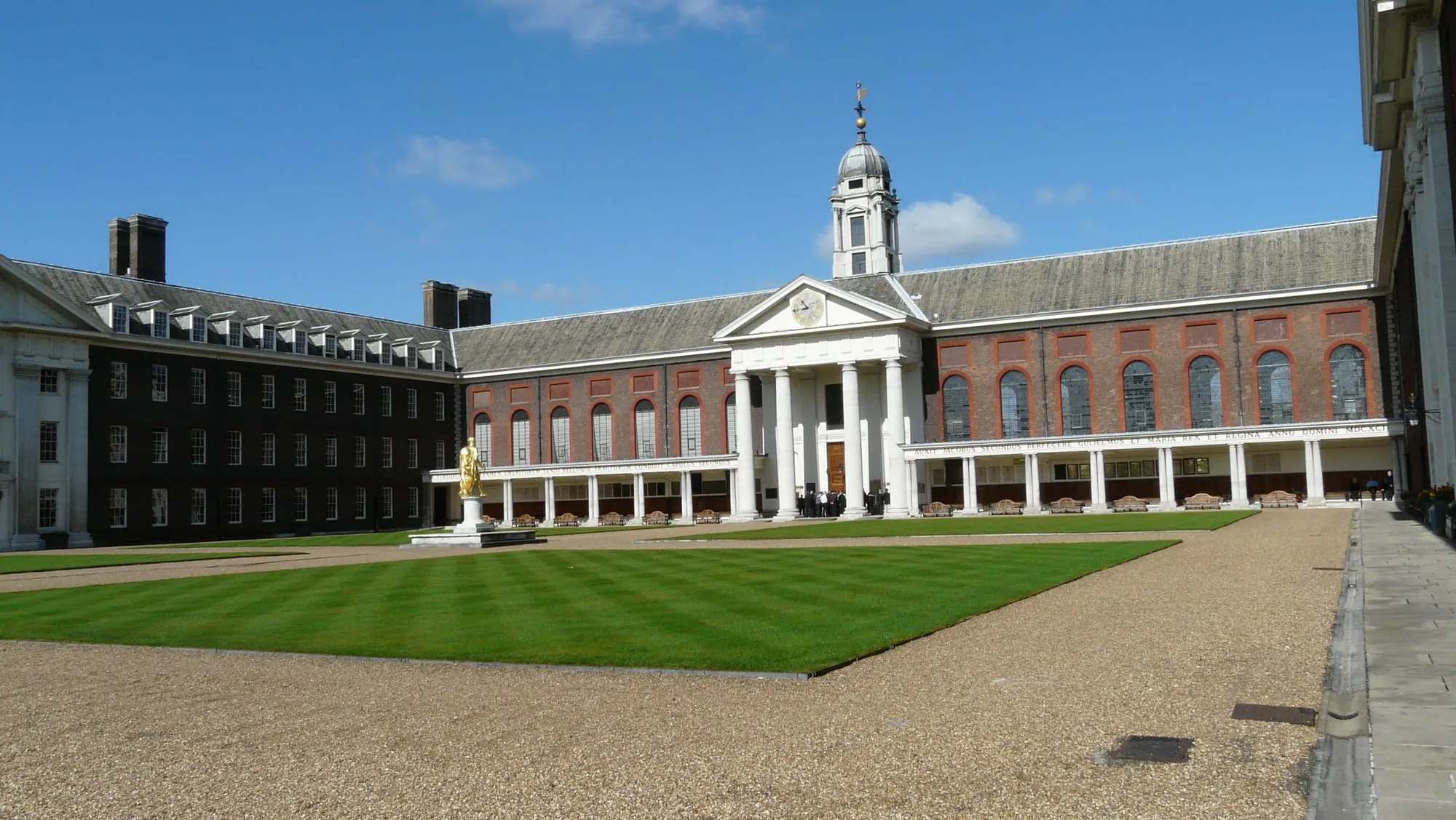
Wren’s home for army veterans, founded by Charles II in 1682 and still doing the job — around three hundred Chelsea Pensioners live here, and the scarlet coats are everyday dress, not costume.
The exhibition in the Soane Stable Yard is free and needs no ticket, and it is the best-value stop on the walk.
⚠️ Open Tuesday to Sunday, 9am to 5pm, last admission 4pm — closed Mondays.
9. Sloane Square and the Saatchi Gallery
The halfway point and the obvious place to stop. Sloane Square has the Royal Court Theatre on one side; Duke of York Square off it has the Saatchi Gallery, which is free and open seven days, 10am to 6pm.
The gallery closes for a few days at a time between exhibitions to install the next one, so check first if you came for it rather than passing it on the way.
10. Ebury Street and Mozart’s first symphony
You are in Belgravia now, and the plaque here is the oldest story on the walk.
Wolfgang Amadeus Mozart composed his first symphony at 180 Ebury Street in 1764, aged eight. The family was in London on a three-year European tour, Leopold fell ill, and the children were forbidden from touching the harpsichord while he recovered — so Wolfgang wrote a symphony instead.
It is a brown plaque, not a blue one, which is a good moment to notice that the scheme has never been consistent: English Heritage runs the blue ones now, but boroughs, societies and private owners have all put up their own.
Ian Fleming is at number 22, on the same street — about eight minutes’ walk from Mozart at 180. “Creator of James Bond lived here.” Two plaques of that size on one residential street is the most efficient stretch of the whole walk, and neither house is anything to look at.
Between the two, Mary Shelley is at 24 Chester Square, a two-minute detour north. She died in that house in 1851, decades after writing Frankenstein at eighteen — the square garden is private and railed, so you look at the house across it.
11. Belgrave Square and the Belgravia plaques
The grandest square on the route and the least residential — most of the houses are embassies now, which is why the plaques thin out on the square itself and cluster on the streets around it.
Within a few minutes: William Wilberforce, who died here on Cadogan Place; Alfred Lord Tennyson, who lived on Upper Belgrave Street in 1880 and 1881; Matthew Arnold; and Walter Bagehot, the economist whose name is on the Economist’s main column to this day.
Belgravia’s plaque density is lower than Chelsea’s but the names are heavier — this was where power lived, not where art did, and the two neighbourhoods read completely differently as a result.
The detour: Alexander Fleming
Alexander Fleming, Danvers Street — “discoverer of penicillin lived here”. Two minutes west of the route between stops 1 and 2, and the only plaque on this walk marking something that changed the world, not described it.
He is the second Fleming here. Ian Fleming is at 22 Ebury Street, and he is on the route rather than off it — see stop ten.
Where to eat
This is an expensive postcode and the walk does not pass much that is cheap.
- Duke of York Square (££) at stop nine — the food market runs on Saturdays, and there are cafés around the square the rest of the week. The natural halfway stop.
- The Cross Keys, Lawrence Street (££) — a pub near stop 2 with its own heritage plaque listing the drinkers: Dylan Thomas, Turner, Agatha Christie, Whistler and John Singer Sargent. Worth it for the plaque alone.
- The Chelsea Physic Garden café (££) at stop three — only useful if you have paid to go in, and closed on Saturdays with the garden.
For the fuller picture, the Chelsea and Belgravia area guides cover it.
The best day to go
Wednesday, and this route is unusually clear-cut about it, because three stops close on three different days.
| Day | What you get |
|---|---|
| Wednesday | Everything. The only day Carlyle’s House opens at all |
| Tue, Thu, Fri | Physic Garden and Royal Hospital open; Carlyle’s House shut |
| Sunday | Physic Garden and Royal Hospital open; quietest streets |
| Saturday | Physic Garden shut. Duke of York Square food market on |
| Monday | Royal Hospital shut, Physic Garden open, Carlyle’s shut |
What never closes: every plaque on the walk. They are on the outside of buildings on public streets, so the core of this route works at any hour on any day, in any weather, for nothing. If you are here on a Monday in February, you still get Wilde, Twain, Stoker, Eliot and Whistler.
On time of day: the plaques are at first-floor height on north- and south-facing terraces, so late morning and mid-afternoon light them best. Cheyne Walk faces south over the river and is at its best early.
Getting there and back
Start: Sloane Square (District, Circle) and walk south-west down to the river, or South Kensington (District, Circle, Piccadilly) and walk south. Cheyne Walk has no station of its own, which is part of why it stays quiet.
Finish: Hyde Park Corner (Piccadilly) or Victoria (Victoria, District, Circle, rail), both a few minutes from Belgrave Square.
The route is flat and step-free on pavements throughout. Walked in reverse it works but ends at the river with a longer walk to a station.
Carry on walking
- Fitzrovia to Mayfair — Hyde Park Corner, at the top of Belgravia, is the west end of Green Park.
- Westminster — Victoria and Westminster Cathedral are just east of Belgravia.
What to do with the rest of the day
- The Chelsea area guide and the Belgravia area guide — the King’s Road, the pubs, the garden squares and where to stay.
- London’s blue plaques — how the scheme works, who qualifies, and the interactive map of every plaque in the city.
- The plaque map — all 184 in this square, filtered to the area, if you want to build your own route.
- Free things to do in London — nine of these eleven stops cost nothing.
Common questions
Where are the most blue plaques in London?
Chelsea and Belgravia, taken together, carry one of the densest concentrations in the city — 184 blue plaques inside the square between Cheyne Walk and Belgrave Square, of which 163 mark where somebody lived, worked or died. Cheyne Walk alone has Whistler, Turner, George Eliot and Rossetti along a single riverside terrace.
Which famous people lived in Chelsea?
Oscar Wilde on Tite Street, Mark Twain on Tedworth Square, Bram Stoker on St Leonard's Terrace, George Eliot on Cheyne Walk, Alexander Fleming on Danvers Street and Thomas Carlyle on Cheyne Row — and the first five are all within about ten minutes' walk of each other. Mozart wrote his first symphony on Ebury Street in Belgravia, aged eight, and Ian Fleming lived eight minutes along the same street.
What day should I do the Chelsea blue plaque walk?
Wednesday, if you want everything open. Carlyle's House opens on Wednesdays only and by pre-booked timed entry, the Chelsea Physic Garden is closed on Saturdays, and the Royal Hospital Chelsea's exhibition is closed on Mondays. Wednesday is the only day all three are open. The plaques themselves are on public streets and never close.
Is the Chelsea blue plaque walk free?
The walk and every plaque on it are free — they are on the outside walls of ordinary houses. Three stops are optional and only two of those cost anything: Carlyle's House is £12, the Chelsea Physic Garden is £15, and the Royal Hospital Chelsea's exhibition and the Saatchi Gallery are both free.
Can you go inside the blue plaque houses in Chelsea?
Almost none of them. They are private homes and people live in them — Oscar Wilde's, Mark Twain's and Bram Stoker's houses are all lived in. Carlyle's House on Cheyne Row is the exception, kept by the National Trust and open on Wednesdays. Photograph from the pavement and do not use anyone's steps.
How long does the Chelsea to Belgravia walk take?
Two to three hours at a walking pace with short stops, covering roughly 4km from Cheyne Walk to Belgrave Square. Add an hour for the Physic Garden and another for Carlyle's House if it is a Wednesday.