In this guide
At a glance
- Vibe
- Dense, loud and at its best after dark
- Time needed
- An evening, or half a day with Chinatown
- Best day
- Thursday to Saturday evenings; a weekday lunchtime for Chinatown
- Travel zone
- 1
- Walkability
- 5/5
- Typical spend
- ££
Best for
Nearest stations
- Tottenham Court RoadElizabeth lineCentralNorthern
- Piccadilly CircusPiccadillyBakerloo
- Oxford CircusCentralVictoriaBakerloo
Soho is one square kilometre, walkable end to end in fifteen minutes, bounded by Oxford Street, Regent Street, Shaftesbury Avenue and Charing Cross Road, and packed with restaurants, bars, theatres and recording studios.
It is also two different places depending on when you arrive. By day it is a working media district with good coffee and quiet streets. From about 18:00 it becomes the busiest nightlife area in London.
Soho has its own share of the commemorative plaques marking where notable people lived or worked - see them on our interactive map.
Why visit — and who should skip it
Come here if you want to eat and drink well, or you want London with the volume turned up. Soho has the best concentration of restaurants in the city at every price point, from £8 roast duck on Gerrard Street to tasting menus on Lexington Street.
Skip it if you are travelling with young children in the evening, or you want landmarks. Soho has no major sights — no museum, no monument, nothing to queue for. Its appeal is entirely atmosphere and food. Come for dinner, not sightseeing.
Top sights and activities
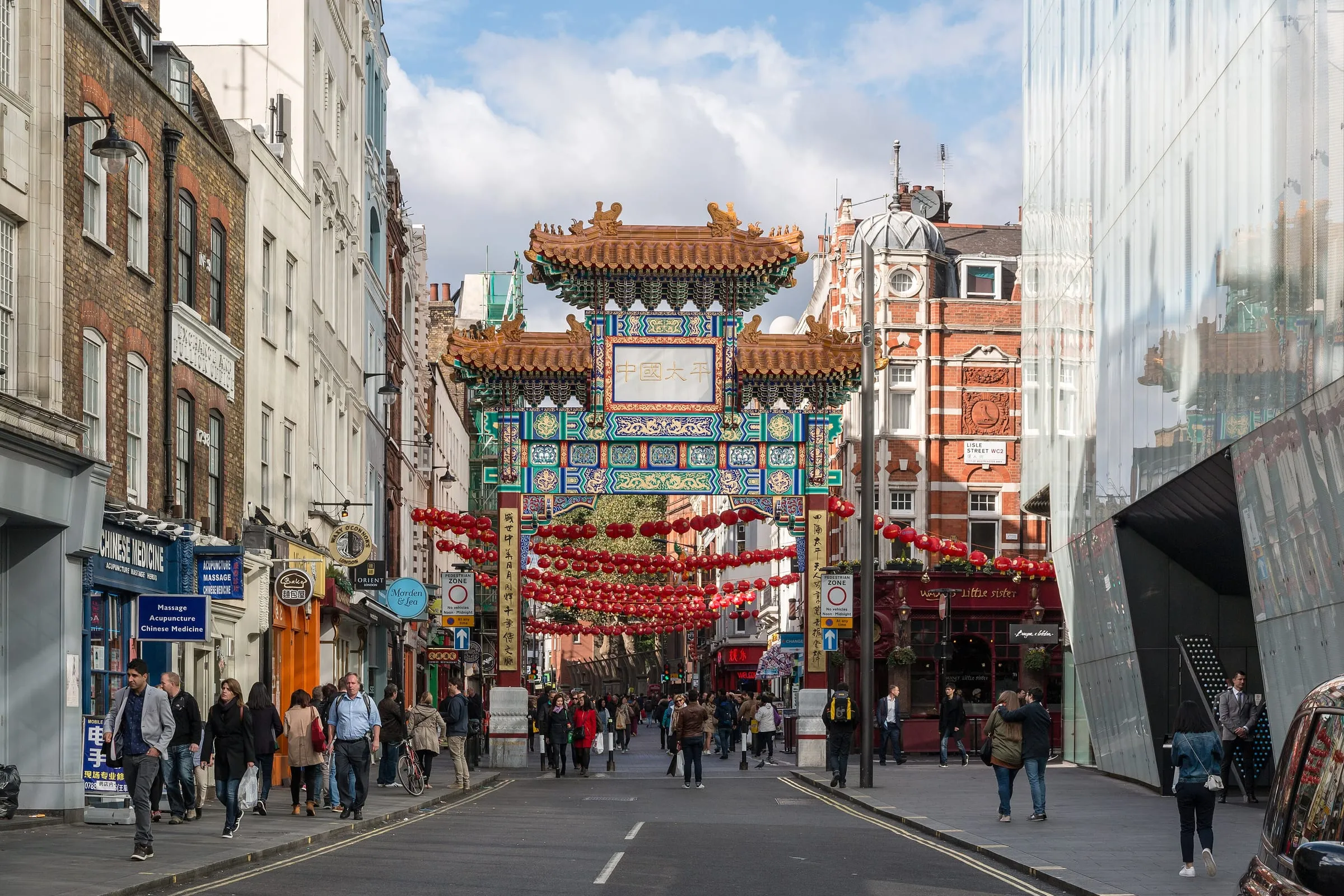
- Chinatown (Gerrard Street) — Pedestrianised, gated at both ends, and the best-value eating in central London. Roast meats in the windows, dim sum from mid-morning, bakeries and bubble tea throughout.
- Carnaby Street and Kingly Court — The 1960s fashion street, now largely chains. Kingly Court just off it is the better stop: three storeys of independent restaurants and bars around a covered courtyard.
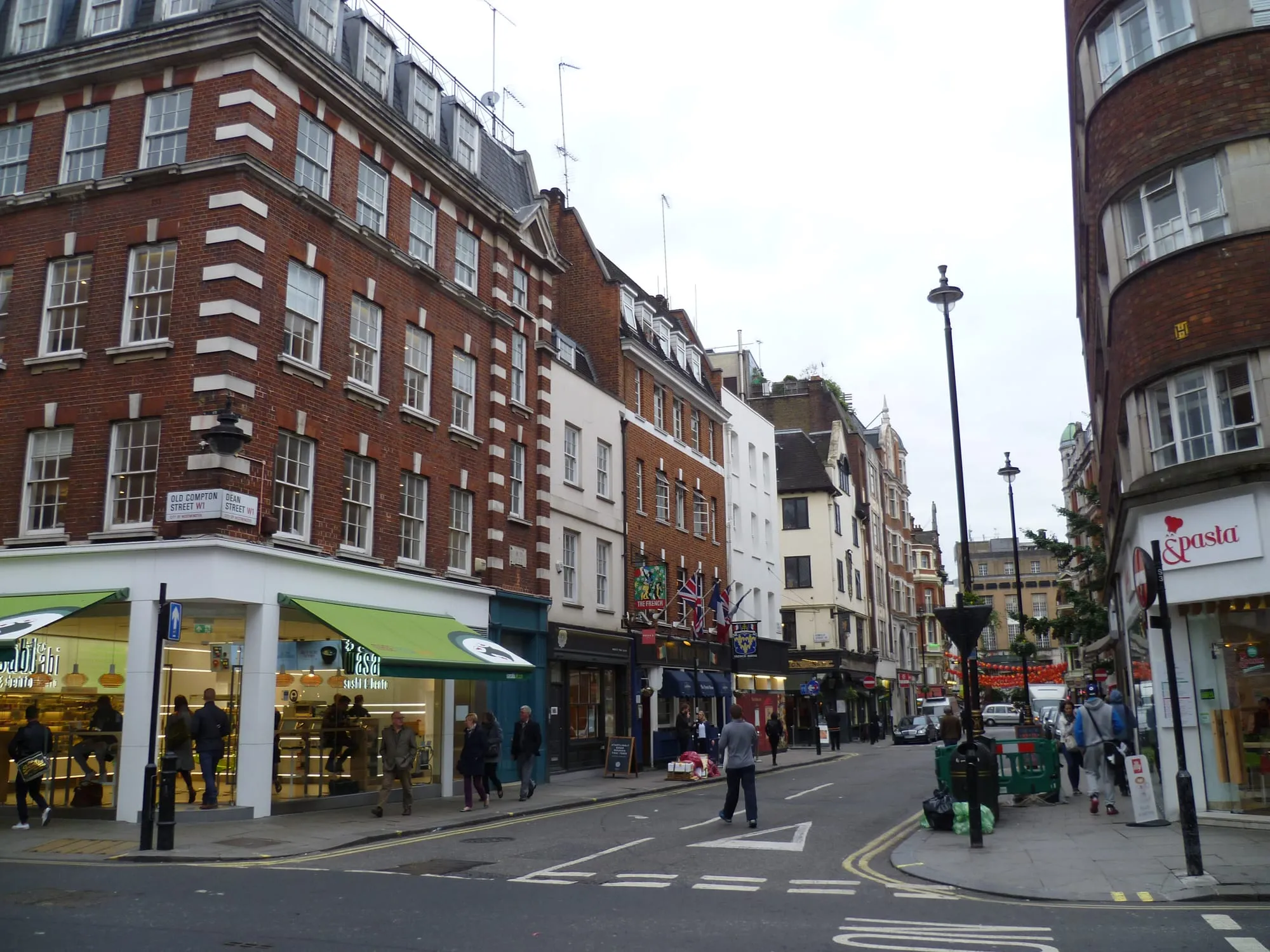
- Old Compton Street — The heart of London’s LGBTQ+ nightlife for decades, and still the busiest street in Soho after dark. Cafes and bars spill onto the pavement all evening.
- Berwick Street — A street market since the 1770s, plus the surviving record shops that made this the centre of London’s vinyl trade.
- Denmark Street — “Tin Pan Alley”. The guitar shops and the studios where the Rolling Stones and David Bowie recorded. Much reduced by redevelopment but still recognisable.
- Soho Square — One of Soho’s three public gardens, with the mock-Tudor gardener’s hut at its centre. Full of office workers at lunchtime and the quietest spot in the area.
- Ronnie Scott’s — The jazz club on Frith Street. Founded in 1959, though it opened on Gerrard Street and only moved here in 1965. Book ahead for the main show, or turn up for the 11.15pm Late Late Show at £12.
Key streets and micro-districts
Gerrard Street and Chinatown
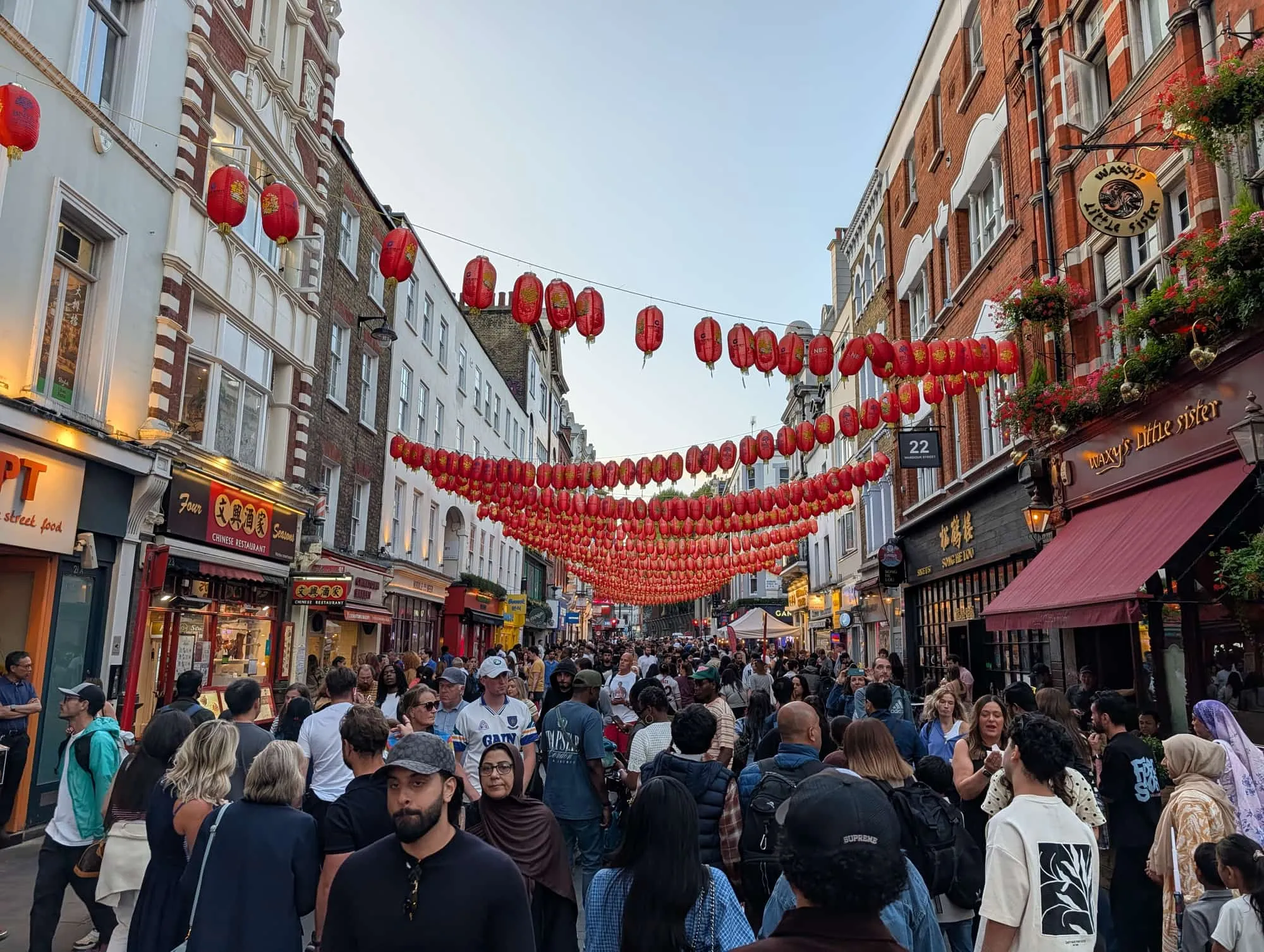
The Chinatown stretch of Wardour Street.
Pedestrianised and lantern-strung, and London’s Chinatown is Cantonese first — roast meats hanging in windows, dim sum until mid-afternoon, hotpot, and bakeries open later than almost anything else in the West End.
Gerrard Street is the spine, with Lisle Street parallel to it and usually cheaper. The first gates went up in the late 1980s, and the largest, on Wardour Street, in 2016; the community moved here from Limehouse after the war.
Busiest on Sunday afternoons, which is when families come to eat — good for atmosphere, bad for a table. Dim sum kitchens generally stop by about 4pm, so come earlier than you think.
Old Compton Street
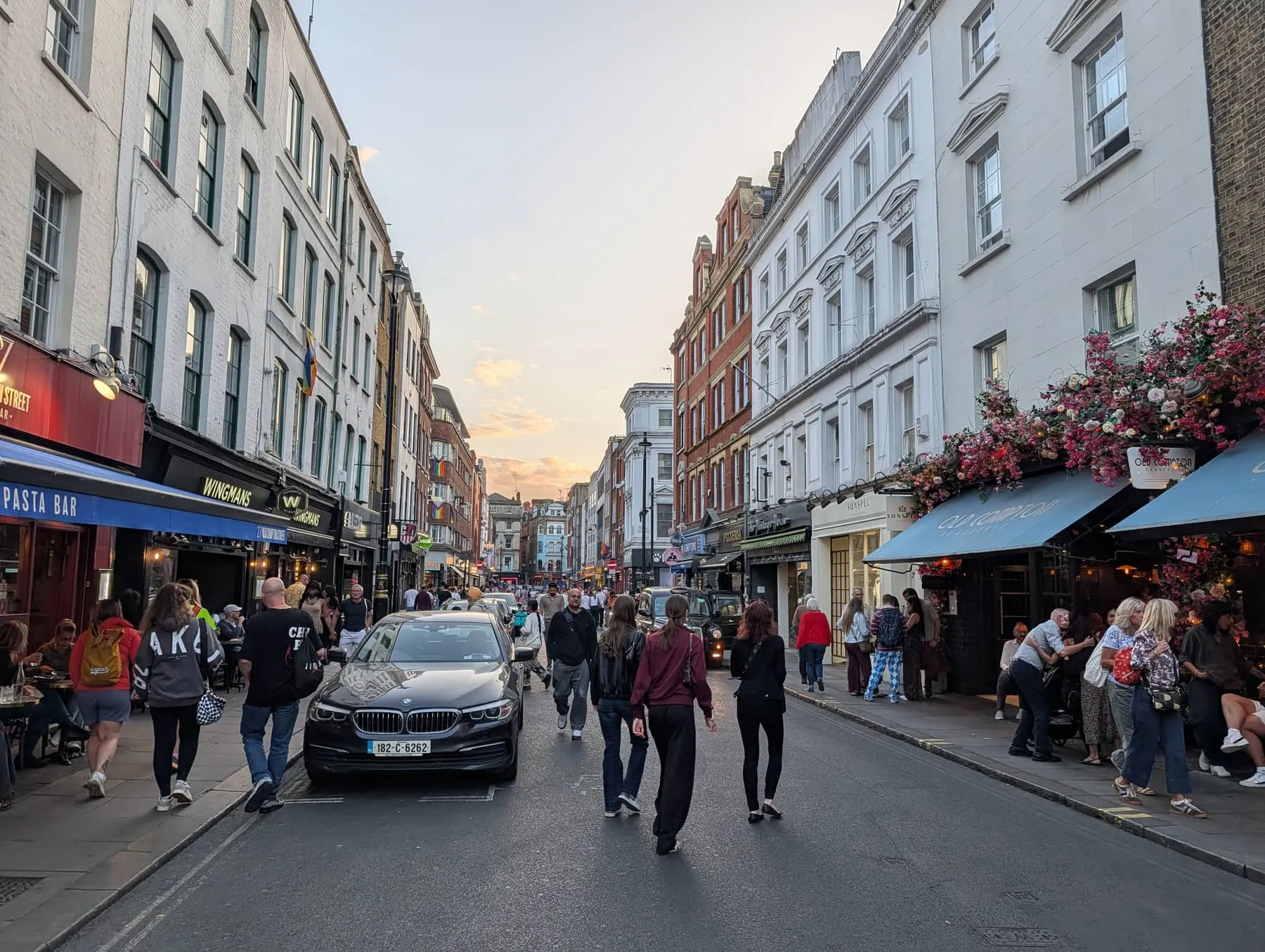
Old Compton Street at dusk. The east–west spine of Soho nightlife, and the centre of its LGBTQ+ scene since the 1980s — bars, cafés and a street that has been the visible heart of gay London for forty years.
By day it is coffee and outside tables; from about 9pm it is shoulder to shoulder, and the drinking spills into the street itself in summer.
It is four minutes end to end. Leicester Square and Tottenham Court Road stations are both close, and the whole street is pedestrian-friendly rather than pedestrianised, so traffic still comes through.
Carnaby Street and Kingly Court
Pedestrian shopping to the west, and fourteen streets rather than one — Carnaby is the name people know, but the surrounding lanes hold most of what is worth finding.
Liberty, the mock-Tudor department store on the corner of Great Marlborough Street, was built in the 1920s from the timbers of two Royal Navy ships and is free to walk into.
Come for Kingly Court: three galleried floors around an open courtyard, almost entirely food and drink, and covered enough to work in the rain.
Free to walk through, open daily, and five minutes from Oxford Circus. The courtyard is busiest between 6pm and 8pm, and most of its restaurants take bookings — worth doing at a weekend.
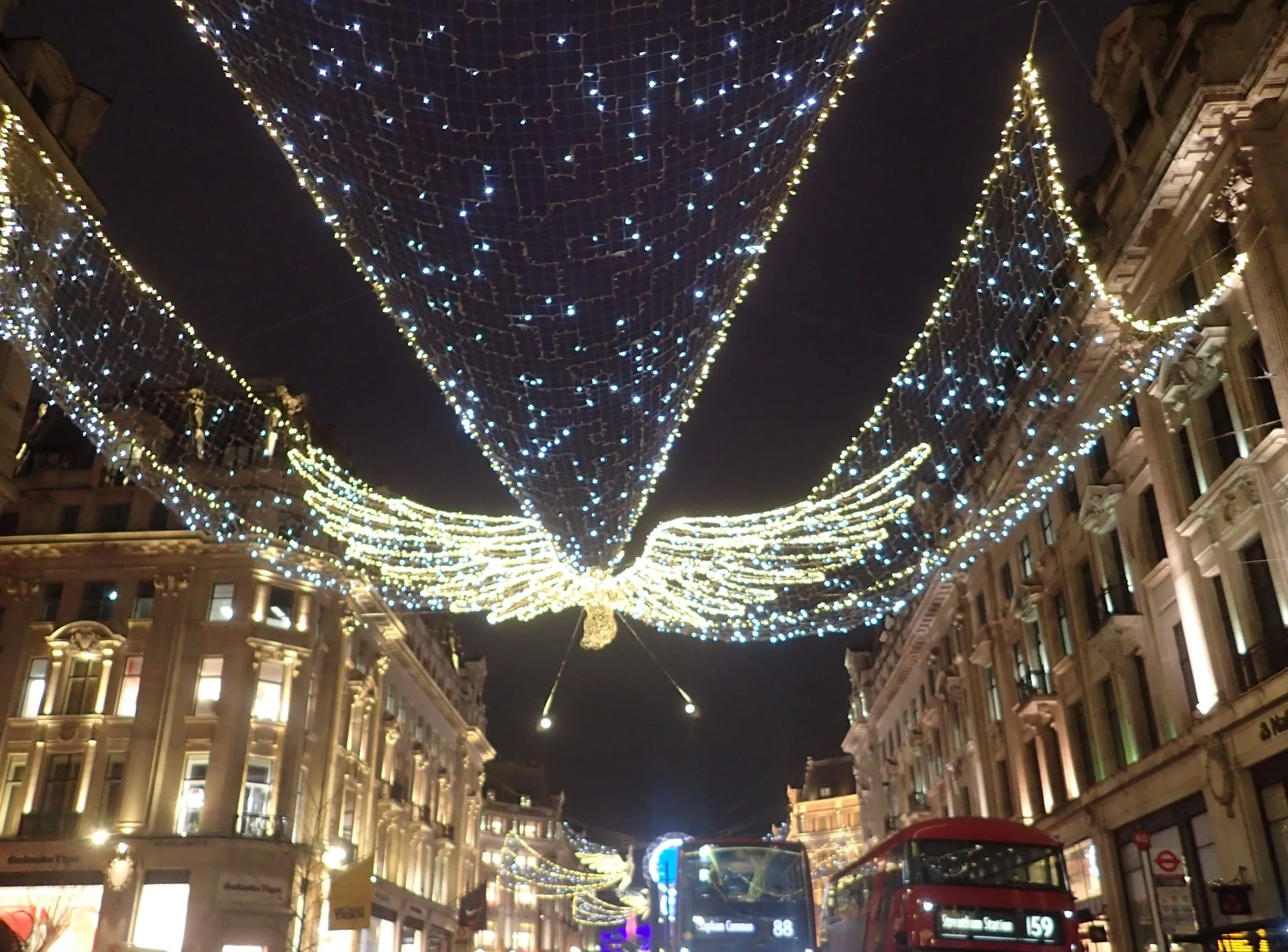
Carnaby’s Christmas lights switch-on is Wednesday 4 November 2026, and the street is stop six on our Christmas lights walk, between the Regent Street angels and Seven Dials.
Berwick Street and Broadwick Street
Market stalls, record shops and some of Soho’s better restaurants — Berwick Street market has traded since the 1770s and is now a short run of food stalls, not the fruit and veg it was, with the surviving record shops on the same stretch.
Broadwick Street has the John Snow pump replica, marking where Snow traced the 1854 cholera outbreak to a single water source and effectively founded modern epidemiology. The pub beside it is named after him.
The market trades Monday to Saturday, 8am to 6pm, and not on Sundays. Lunchtime is when the food stalls are busiest.
Dean Street and Frith Street
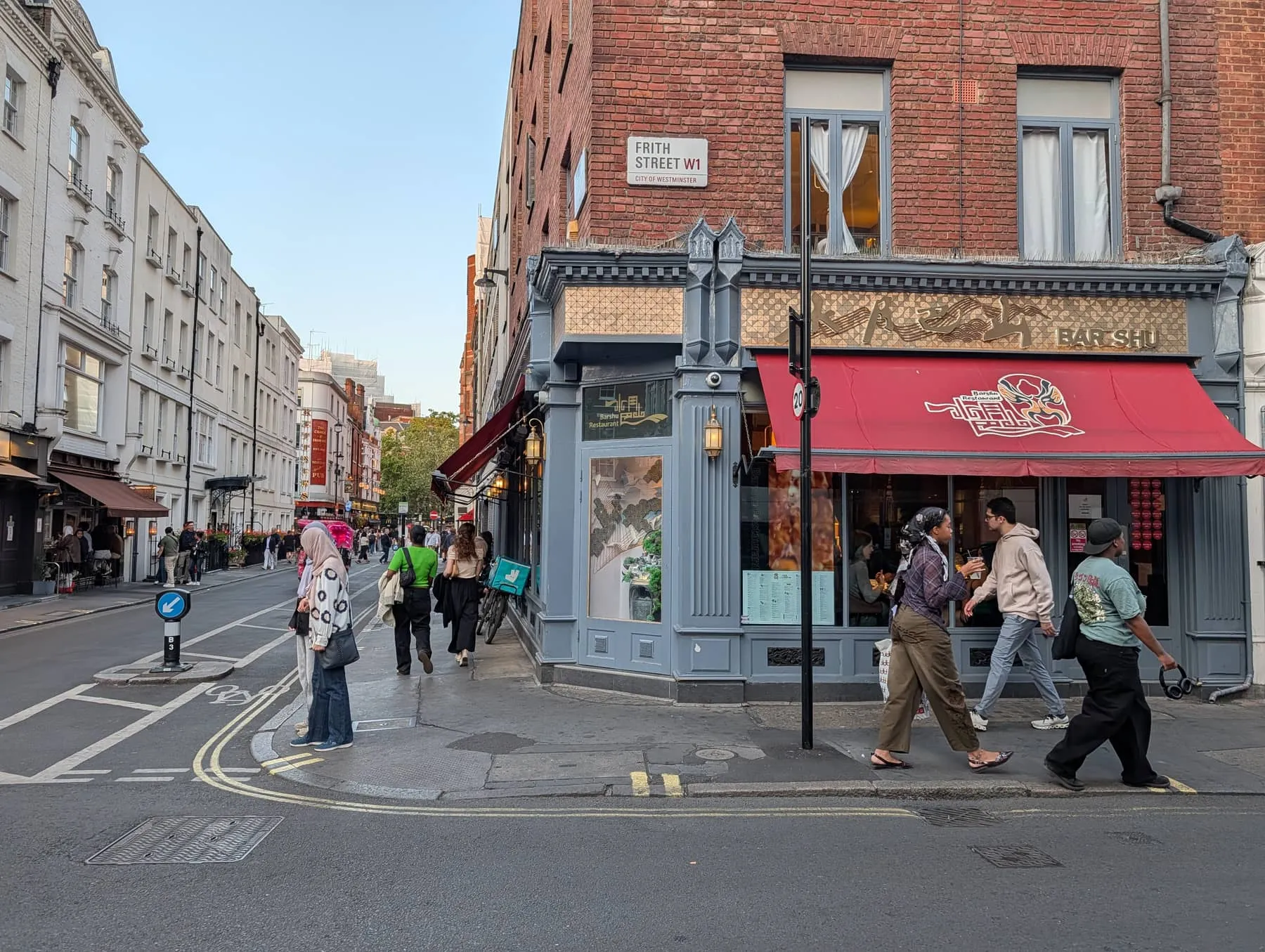
Frith Street, at Shaftesbury Avenue. North–south restaurant streets running parallel through the middle of Soho, and where most of the eating actually happens.
Ronnie Scott’s has been on Frith Street since 1965 and is still the serious jazz room in London — two sets a night, booked well ahead. Bar Italia, directly across the street, has been open since 1949 and trades nearly around the clock. The private members’ clubs are on Dean Street and Greek Street, unmarked and not for walking into; our members’ clubs guide covers what the Groucho and Soho House cost to join and which Soho House bedrooms take non-members.
Book anything you actually want. These two streets fill from about 7pm and the good tables go days in advance, particularly at weekends.
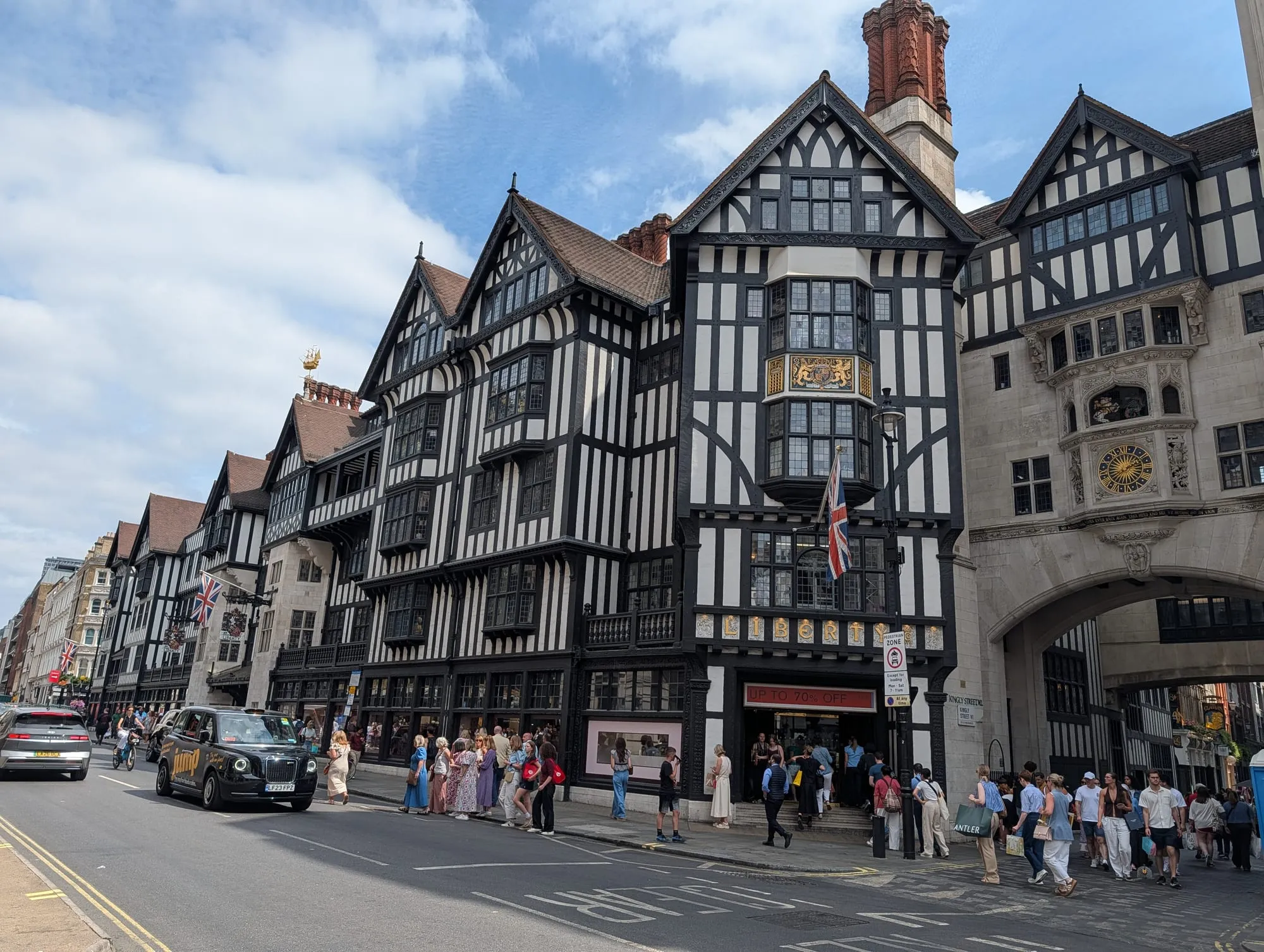
Liberty, Great Marlborough Street.
Where to eat and drink
| Spot | Style | Price | Why go |
|---|---|---|---|
| Bao Soho | Taiwanese buns | £ | Small counter on Lexington Street; queue, no bookings |
| Four Seasons | Cantonese roast duck | £ | Chinatown institution; the duck is the entire point |
| Kiln | Thai, live fire | ££ | Counter seating on Brewer Street; walk-ins downstairs |
| Barrafina | Spanish tapas | ££ | Counter only, no bookings; go early or late |
| Bar Italia | Coffee | £ | Frith Street, open since 1949 and nearly around the clock |
| The French House | Historic pub | £ | Dean Street; beer served in halves by tradition |
For dinner with live music, Brasserie Zédel’s house band plays every day with no charge on the bill, and Ronnie Scott’s serves dinner through its sets. Dinner and a Show in London compares them.
For karaoke, Lucky Voice on Poland Street opened in 2005, Karaoke Box has been on Frith Street since 1997, and Karaoke Epoc on Brewer Street is a Japanese-style box; all three are in our karaoke guide.
Soho is also where central London’s Indo-Chinese cooking is: Fatt Pundit on Berwick Street and the all-vegetarian Tangra on Frith Street, a few doors from Chotto Matte’s Japanese-Peruvian menu. All three are in our fusion restaurants guide.
Five of the bars in our speakeasy guide are in Soho and Chinatown: Opium behind a jade door on Gerrard Street, Experimental Cocktail Club upstairs from the same street, SOMA down an unmarked staircase on Denman Street, Basement Sate behind a red door on Broadwick Street, and The Vault behind a bookcase in Milroy’s whisky shop on Greek Street. The Best Speakeasy Bars in London says how to find each door.
See all 114 places to eat and drink in Soho
Getting there
By Tube. Four stations sit on Soho’s edges. Tottenham Court Road (Elizabeth line, Central, Northern) is best for the east side and Chinatown. Oxford Circus is best for Carnaby Street. Piccadilly Circus is closest to Chinatown’s southern gate.
Best exit. From Tottenham Court Road, use the Dean Street exit to come out directly in Soho, not on Oxford Street.
Late night. The Central, Victoria, Northern, Jubilee, Piccadilly and Windrush lines run a Night Tube on Friday and Saturday nights. The Elizabeth line does not — it runs later than the rest of the Tube but still stops. Night buses run from Trafalgar Square and Oxford Circus every night. Details in the Getting Around London guide.
How long to spend, and when to go
| If you have | Do this |
|---|---|
| Two hours | Chinatown for lunch, then Berwick Street and Kingly Court |
| An evening | Early dinner, a drink on Old Compton Street, a show or Ronnie Scott’s |
| Half a day | Add Carnaby Street, Denmark Street and Soho Square |
Best time: Evening. Soho is a nightlife district and feels flat before about 17:00.
For Chinatown: Sunday afternoon is traditional and busiest. Weekday lunch is the quiet alternative.
Map of Soho
Open the map113 places: 89 places to eat · 11 things to do · 7 hidden spots · 6 places to stay
The map loads when you open this section.
Eat & drinkThings to doHidden LondonStay
What's on in Soho
Limited runs and the annual fixtures. Anything already finished is removed automatically.Links marked ad are affiliate links. If you book through one we may earn a commission, at no extra cost to you. It never affects what goes on this list.
Sophie's Surprise Christmas Party
Not open yet18+Circus, cabaret and comedy in a Christmas show that is emphatically not for children, and returns most years.
Runs 13 November 2026 to 10 January 2027. Over-18 - the name is misleading and families do turn up expecting otherwise.
Chinese New Year in London
Not open yetEurope's largest gathering of Chinese lions and dragons parades from Trafalgar Square into a Chinatown closed to traffic for the day. Several hundred thousand people come, so arrive well before the late-morning start.
Lunar New Year 2027 falls Saturday 6 February; London celebrates the following day. Full programme publishes nearer the time.
London Fashion Week
Not open yetUnlike Paris or Milan, London runs a genuine public fringe - designer pop-up sales and British Fashion Council exhibitions alongside the closed shows - so a visitor without an invitation still has something real to do beyond people-watching outside venues.
February 2027 edition confirmed 19-23 February. The public programme publishes at londonfashionweek.co.uk close to each edition.
London Cocktail Week
Not open yet18+The format is the draw: one wristband works at several hundred independent bars, which turns it into a self-guided crawl through neighbourhoods you would not otherwise hit in one trip. Pairs naturally with our cocktail bars guide.
Buy the wristband online ahead. Signature serves are discounted, not free.
Pride in London
Not open yetThe parade runs through the middle of town to Whitehall, and Soho - which is the reason Pride is here at all - becomes one continuous street party for the day.
Free. Soho is closed to traffic and rammed; Old Compton Street is the centre of it. Trafalgar Square and Golden Square hold the free stages.
Coming up near Soho
Gigs, shows and exhibitions in the next fortnight at venues closest toTottenham Court Road, Piccadilly Circus, Oxford Circus. See everything on the What's On page.
Thursday22 October
-
14:30The Standard of Living
Theatre Royal Haymarket · Piccadilly Circus Zone 1
-
18:45HAM
Soho Theatre · Tottenham Court Road Zone 1
£26–£28 Venue site -
19:00Heated Rivalry: The Unauthorized Musical Parody
Boulevard Theatre · Piccadilly Circus Zone 1
-
19:00KHAKIKID
The Lower Third · Tottenham Court Road Zone 1
-
19:00ROLEPLAY
Soho Theatre · Tottenham Court Road Zone 1
£18–£22 Venue site -
19:00Stranger Things: The First Shadow
Phoenix Arts Club · Tottenham Court Road Zone 1
-
19:15Dina Martina: Halloweena!
Soho Theatre · Tottenham Court Road Zone 1
£17–£24 Venue site -
19:30Avenue Q
Shaftesbury Theatre · Tottenham Court Road Zone 1
-
19:30Inala
House of Sisters Grimm · Oxford Circus Zone 1
-
19:30The Best in Stand Up - Thursday 22nd October
Comedy Store · Piccadilly Circus Zone 1
Things to do in Soho
Beyond eating and drinking. Free things are listed first.Links marked ad are affiliate links. If you book through one we may earn a commission, at no extra cost to you. It never affects what goes on this list.
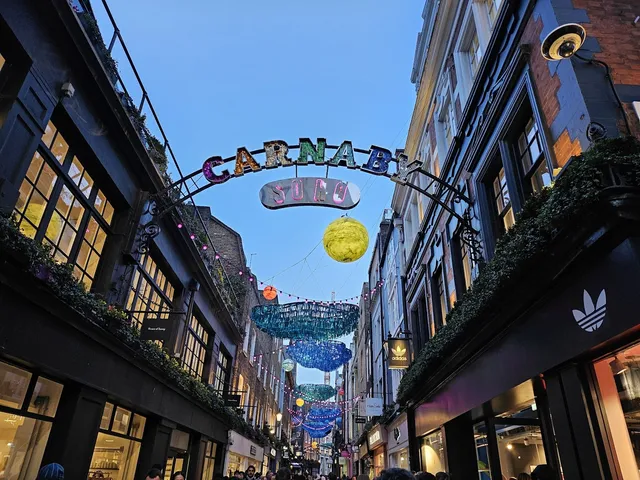
Carnaby Street
FreeThe street the Sixties happened on, now thirteen pedestrianised lanes of independents and the best Christmas lights in central London.
Free to walk. Kingly Court off the middle of it is the part worth finding - three tiers of small restaurants around an open courtyard.
Outernet London
FreeFour-storey 16K screens wrapping the walls and ceiling of a public hall by Tottenham Court Road - you walk in off the street, for nothing, and stand inside the picture.
FREE and no booking. The content changes constantly, so it is worth a look whenever you pass rather than a planned trip. The music venue underneath is ticketed; the screen halls are not.
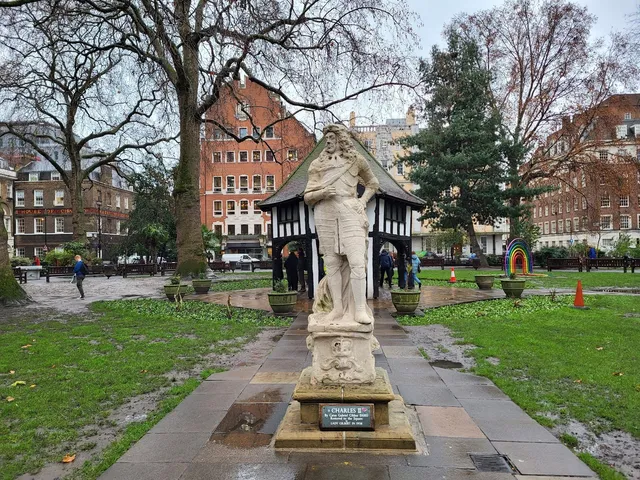
Soho Square
FreeThe one patch of grass in Soho, with a half-timbered garden hut in the middle that hides the entrance to an electricity substation.
Free and locked overnight. Full to bursting on the first warm day of the year and half empty for most of the rest.
Below Stone Nest
18+ in the eveningA candlelit basement bar with live music under Stone Nest, a former Welsh chapel turned performance space on Shaftesbury Avenue - one of the more atmospheric small rooms in the West End.
Below-ground and candlelit - genuinely dark, which some find romantic and others find impractical for reading a menu.
Boom Battle Bar Oxford Street
A games bar with Boom Box karaoke booths and 100,000 songs, alongside its other games.
Cahoots
18+A disused 1940s Tube station rebuilt underneath Kingly Court, complete with a carriage, ration-book menus and staff who stay in character all night.
Over-18 and booked in advance - it is not a walk-in. Playing along is expected; the staff will not drop the act if you do not.
House Party
18+Seven storeys done out as rooms of a house - DJ sets in the kitchen, karaoke in the parents' bedroom, beer pong on the roof - with actors working the floors in character.
Over-18 throughout. Co-founded by Stormzy and open since 2024; it is a bar and club rather than a bookable game, so there is nothing to reserve beyond a table.
Karaoke Box Soho
18+ in the eveningProper Japanese-format private rooms rather than a stage in a pub - your group, your booth, a door that shuts, and a sake list.
Booked by the room by the hour, so the cost per head falls sharply with numbers. Open very late at weekends.
Karaoke Epoc
Japanese karaoke boxes with a large Japanese, Korean and Chinese catalogue, yakitori and highballs, from £7 a head an hour before 4pm.
Closes at 11pm every night. Walk-ins are taken when a room is free.
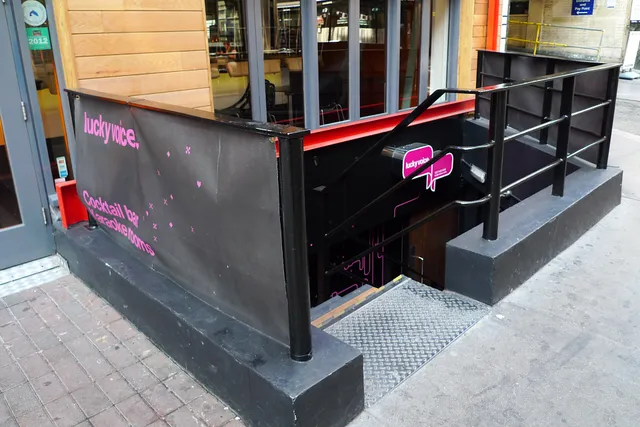
Lucky Voice Soho
18+The original of the London private-booth karaoke format, with a button on the wall that summons drinks so nobody has to leave mid-song.
Over-18 only, unlike some of the newer competition. Book the room, not the person - a half-full booth costs the same as a packed one.
NQ64 Soho
18+A dark basement of arcade cabinets and console booths played on tokens, with cocktails named after video games - and no booking needed.
Over-18 at all times. Walk-in, which makes it the rare activity bar you can use on a whim; queues form late at weekends.
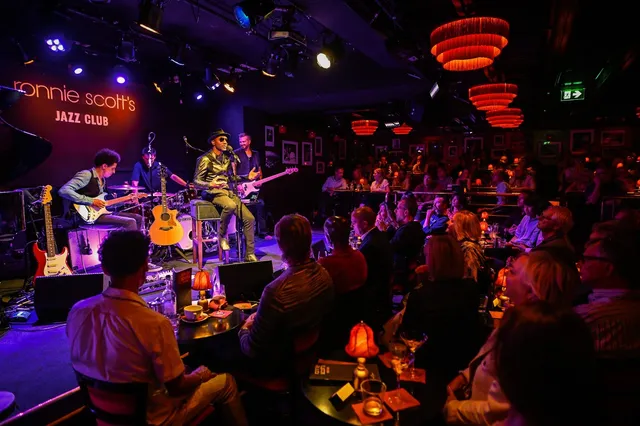
Ronnie Scott's
18+ in the eveningOpen since 1959 and still the most famous jazz room in the world, with table service, low ceilings and a stage close enough to see the fingering.
Book a table rather than a bar ticket if you want to see the stage. The Late Late Show after the main set is cheaper and much less formal.
Simmons
A late-night bar chain with happy hours and private karaoke rooms in several branches. The Soho room takes 25; Old Street's takes five, from £5 a head.
Eight bars: Soho, Greek Street, Leicester Square, King's Cross, Old Street, Oxford Street, Liverpool Street and Monument. Oxford Street has a karaoke recording studio for 15.
The 100 Club
18+ in the eveningThe same basement since 1942 - trad jazz, then the Rolling Stones, then the 1976 Punk Festival that launched the Sex Pistols and the Clash in one weekend.
A low basement with pillars, so sightlines are poor from the back - get down the front or accept you are there for the sound and the room.
The Crystal Maze LIVE Experience
Aztec, Medieval, Industrial and Futuristic zones played against the clock with a live Maze Master, ending in the Crystal Dome with the gold tickets whipping round.
Teams are combined with strangers unless you book the whole slot. At 22-32 Shaftesbury Avenue - it moved from its original Angel site.
The Photographers' Gallery
The first public gallery in the country devoted to photography, on a back street off Oxford Street, with a bookshop and print sales worth the trip on their own.
Free entry before noon on weekdays, ticketed after. Easy to miss - it is down a side street behind the Oxford Street crowds.
Hidden Soho
Free, self-guided and easy to walk past without knowing it's there.
28 Days Later's Car Alarm Scene (Centre Point)
Filming location28 Days Later (2002) - Jim sets off a car alarm at St Giles Circus
The same spot where a Banksy piece appeared in 2025 - the film sequence has Jim detour east past the Bank of England before setting off a car alarm here, a different reason to know this corner than the street art.
A busy public junction, viewable any time.
Air Street
Filming locationMission: Impossible - Rogue Nation (2015) - Hunt receives his assignment
The record-shop-turned-cafe where Ethan Hunt is handed his mission in the back room. Air Street is the short arcade linking Regent Street to Piccadilly and is easy to miss twice a day.
Free, a public street through an arcade, always open. One minute from Piccadilly Circus.
Banksy's Stargazing Children, Centre Point
Street artA 2025 piece near St Giles Square / Centre Point
One of two "Stargazing Children" pieces that appeared in 2025 - this one near the foot of Centre Point, at the northern tip of Soho where it meets St Giles.
Street-level, out in the open. As with all recent Banksy pieces, confirm it's still there before a special trip.
Karl Marx's Soho Home
Blue plaqueKarl Marx (1818–1883), philosopher and economist
Marx lived here in poverty with his family while writing much of Das Kapital - a few doors from where he and Engels regularly met.
Above what is now a restaurant - the plaque is at first-floor level.
Liberty
Filming locationCruella (2021) - the opening heist and the job interview
The mock-Tudor department store used as the fashion house Estella talks her way into. The building was put up in 1924 from the timbers of two Royal Navy warships, which is why the floors slope.
Free to walk into, open daily. Oxford Circus, two minutes. The atrium and the top-floor galleries are the parts worth the climb.
Mary Seacole's Soho Home
Blue plaqueMary Seacole (1805–1881), Crimean War nurse and businesswoman
Seacole's plaque was re-erected here in 2007, marking where research showed she lived in 1857 after returning from nursing British soldiers in Crimea.
On a building overlooking the square itself.
Percy Bysshe Shelley's Soho Home
Blue plaquePercy Bysshe Shelley (1792–1822), Romantic poet
Shelley lodged here as a young radical, years before Ozymandias - a Soho address for one of Romantic poetry's biggest names.
A private/commercial building - viewable from the street only.
The (What's the Story) Morning Glory? Cover Site
MusicOasis, (What's the Story) Morning Glory? (1995) - the album cover street
Shot at dawn on a Sunday in July 1995, between the record shops that made Berwick Street the centre of London's vinyl trade. Sister Ray still trades on the street, which is more than most locations on this list can say.
A public street, walkable any time. Best early on a Sunday if you want the empty-street look of the sleeve - the market stalls fill it on weekdays.
Where Keith Moon Played
Blue plaqueKeith Moon (1946–1978), drummer, The Who
Marks where The Who played in the earliest days of the band, rather than a home address - a different kind of plaque story from the usual "lived here".
On the former Marquee Club site, now a different business - the plaque is the only trace of the venue at street level.
Where Television Was Born
Blue plaqueJohn Logie Baird (1888–1946), television pioneer
Baird gave the first public demonstration of television in an attic room here in 1926 - a genuinely world-changing moment on an ordinary Soho street.
The building is now Bar Italia at street level; the plaque is above.
Where to stay
Central and convenient, but noisy. Ask for a room away from the street.
- Soho proper — Boutique hotels on Dean, Frith and Greek Streets. You will hear the street until late.
- Fitzrovia — Ten minutes north across Oxford Street. Same access, considerably quieter.
- Covent Garden — East, calmer after the market closes, and better for theatre.
Soho has almost nothing between a windowless room at £100 and a boutique double at £450, and the ordinary room at the ordinary price turns out to be ten minutes north. For the nine West End hotels compared on price and room size, what the windowless formats actually cost, and which streets are still loud at 2am, see where to stay in Soho and the West End.
Cheapest first. Prices are a typical starting rate per night, not a quote.Links marked ad are affiliate links. If you book through one we may earn a commission, at no extra cost to you. It never affects what goes on this list.
Zedwell Capsule Hotel Piccadilly Circus
£Zedwell's capsule product rather than its rooms: a berth with a roller shutter in a shared dormitory, with the same Hypnos mattress and windowless philosophy at a lower price than the hotel next door.
A shared dormitory with shared bathrooms, in Zedwell's own words - not the private cocoon rooms sold under the same brand in the same part of town, and both are called 'Cocoon' on the booking page. Its price is the steadiest of the capsule places: a berth roughly doubles between the quietest and busiest nights while a Zedwell room triples, so the room's premium over a berth widens from 2.9x on a quiet night to 4.2x in December. This is the one to book when London is busy. The female-only floor runs about £7 a night above the mixed one throughout. Padlock is yours to bring; lockers are bought separately. Opened September 2025.
Otherwander Soho
££A brand-new capsule hotel on Dean Street with its own air conditioning, lighting and sockets in each pod, a few steps from the Dean Street entrance to the Elizabeth line.
You cannot stand up inside a pod, and bathrooms are communal - clean and room-like, but shared. Sold as 'Nests', stacked upper and lower; which of the two costs more flips about between dates, so there is no reliable premium either way. Roughly double the Zedwell capsule on any night, and on a quiet night a single nest costs more than a private room at Tottenham Court Road. Reviewers report hearing corridor conversation and pod doors despite the soundproofing claim, and taller guests find the upper pods awkward. Adults only.
The Resident Soho
££HotelSeventy-eight rooms, every one with the group's signature mini-kitchen, tucked at the dead end of Carlisle Street a few steps from Soho Square - which makes it far quieter than a Soho address suggests.
The mini-kitchen in every room is the reason to book it: it turns a West End stay into one you can eat breakfast in, which is what keeps it on longer-stay and family lists.
The Z Hotel Soho
££HotelThe compact-room format on Moor Street, a few steps from Cambridge Circus and Old Compton Street - about as central as a room at this price gets in the West End, with the theatres on the doorstep.
Breakfast is not included as standard: Z Hotels' own site says breakfast, drinks and snacks are bought from the Z Cafe, and are included in the rate only in the pricier Z Club rooms - the same page puts the complimentary cheese and wine behind Z Club membership too.
Zedwell Piccadilly Circus
££HotelAccessible roomsAlmost a thousand windowless, soundproofed 'cocoon' rooms above Piccadilly Circus, sold in sizes from one bed to twelve. The second person costs about £5 whatever the room costs, so the per-head price halves the moment there are two of you and keeps falling as the room gets bigger.
Private rooms with en-suite rainfall showers, not capsules - the capsule product is a separate Zedwell property nearby. The most volatile price in the pods set: a Cocoon 1 ran £97 to £287 depending on the night, so the night chosen matters more here than anywhere else. Windowless by design: filtered air, blackout, no wardrobe, no TV, no kettle. Cleaned every four days, not daily; a hairdryer or iron delivered costs £10. Cocoon 4 and above are double beds in bunks, so four friends share two doubles rather than getting four berths. The big rooms sell out first.
Courthouse Hotel Soho
£££HotelThe former Great Marlborough Street magistrates' court, where Oscar Wilde and John Lennon both stood - three original cells survive off the bar, which is exactly as odd as it sounds.
Directly behind Liberty and a minute from Carnaby Street, so the location is Soho-adjacent rather than deep in it.
Dean Street Townhouse
£££TownhouseThe Soho House group's one hotel that anybody can book, with rooms graded from Tiny upwards - the dining room downstairs is a proper Soho institution rather than a hotel restaurant.
The room grades are honest about size: Tiny means tiny.
Hazlitt's
£££TownhouseThree 1718 townhouses on Frith Street, run as a hotel since 1986 and left deliberately un-modernised - panelling, four-posters, uneven floors, and the essayist William Hazlitt died in the building.
There is no lift and the stairs are original, so it is a poor choice for anyone with mobility needs or heavy luggage.
Karma Sanctum Soho
£££HotelThe rock-and-roll hotel in Soho - a 24-hour licence, a rooftop hot tub and a guitar in the room if you ask, on Warwick Street behind Regent Street.
The late licence is the whole proposition and also the warning: this is not a quiet stay.
Mimi's Hotel Soho
£££BoutiqueA small independent on Frith Street in the middle of Soho's restaurant blocks - close enough to Ronnie Scott's to walk back from a late set.
Small enough that room choice matters; ask which face the street.
Broadwick Soho
££££BoutiqueAccessible roomsLeopard print, velvet and clashing colour by Martin Brudnizki, built by a group of friends rather than a hotel group - and named the UK's best hotel at the 2026 Muddy Stilettos Awards, beating out the country's grandest countryside piles.
A national award, not a London-only one - it beat entries from Bath, Hampshire, Wiltshire and Kent to take the UK title. Fifty-seven rooms, so it is small and books out.
Ham Yard Hotel
££££HotelAccessible roomsTwo Michelin Keys, built from the ground up around a tree-filled courtyard with a Tony Cragg bronze, and a 1950s bowling alley in the basement.
Kit Kemp's patterns throughout, as at Charlotte Street. The bowling alley and the roof terrace are bookable without a room.
Hotel Café Royal
££££HotelAccessible roomsTwo Michelin Keys, a grand nineteenth-century building on the Soho edge of Regent Street, and the Akasha spa that Time Out named London's best in 2025.
The Grill Room and the Oscar Wilde Lounge are open to non-residents and are the affordable way to see the interiors.
The Soho Hotel
££££HotelAccessible roomsTucked down a mews off Dean Street behind a plain red-brick front, with two private screening rooms and a Botero cat in the lobby.
The Sunday film club - a screening plus lunch - is open to non-residents and is the best-value way in.
Make a day of it
Combine Soho with
Walking times are from the centre of Soho. Each of these works as an afternoon once you have finished here.
Covent Garden
8 min walkEast across Charing Cross Road for the Piazza, Seven Dials and the theatres.
Mayfair and Regent Street
10 min walkWest across Regent Street for galleries, arcades and the expensive end of town.
Bloomsbury
12 min walkNorth-east for the British Museum and a much quieter afternoon.
South Bank
20 min walkSouth through Trafalgar Square and over the Golden Jubilee Bridges.
Walking routes
A Walk Through Soho and Chinatown: Tin Pan Alley to Gerrard Street →
Our full daytime route: eleven numbered stops over about 3km, from Denmark Street to Chinatown, with a map, a Google Maps walking link and what is shut on which day. It passes the plaques to Marx, Mozart and Baird, Berwick Street market, Kingly Court and the churchyard where Hazlitt is buried, and times the walk so you reach Chinatown for lunch.
The short version, if you only have an evening
- Start: Tottenham Court Road station, Dean Street exit.
- Chinatown: South to Gerrard Street for the gates and the roast meat windows.
- Old Compton Street: North for a drink as the street fills up.
- Berwick Street: West past the record shops to Broadwick Street.
- Kingly Court: Through to Carnaby Street and the courtyard.
- Finish: Ronnie Scott’s on Frith Street, or a late plate at Bar Italia.
Common mistakes to avoid
- Coming in the morning. Much of Soho does not open until midday and the atmosphere is entirely absent before evening.
- Expecting to book everywhere. Several of the best restaurants are walk-in only. Arrive at 17:30 or after 21:00 to avoid the worst queues.
- Treating Carnaby Street as the destination. Twenty minutes is enough. Kingly Court beside it is better.
- Assuming Chinatown is expensive. It is the cheapest good eating in Zone 1, and most places seat you quickly.
- Driving or taking a cab. Much of Soho is pedestrianised or one-way, and the Congestion Charge applies. Walk.
- Missing the last Tube on a weeknight. Night Tube runs Friday and Saturday only; other nights the last trains go around 00:30.
Common questions
Is Soho safe at night?
Yes, in the sense that it is busy and well lit until very late. It is London's densest nightlife district, so expect crowds, noise and drunk people at closing time, particularly around Old Compton Street and Wardour Street on weekends. Normal city awareness applies: watch your bag and your phone in crowds.
Where is Chinatown in London?
Centred on Gerrard Street, between Shaftesbury Avenue and Leicester Square, marked by ornate gates at either end. It is pedestrianised and takes in Lisle Street and Newport Place as well. It is a five-minute walk from Piccadilly Circus or Leicester Square stations.
What is Soho actually known for?
Three overlapping things: eating and drinking, the music industry, and LGBTQ+ nightlife centred on Old Compton Street. Historically it was London's red-light district and its film and recording hub — Denmark Street was the country's centre for instrument shops and songwriting. Most of that character survives in fragments.
Do I need to book restaurants in Soho?
For dinner between Thursday and Saturday, yes. Many of the best-known places do not take bookings at all and run walk-in queues instead — go early, around 17:30, or late after 21:00. Chinatown is the reliable fallback, as most restaurants there seat quickly.
Is Carnaby Street worth visiting?
It is worth twenty minutes rather than an afternoon. The 1960s history is real but the street is now mostly mainstream chains. The better shopping is in Kingly Court just off it, a three-storey courtyard of independent restaurants and bars.