In this guide
Heathrow has excellent public transport, but the fastest train to Paddington is not automatically the fastest route to your hotel. The Elizabeth line and Piccadilly line continue through London, while Heathrow Express stops at Paddington and may leave you with another journey.
The short version: take the Elizabeth line for the best combination of speed, comfort and useful central stops; take the Piccadilly line when price matters or your hotel is directly beside it; and take Heathrow Express when Paddington is genuinely convenient, particularly if you found a cheap advance ticket. A taxi is most useful for a group, substantial luggage, limited mobility or an address poorly served by rail.
Heathrow transport at a glance
Prices and normal journey times below were checked on 28 July 2026. Rail times are approximate from Heathrow Terminals 2 & 3; Terminal 4 or 5 can add several minutes.
| Option | Typical adult cost to central London | Approximate time | Comfort | Best for |
|---|---|---|---|---|
| Piccadilly line | About £5.90 with Oyster/contactless to Zone 1 | 50–60 minutes | 2/5 | Lowest cost; hotels near a Piccadilly line station |
| Elizabeth line | £15.50 with Oyster/contactless to Zone 1 | 28 minutes to Paddington; 35–55 minutes farther east | 4/5 | Most visitors, luggage and direct east-west travel |
| Heathrow Express | £26 walk-up single; advance singles from £10 | 15 minutes to Paddington | 5/5 | Paddington and nearby hotels; advance bargains |
| Coach to Victoria | From about £10 | Roughly 45–90 minutes | 3/5 | Victoria or onward coach travel |
| TfL local bus | £1.75 currently | Varies; not a sensible central-London journey | 2/5 | Hotels and destinations in west London |
| Black cab | Approximately £70–£120 | Roughly 30–90 minutes | 4/5 | Door-to-door travel, groups and accessible vehicles |
| Pre-booked private hire | Quoted by the operator | Roughly 30–90 minutes | 4/5 | A known pickup and fixed quoted price |
Traffic, disruption, immigration and baggage reclaim can change the real door-to-door time. Compare the complete journey to your hotel, not only the advertised airport-to-terminus time.
Which route is best for your hotel?
| Hotel area or destination | Usually the best first choice | Why |
|---|---|---|
| Paddington | Heathrow Express or Elizabeth line | Both are direct; Express saves around 15 minutes but normally costs more |
| Bayswater or Notting Hill | Elizabeth line to Paddington, then walk, taxi or local connection | Usually simpler than crossing central London |
| Bond Street and Oxford Street | Elizabeth line | Direct, step-free and close to many West End hotels |
| Tottenham Court Road, Soho and Bloomsbury | Elizabeth line | Direct to Tottenham Court Road; check the correct station exit |
| Farringdon, Clerkenwell and St Paul’s area | Elizabeth line | Direct to Farringdon, with Thameslink interchange |
| Liverpool Street, Shoreditch and the City | Elizabeth line | Direct without changing |
| Canary Wharf and Stratford | Elizabeth line | Direct and much more convenient than Heathrow Express |
| Hammersmith or Barons Court | Piccadilly line | Direct and inexpensive |
| Earl’s Court and South Kensington | Piccadilly line | Direct; useful for western Kensington hotels |
| Knightsbridge and Green Park | Piccadilly line | Direct to the hotel districts around these stations |
| Piccadilly Circus, Leicester Square and Covent Garden | Piccadilly line | Direct, although stairs and crowds can be awkward with luggage |
| King’s Cross St Pancras | Piccadilly line | Direct to both the mainline stations and Eurostar |
| Victoria | Coach, or rail with one change | A direct coach avoids an interchange; rail is less vulnerable to traffic |
| Waterloo and the South Bank | Elizabeth line to Bond Street, then Jubilee line | A practical step-free interchange when lifts are operating |
| London Bridge and Borough | Elizabeth line to Farringdon, then Thameslink | Often easier with luggage than crossing the West End |
| Euston | Elizabeth line to Tottenham Court Road, then Northern line or a short taxi | Normally faster and more comfortable than taking the Piccadilly line across London |
If the hotel advertises itself as “Paddington”, “Heathrow” or “central London”, still check its actual address. A hotel beside Hammersmith station can be easier by Piccadilly line than by Heathrow Express, even if its marketing mentions Paddington.
Elizabeth line
The Elizabeth line is the best default for many arrivals. Its long, air-conditioned, walk-through trains have dedicated luggage areas and provide direct journeys through central London.
Useful direct stations include:
- Paddington for west London and Great Western Railway;
- Bond Street for Oxford Street, Mayfair and the Jubilee line;
- Tottenham Court Road for Soho, Bloomsbury and the Northern line;
- Farringdon for the City and Thameslink;
- Liverpool Street for the City and connections from London Liverpool Street;
- Canary Wharf and Stratford for east London.
From Heathrow Terminals 2 & 3, allow roughly 28 minutes to Paddington, around 35–40 minutes to Bond Street or Tottenham Court Road and approximately 45 minutes to Liverpool Street. Check the live timetable rather than treating these as guaranteed times.
Elizabeth line cost and payment
The adult pay-as-you-go fare between Heathrow and a Zone 1 station is currently £15.50. Heathrow carries a special Elizabeth line supplement, so this is higher than an ordinary Zone 1–6 rail fare.
Use:
- a contactless bank card;
- Apple Pay, Google Pay or another supported contactless device;
- an Oyster card with sufficient pay-as-you-go credit;
- a paper ticket or a Travelcard covering the required zones.
There is no need to reserve a train or buy an airport ticket in advance. Touch in at Heathrow and touch out at the final station with exactly the same card or device. A physical bank card and that card on a phone are treated separately.
The Elizabeth line journey is eligible for TfL capping, although the Heathrow single fare can sit close to the Zone 1–6 daily cap. Use the TfL Single Fare Finder immediately before travelling if your destination is outside Zone 1 or your journey includes an unusual route.
Piccadilly line
The Piccadilly line is the least expensive direct rail route. It serves all Heathrow passenger terminals and runs through west and central London to King’s Cross St Pancras.
It is particularly useful for Hammersmith, Earl’s Court, South Kensington, Knightsbridge, Green Park, Piccadilly Circus, Leicester Square, Covent Garden, Holborn and King’s Cross.
The trade-offs are important:
- the journey to central London takes about 50–60 minutes;
- existing trains have limited luggage space and no air conditioning;
- trains can become crowded through west London;
- several central stations have stairs or long passages;
- a direct journey may still be easier than changing from a faster airport train.
Piccadilly line cost and payment
A Zone 1–6 adult pay-as-you-go journey is currently about £5.90 at the applicable Heathrow fare. The precise charge can depend on the route and time, so confirm it with TfL’s Single Fare Finder.
Oyster and contactless work normally, and the journey counts towards the applicable TfL cap. A Travelcard must include Zone 6. Paper single tickets are available but usually offer no advantage over Oyster or contactless.
Do not board the first westbound-looking train when returning to the airport. Check whether its destination is Heathrow Terminal 4, Heathrow Terminal 5 or somewhere else on the line.
Heathrow Express
Heathrow Express runs nonstop between Heathrow Central, serving Terminals 2 & 3, and Paddington every 15 minutes. The advertised journey is 15 minutes, with Terminal 5 about six minutes farther.
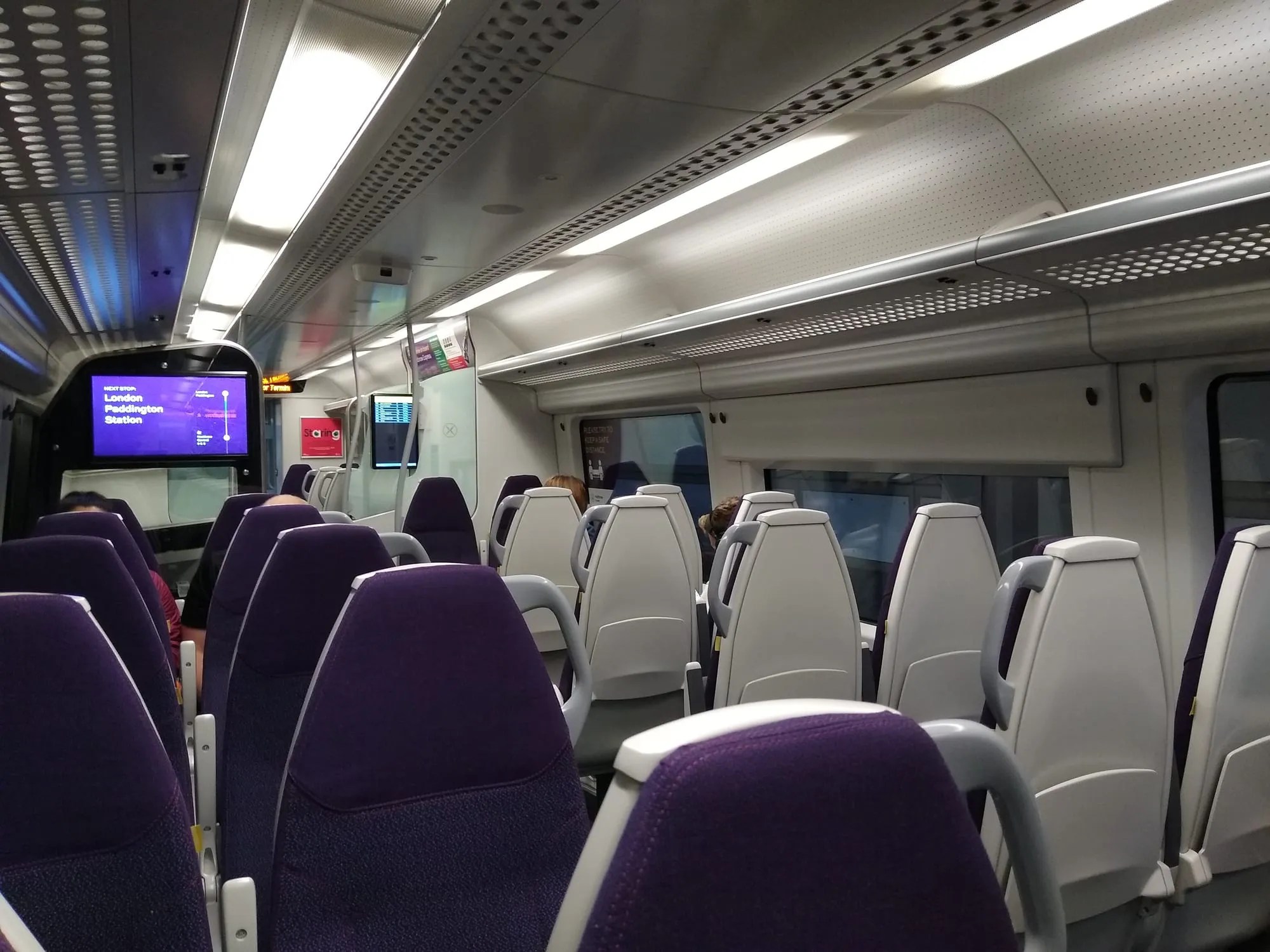
It offers air conditioning, luggage space, Wi-Fi, power sockets, toilets and more conventional seating than the Tube. This makes it the most comfortable option, but not always the fastest door-to-door route.

Inside a Heathrow Express train. Photo: Mx. Granger, released under CC0.
Heathrow Express fares
| Ticket | Standard Class | Premier+ |
|---|---|---|
| Walk-up single | £26 | £32 |
| Advance discounted single | From £10 | Not offered |
| Same-day return | £30 | £36 |
| Return | £42 | £46 |
Children aged 15 and under travel free in Standard Class with a paying adult. Railcard discounts are available on eligible tickets.
You can touch in and out with Oyster or contactless, but that normally charges the walk-up Heathrow Express fare. Heathrow Express is excluded from ordinary TfL caps and Travelcards. To obtain an advance fare, Railcard discount or return deal, buy the appropriate Heathrow Express ticket separately.
Heathrow Express is worthwhile when:
- your hotel is at or close to Paddington;
- you have several suitcases and value a conventional train interior;
- you have booked the £10 advance fare;
- children travelling free make the family total competitive;
- a fast connection at Paddington is more important than the price.
It is usually poor value if you immediately travel back east on the Elizabeth line or spend a long time changing to the Underground.
Coaches, buses and RailAir links
Long-distance coaches connect Heathrow with Victoria Coach Station and destinations across Britain. Central-London fares can start around £10, but departures are tied to an operator and ticket rather than Oyster. Book with the coach company and allow for motorway and central-London traffic.
A coach can suit Victoria, a very early or late journey, or an onward destination outside London. Check which terminal it serves: Terminals 2 & 3 use Heathrow Central Bus Station, while Terminals 4 and 5 have separate coach stops.
TfL local buses connect Heathrow with places including Southall, Hounslow, Kingston, Ruislip and local railway stations. They accept Oyster or contactless and currently use the £1.75 bus fare, but they are not a practical substitute for a direct train into central London.
RailAir and other coach links connect Heathrow with National Rail stations including Reading, Woking, Guildford, Watford Junction and Feltham. They can avoid travelling into central London merely to travel back out again.
At night, check the current rail finish times and night-bus or coach timetable before landing. A route that works at 20:00 may not exist after midnight.
Taxis, private hire and hotel transfers
Licensed black cabs wait at official ranks outside every terminal. They are wheelchair accessible, accept card payments and use a regulated meter. TfL’s indicative fare between Heathrow and central London is approximately £70–£120, with a typical road journey of 30–60 minutes before severe congestion.
A licensed private-hire vehicle, including Uber and similar services, must be booked in advance. Follow the app or operator’s instructions to the correct pickup area; drivers cannot collect passengers from the terminal drop-off lane.
Before booking, compare:
- the complete quoted fare, including airport parking or pickup charges;
- luggage and passenger capacity;
- child-seat arrangements;
- the operator and vehicle licence details;
- waiting-time rules if immigration or baggage reclaim is delayed.
For one traveller, rail is normally much cheaper. For four people sharing the fare, a pre-booked vehicle can become more reasonable, particularly for a difficult address or substantial luggage.
Anyone driving you to departures should know that Heathrow currently charges £7 per entry to the terminal drop-off areas. Pickup is from Terminal Parking or Park & Ride rather than the departures forecourt.
Understanding Heathrow’s terminals
Heathrow currently has four passenger terminals: 2, 3, 4 and 5. Terminal 1 is closed.
| Terminal | Rail and Underground station | Important layout point |
|---|---|---|
| Terminal 2 | Heathrow Terminals 2 & 3 | Walk from the shared station through signed pedestrian subways |
| Terminal 3 | Heathrow Terminals 2 & 3 | Uses the same rail station and Central Bus Station as Terminal 2 |
| Terminal 4 | Heathrow Terminal 4 | Separate station beside the terminal |
| Terminal 5 | Heathrow Terminal 5 | Its own station beneath the terminal |
Do not guess a terminal from the airline name. Some airlines use more than one terminal, and assignments can change. Check the booking, airline app or Heathrow’s terminal finder.
Which trains serve each terminal?
- Elizabeth line: serves Terminals 2 & 3, Terminal 4 and Terminal 5, but individual trains branch to either Terminal 4 or Terminal 5. Read the destination display.
- Piccadilly line: serves the shared Terminals 2 & 3 station and separate Terminal 4 and 5 stations. Check the train’s destination and the branch diagram.
- Heathrow Express: serves Heathrow Central and Terminal 5. Terminal 4 passengers use the signed free connection via Heathrow Central.
Free travel is available between Heathrow terminal stations on the designated rail services. Oyster or contactless may be required to open the gates even when no fare is charged; a free transfer ticket is also available for specified train connections. Follow the airport’s free terminal travel map.
Moving between Terminals 4 and 5 generally requires a change. Allow substantially more time than the train ride itself for walking, waiting and finding the correct platform.
Travelling to Heathrow for a departure
First verify:
- the departure terminal;
- the airline’s recommended check-in or bag-drop deadline;
- live flight status;
- engineering work or disruption on your chosen route;
- the time needed to walk from the station to check-in.
Use Heathrow’s live departures page and your airline app before leaving the hotel. A delayed flight does not necessarily mean check-in or bag drop will stay open later, so follow airline instructions rather than deliberately arriving late.
Check TfL status updates for the Elizabeth and Piccadilly lines, or the Heathrow Express service page for the express train. Build in an alternative: from central London, the Elizabeth and Piccadilly lines usually provide independent rail routes.
For an early-morning flight, check the first train on the exact date. Sunday starts, engineering work and public holidays can differ from an ordinary weekday.
Arriving at Heathrow: SIM cards and Wi-Fi
For a full comparison of airport shops, local mobile stores and installing an eSIM before flying, read Should You Buy a SIM Card at the Airport?.
Heathrow provides free Wi-Fi throughout all terminals. Connect to _Heathrow Wi-Fi and complete the registration screen. This is enough to message your hotel, load a ticket, download a map or arrange onward travel before buying mobile service.
SIM Local has shops or vending locations across Terminals 2, 3, 4 and 5, and physical SIMs are convenient when you need help installing one immediately. Airport convenience is not always the best price, however.
Before buying:
- check whether your existing mobile plan includes UK roaming;
- see whether the phone is unlocked;
- compare the total data allowance and validity period;
- consider installing a UK or travel eSIM before flying if the phone supports eSIM;
- avoid changing the physical SIM until any banking or login codes have arrived.
For a short visit, an eSIM installed before departure is often simplest. For a longer stay or a large data requirement, compare airport packages with UK-network prepaid SIMs sold in supermarkets, phone shops and convenience stores after reaching London.
Do not buy a SIM merely because you need directions out of the airport: free Wi-Fi can bridge the journey, and stations have clear signs.
Useful apps to prepare
- Airline app: check-in, boarding pass, terminal changes and disruption.
- Heathrow app: live flight, bag-drop, security, gate and baggage-reclaim information.
- TfL Go: official London route planning and live transport status.
- Citymapper or Google Maps: useful door-to-door comparisons and walking directions.
- Heathrow Express app: only necessary if managing a separate Express booking.
- Uber or another licensed operator’s app: optional for a pre-booked private-hire journey.
Download essential apps, boarding passes and the hotel address before flying. Keep a screenshot or offline copy of the hotel details in case roaming or airport Wi-Fi is unavailable when you land.
Luggage and accessibility
Elizabeth line and Heathrow Express stations at the airport are step-free, and their trains are much easier with large luggage than the older Piccadilly line fleet. Central-London interchange stations may still involve long walks even when lifts are available.
If you need assistance:
- request airport and airline assistance before travel;
- check lift status for the complete route;
- avoid a tight interchange with multiple large cases;
- consider a black cab or suitable pre-booked vehicle for the final section;
- keep luggage within sight and do not block train doors or wheelchair spaces.
Heathrow Express offers the most conventional luggage provision, but the Elizabeth line is usually comfortable enough without the premium price.
Common mistakes
- Taking Heathrow Express because it has the shortest advertised time, then making a long journey back across London.
- Boarding an Elizabeth or Piccadilly line train without checking whether it serves Terminal 4 or Terminal 5.
- Using a phone to touch in and the corresponding physical bank card to touch out.
- Expecting a Zone 1–2 Travelcard to cover Heathrow in Zone 6.
- Assuming Heathrow Express is included in a Travelcard or TfL cap.
- Buying an airport SIM before checking roaming, eSIM and city-centre prices.
- Going to the wrong terminal because the airline used another one on a previous trip.
- Treating a flight delay as permission to miss the original check-in deadline.
- Allowing no time for immigration, baggage reclaim, station walking or disruption.
Related London transport guides
- Gatwick Airport to London: Every Transport Option Compared
- All six London airports compared
- Getting Around London: Complete Transport Overview
- London Public Transport Costs and Fares
- Oyster Card or Contactless?
- How to Use the London Underground
- Which London Train Lines Accept Oyster?
Fares, terminal information and airport services checked on 28 July 2026. Always confirm the departure terminal and live transport status before travelling.