In this guide
The single most useful thing to know about London markets is which days they exist. Columbia Road is a street of flower sellers on Sunday and an ordinary road the rest of the week. Broadway Market is a Saturday. Turning up on the wrong day is the standard way to waste a morning.
We keep a full markets by day page for exactly that reason. This guide is about what each one is actually for — including the flower, antiques and shopping markets.
If you are only here to eat, our best street food in London guide compares every food hall, market and container yard on traders, variety, seating and trading days. The seasonal chalet markets and maker fairs of November and December are in our London Christmas markets guide.
💡 The Short Version: Borough is the food market everything else is measured against. Columbia Road is Sunday only and worth the alarm. Maltby Street is the one locals use instead of Borough. And Billingsgate trades before dawn and is finished by 8am.
📘 How we choose these (editorial note). No paid placements. These are drawn from a wide spread of sources - the food and travel press, the big listings sites, independent blogs and specialists, video, and what Londoners recommend themselves - and cross-referenced against each other. Trading days are the thing that changes most and the thing that ruins a trip — every one here was checked in August 2026, but confirm before travelling for a specific market.
Where they are
Map of the best markets in London
Loading the interactive map…
| If you are near… | Which market |
|---|---|
| Borough & Bermondsey | Borough Market, Maltby Street |
| Covent Garden | Apple Market |
| The City | Leadenhall Market |
| Shoreditch & Bethnal Green | Old Spitalfields, Columbia Road, Brick Lane |
| Hackney | Broadway Market |
| Camden | Camden Market, Hawley Wharf, Inverness Street |
| Notting Hill | Portobello Road |
| Greenwich | Greenwich Market |
| King’s Cross | Canopy Market |
| Canary Wharf | Billingsgate Fish Market |
Food markets
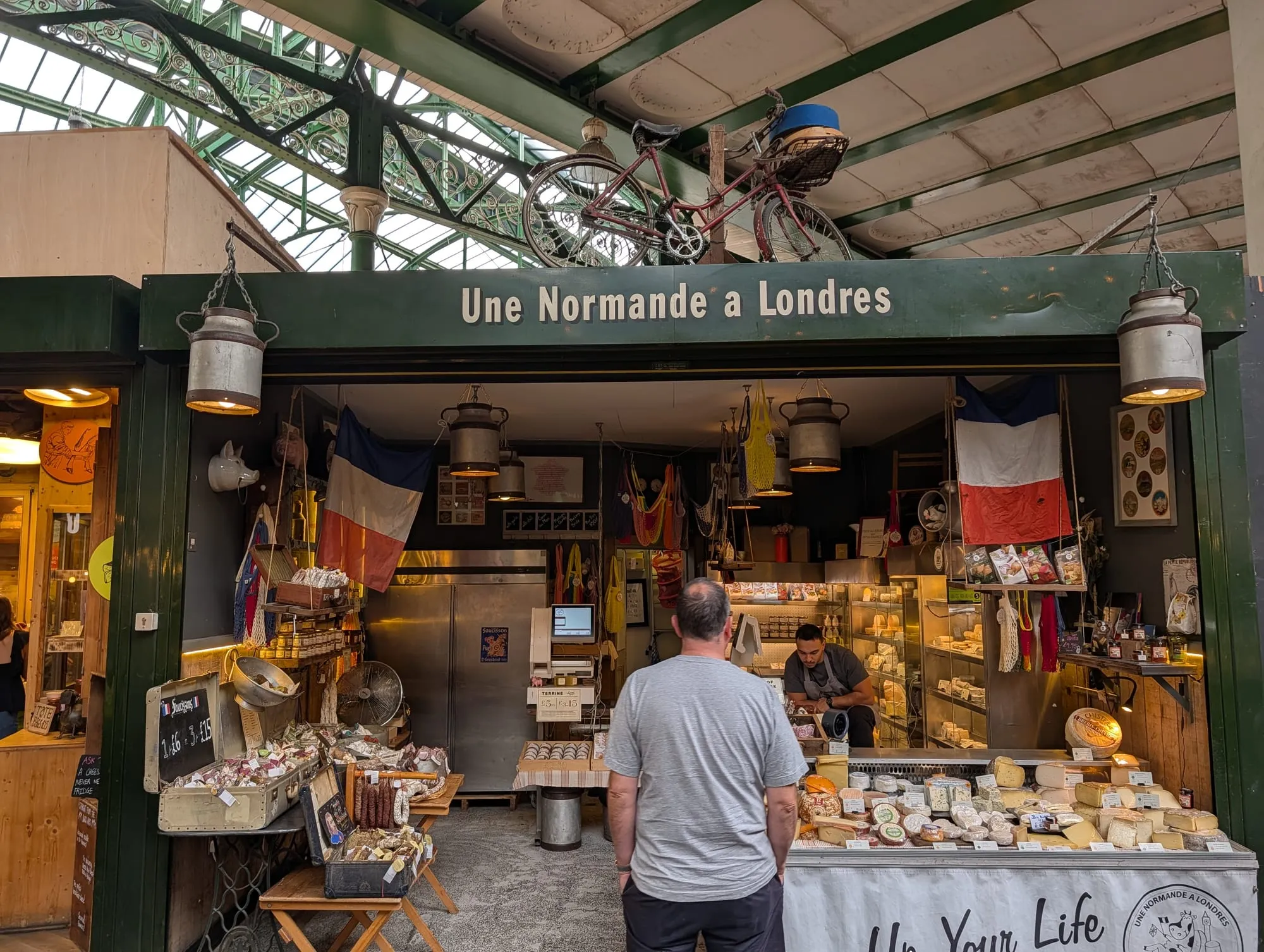
Borough Market, Southwark
Free to enter · most days
The one everything else is measured against — wholesale traders and produce stalls side by side with the hot-food counters that made it famous, under a Victorian iron roof beside Southwark Cathedral.
The timing advice everyone gives is wrong by a day. It is busiest between 11am and 2pm on Saturday, and the good window is Friday mid-morning — everything is stocked and the crush has not started. Tuesday and Wednesday are quiet but several traders are not there.
Kappacasein’s toastie is £8 and is the most queued-for item; it trades Thursday, Friday and Saturday only and nothing the rest of the week. The Black Pig does porchetta thirty seconds away, Tuesday to Sunday, £11.50 to £13.50.
Horn OK Please and Gujarati Rasoi are the two vegetarian Indian stalls worth crossing London for.
SE1 9AH, two minutes from London Bridge. Free to enter, and the Borough Market Kitchen section at the back has the seating. Closed on Mondays. It is the lunch stop on our Bankside and Borough walk, between Cross Bones and Southwark Cathedral.
Maltby Street Market, Bermondsey
Weekends
A narrow ropewalk of food traders wedged under the railway arches since 2010 — oysters, waffles, gin, and about twenty stalls in a corridor. The market locals use instead of Borough, ten minutes away.
⚠️ Friday evening to Sunday only, and this is the most common wasted trip in Bermondsey. Saturday 10am to 5pm, Sunday 11am to 4pm, and Friday 5.30pm to 9pm in summer. The rest of the week Ropewalk is an alley of shuttered arches.
A few arches do trade midweek: 40 Maltby Street at number 40 is a wine bar and kitchen open Wednesday to Sunday, and one of the best wine lists in London behind a roller shutter.
It is tight. By midday on a Saturday you are shuffling single file, so go at opening or accept the crush. Bermondsey is about eight minutes’ walk, London Bridge ten.
Canopy Market, King’s Cross
Free to enter · Wednesday to Sunday
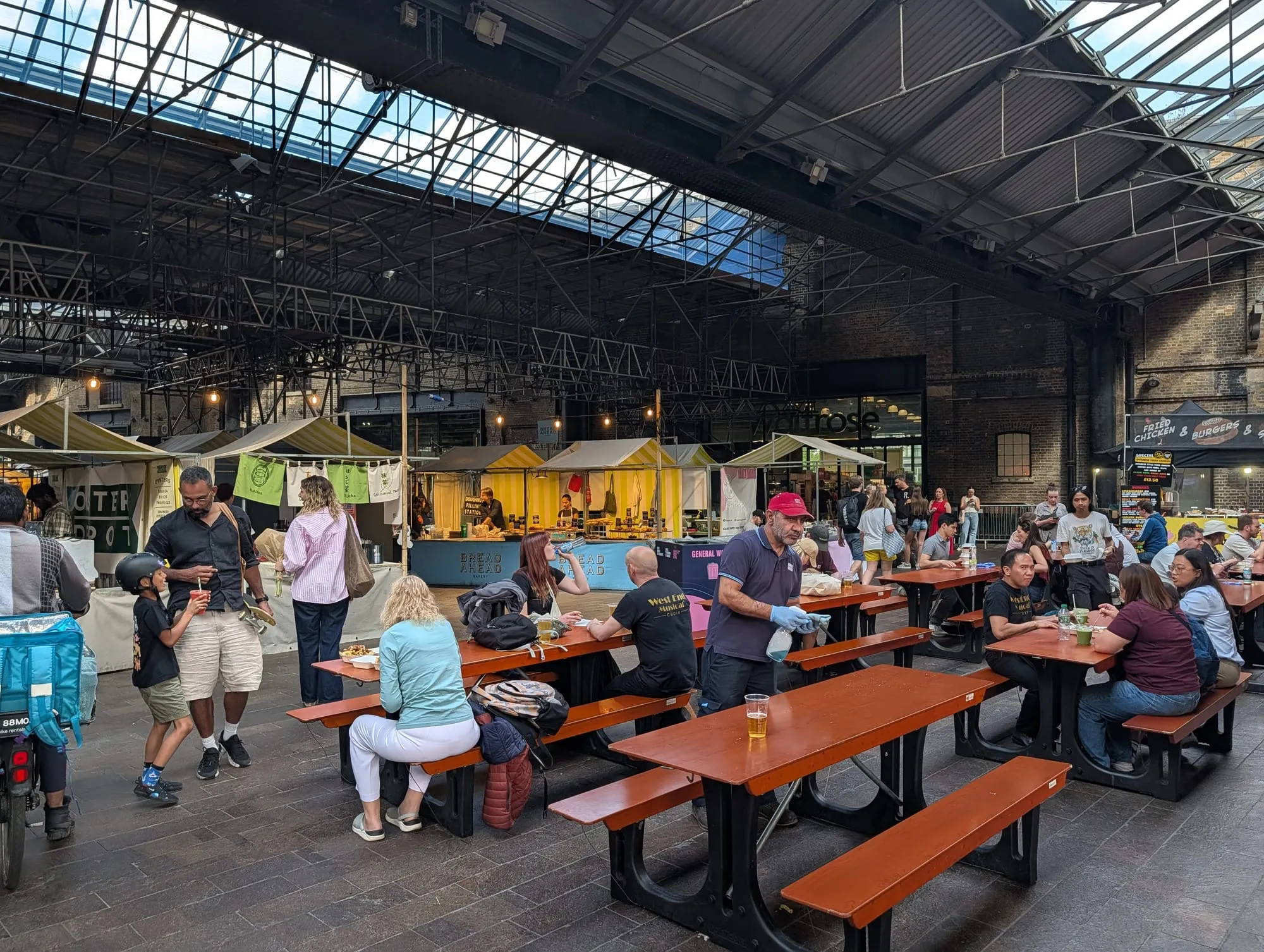
A market of food traders, producers and designer-makers under the glass roof of the West Handyside Canopy, a Victorian goods canopy behind Granary Square. Long communal benches, a bar, and far calmer than Camden or Borough.
It runs on two schedules. Wednesday and Thursday are street food only, midday to 8pm. Friday to Sunday is the full market — produce, jewellery, homeware and accessories alongside the food — noon to 8pm on Friday, 11am to 6pm at the weekend, and the same hours on bank holiday Mondays.
Come at the weekend if you want the makers rather than lunch.
Billingsgate Fish Market, Canary Wharf
Free to enter · before dawn
The UK’s largest inland fish market, trading from around 4am a few minutes from the Canary Wharf towers. The public can buy — you do not need a trade card — and the whole thing is finished by about 8am.
Bring cash, bring a cool bag, and buy in quantity. Traders sell in boxes rather than portions, so this works for a group or a freezer and not for a dinner for one. Wear shoes you do not mind soaking.
The market café does a bacon and scallop roll where the scallops come off the floor downstairs, which is the most London-specific breakfast in this guide.
⚠️ It closes for good by 2028. The City of London Corporation confirmed in November 2024 that Billingsgate will shut permanently and the Poplar site be redeveloped for housing. Traders continue in place until then, but this is an entry with an expiry date on it.
Trading days are Tuesday to Saturday. Canary Wharf and Poplar are the nearest stations, and neither is running at 4am — this is a taxi or a night bus.
One day a week
Columbia Road Flower Market, Bethnal Green
Sunday only
A Victorian street packed shoulder to shoulder with flower sellers shouting prices down, plus about sixty independent shops in the terraces behind them — a cheesemonger, a perfumer, galleries and cafés that only open because the market does.
Sunday only, roughly 8am to 3pm. It does not exist any other day, and the shops behind it largely close with it.
The two-hour rule. Arrive at 8am for the pick of the stock and room to move, or after 2pm when sellers start shouting prices down rather than up and a bunch that was £15 goes for £5. Between 10am and 1pm you are wedged in a crowd unable to carry a plant.
Do not drive and do not bring a pushchair. The street is narrow, closed to traffic and completely full.
E2 7RG. Hoxton is the nearest station at about five minutes; Bethnal Green and Old Street are both around fifteen.
Broadway Market, Hackney
Saturday only · 35 Broadway Market E8 4PH
Food, produce and vintage along a single street running down to the Regent’s Canal, with London Fields at the northern end — which makes it work better than a market on its own: you buy lunch and then have somewhere to eat it.
Saturday is the market, roughly 9am to 5pm. It is much quieter and largely shut the rest of the week, though the permanent shops and cafés along the street trade normally.
It is a locals’ market rather than a visitor one, so the crowd is people doing their weekly shop and the stalls are produce, bread and cheese as much as street food.
Cambridge Heath is the nearest station, about eight minutes, and London Fields station is about the same — Bethnal Green on the Central line is a fifteen-minute walk.
Shopping markets
Portobello Road, Notting Hill
Antiques Saturday
Antiques on Saturday — the largest antiques market in the world by number of dealers — and a different market on every other day of the week, which nobody explains.
Saturday is antiques, and it is the day the road fills end to end. Friday is a smaller antiques day and much the better one if you actually want to buy: the same dealers, room to negotiate, no crowd. The rest of the week the northern end is fruit and veg and general goods for the neighbourhood.
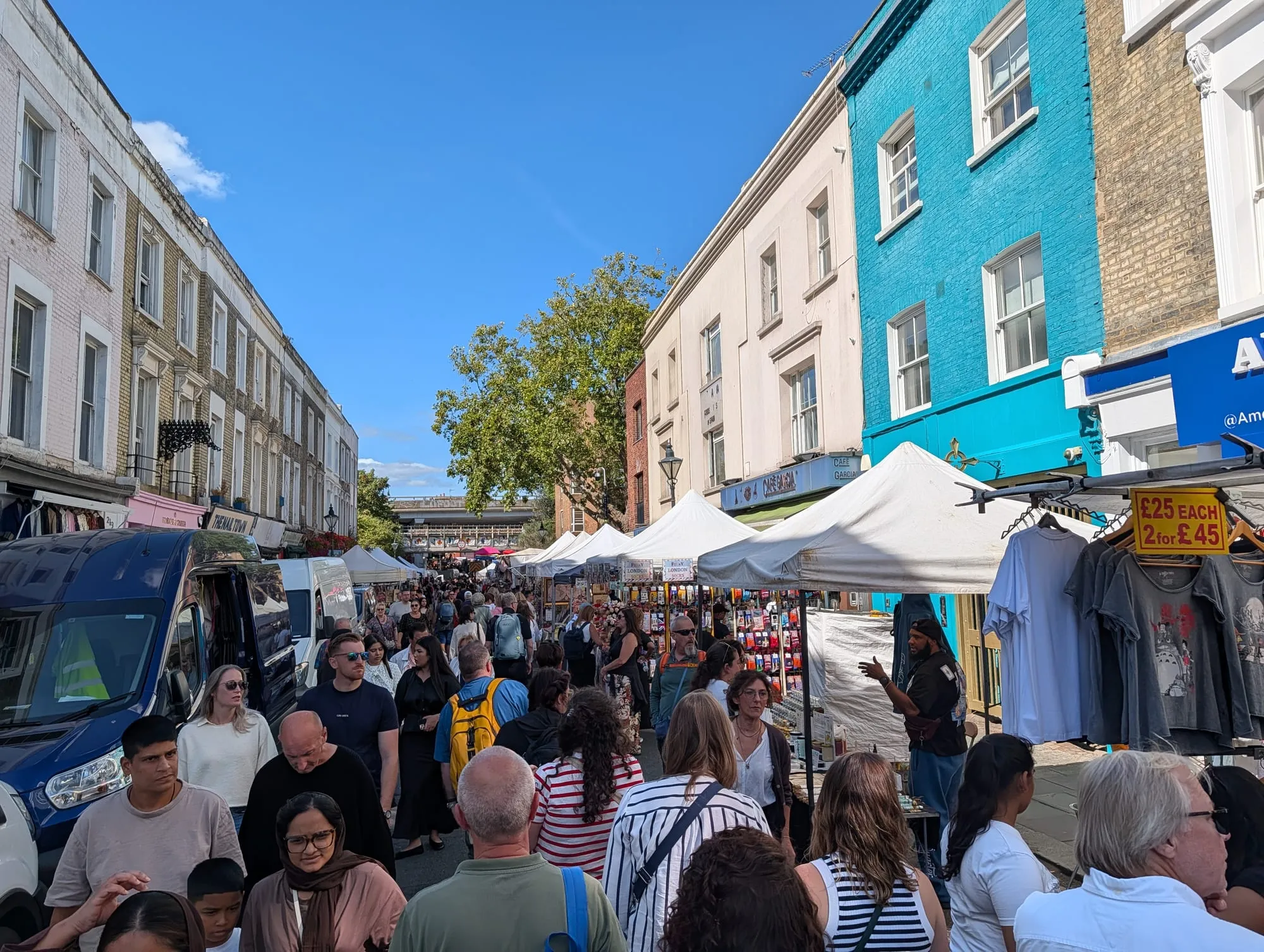
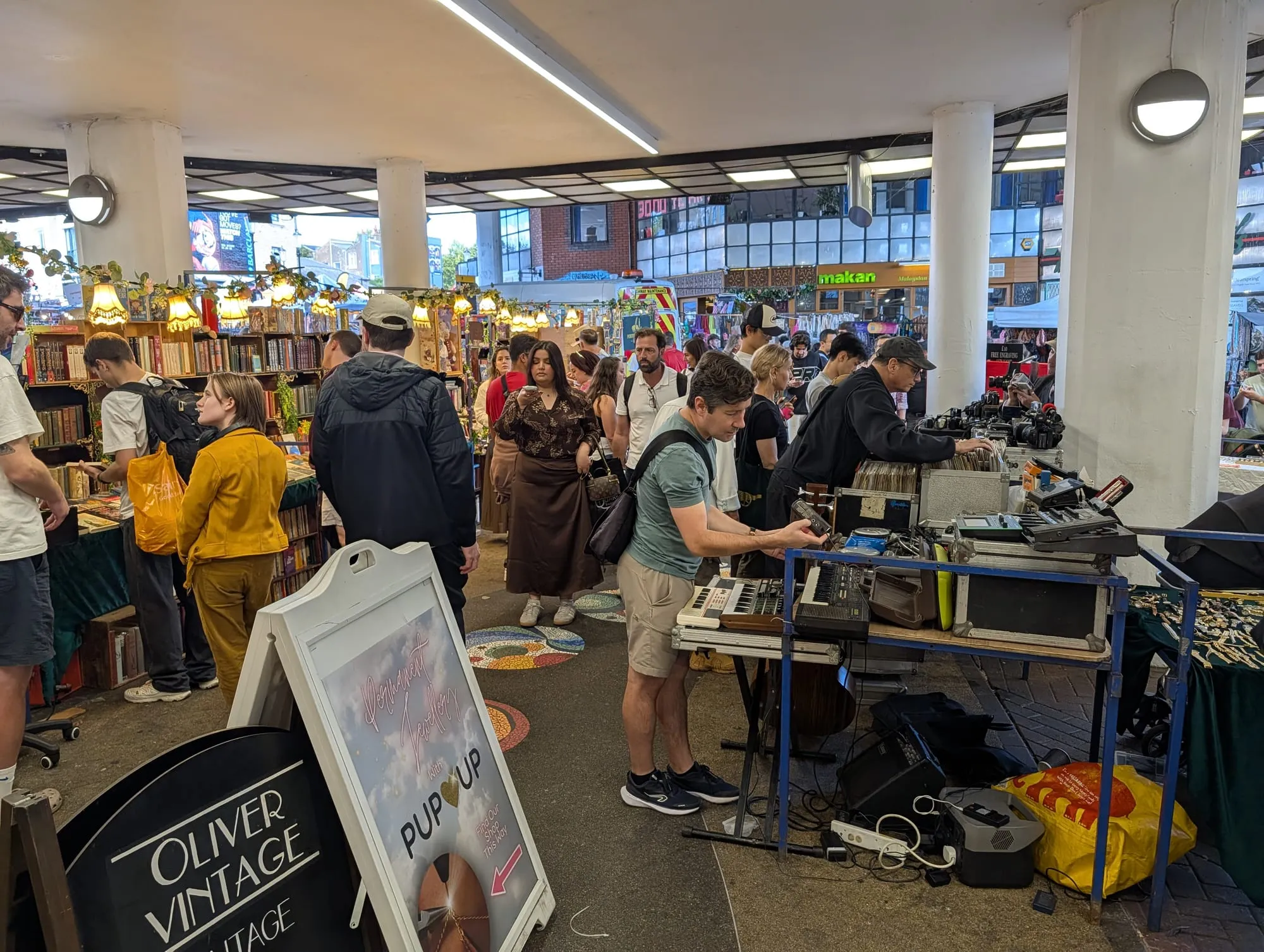
It is a mile and a half long and the character changes as you walk. Antiques at the Notting Hill Gate end, food in the middle, vintage and the Westway arches at the northern end towards Ladbroke Grove.
Walk it north and get the Tube back. Notting Hill Gate to Ladbroke Grove is the natural direction, and both are on the Circle, District and Hammersmith & City lines.
Inverness Street Market, Camden
Most days
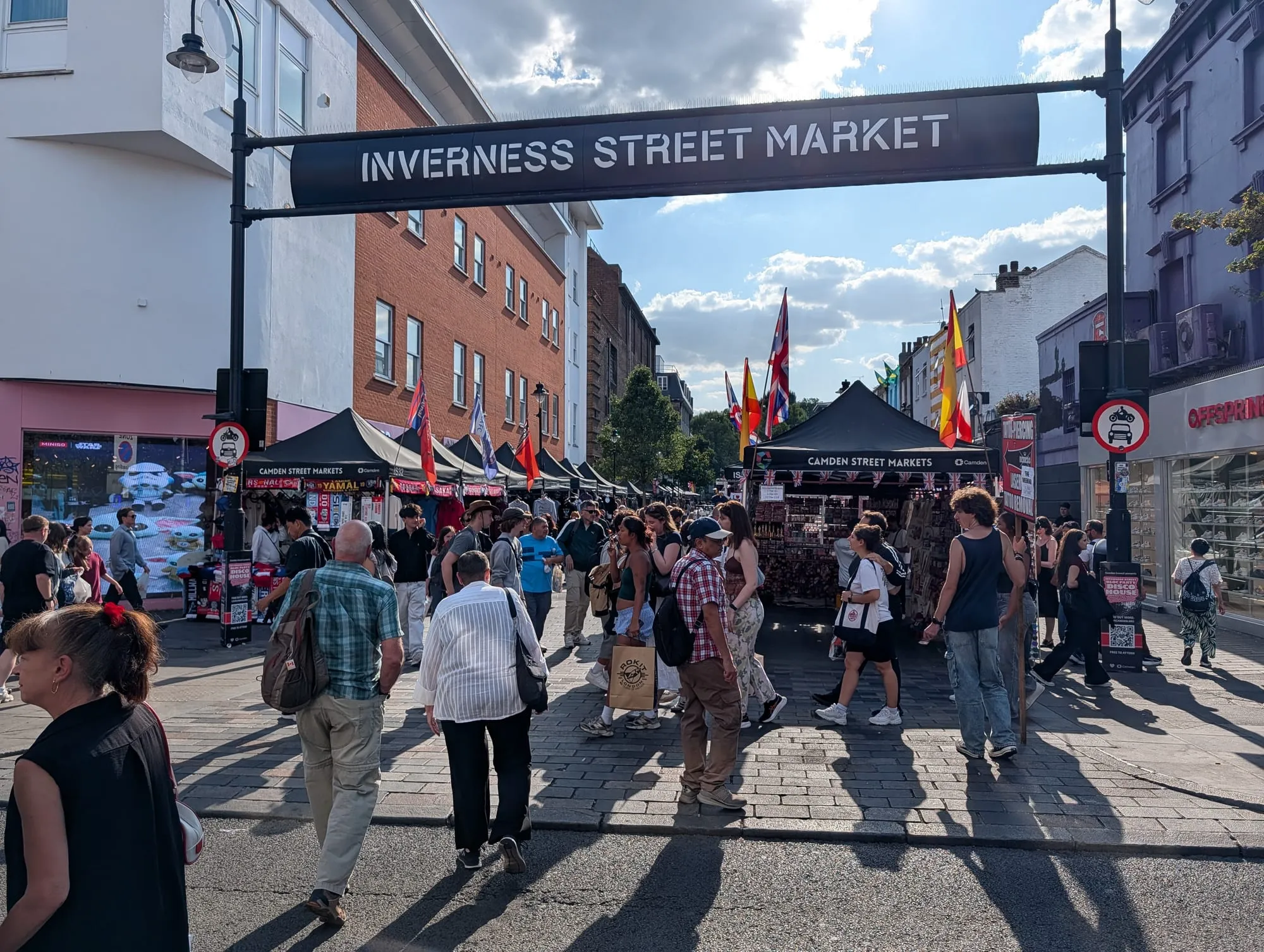
A short street market off Camden High Street, west of the crowds — produce, street food and general goods along a single row, and the part of Camden that locals actually shop in rather than photograph.
It is the antidote to Camden Market, five minutes away and a different experience entirely: no tourists, no queues, and stalls selling vegetables rather than novelty T-shirts.
It is small. Twenty minutes covers it, so treat it as the calm half of a Camden trip rather than a destination — do this, then the canal, then the main market if you still want it.
Most days rather than every day, and it winds down in the afternoon. Camden Town station is two minutes away.
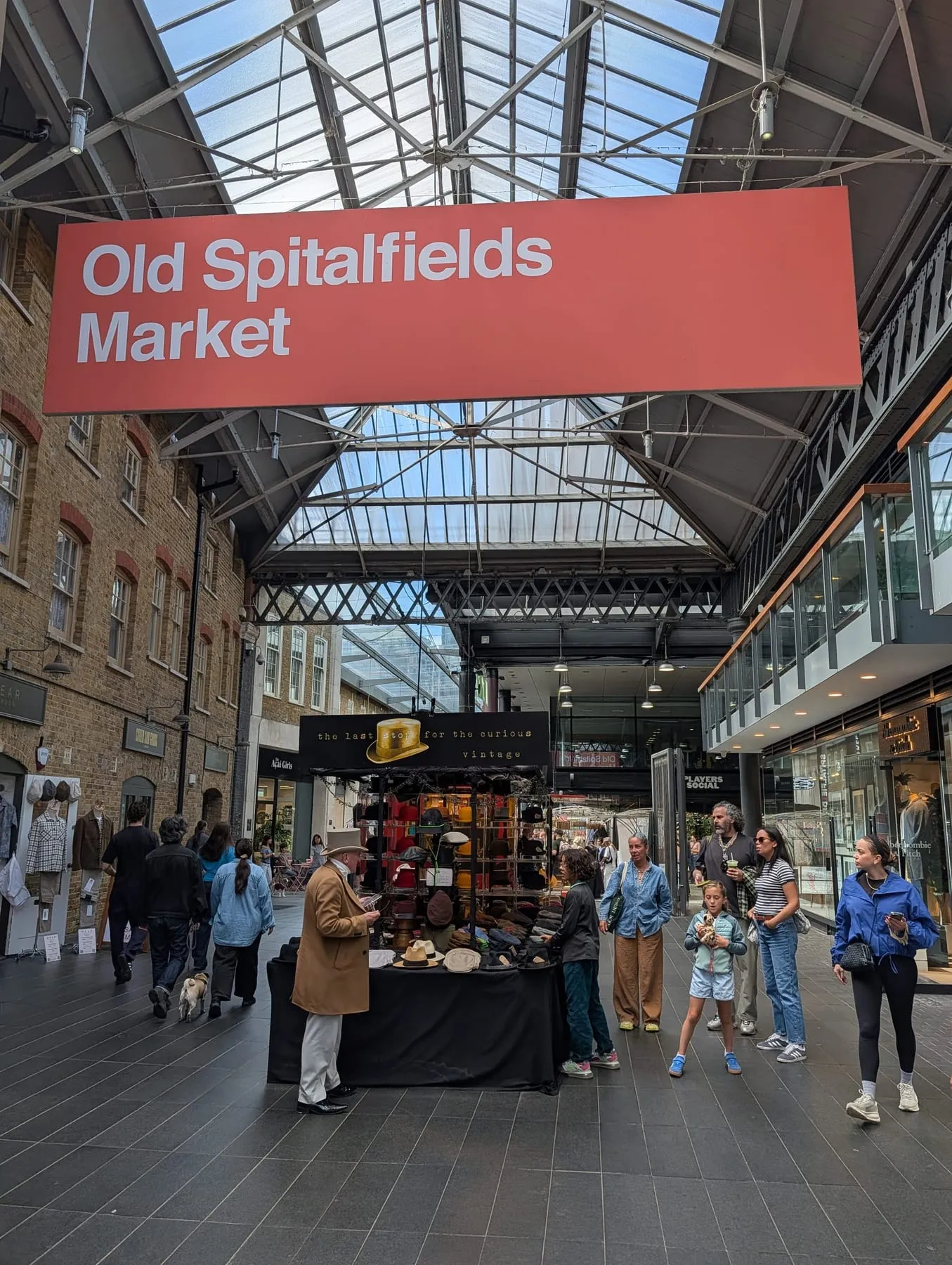
Old Spitalfields Market, Shoreditch
Most days
A covered Victorian market hall of 1887, restored and now half market and half restaurants, with a different theme on different days: antiques on Thursday, when the hall opens early at 8am; records on the first and third Friday of the month rather than every Friday; makers on Wednesday; and a general mix of independent traders, art and fashion the rest of the week.
Check the day against what you want. Turning up on a Thursday hoping for vintage clothes gets you a hall of dealers’ antiques instead, and the two crowds barely overlap.
It is entirely covered, which makes it one of the more reliable wet-weather afternoons in east London, and the food traders around the edge run all week rather than at weekends only.
16 Horner Square, E1 6EW. Liverpool Street is about five minutes and Aldgate East eight, and Brick Lane is directly behind it — so the two combine into one walk.
Camden Market, Camden Town
Every day
Camden Lock, the Stables and Hawley Wharf run together into the best-known collection of street vendors in Britain — over a thousand stalls across three connected markets, and it is busy and touristy and still good.
Weekday lunch is the same food without the crush: the food traders are there all week, and a Saturday afternoon adds queues rather than choice.
The Stables is the interesting half. Built as horse hospital and stables for the canal, it holds the antiques and vintage; Camden Lock has the food; Hawley Wharf is the newest and the most polished.
54–56 Camden Lock Place, NW1 8AF, five minutes from Camden Town station — which is exit-only on Sunday afternoons, so plan to leave from Chalk Farm instead.
Greenwich Market, Greenwich
Most days
Trading since 1737 and the only London market inside a World Heritage site — a small covered hall of designer-makers, antiques and a good run of food stalls, roofed in glass and timber.
The stall line-up changes day to day, which is unusual: some traders are weekend-only, others run midweek, and the theme shifts with them. It is busiest at weekends, and a weekday visit is quieter but thinner.
It is compact enough to do in half an hour, which makes it the right anchor for a Greenwich day — the Old Royal Naval College, the Cutty Sark and the free park viewpoint are all within ten minutes.
Cutty Sark DLR is three minutes away. The market is covered, so it works in rain when the rest of Greenwich does not.
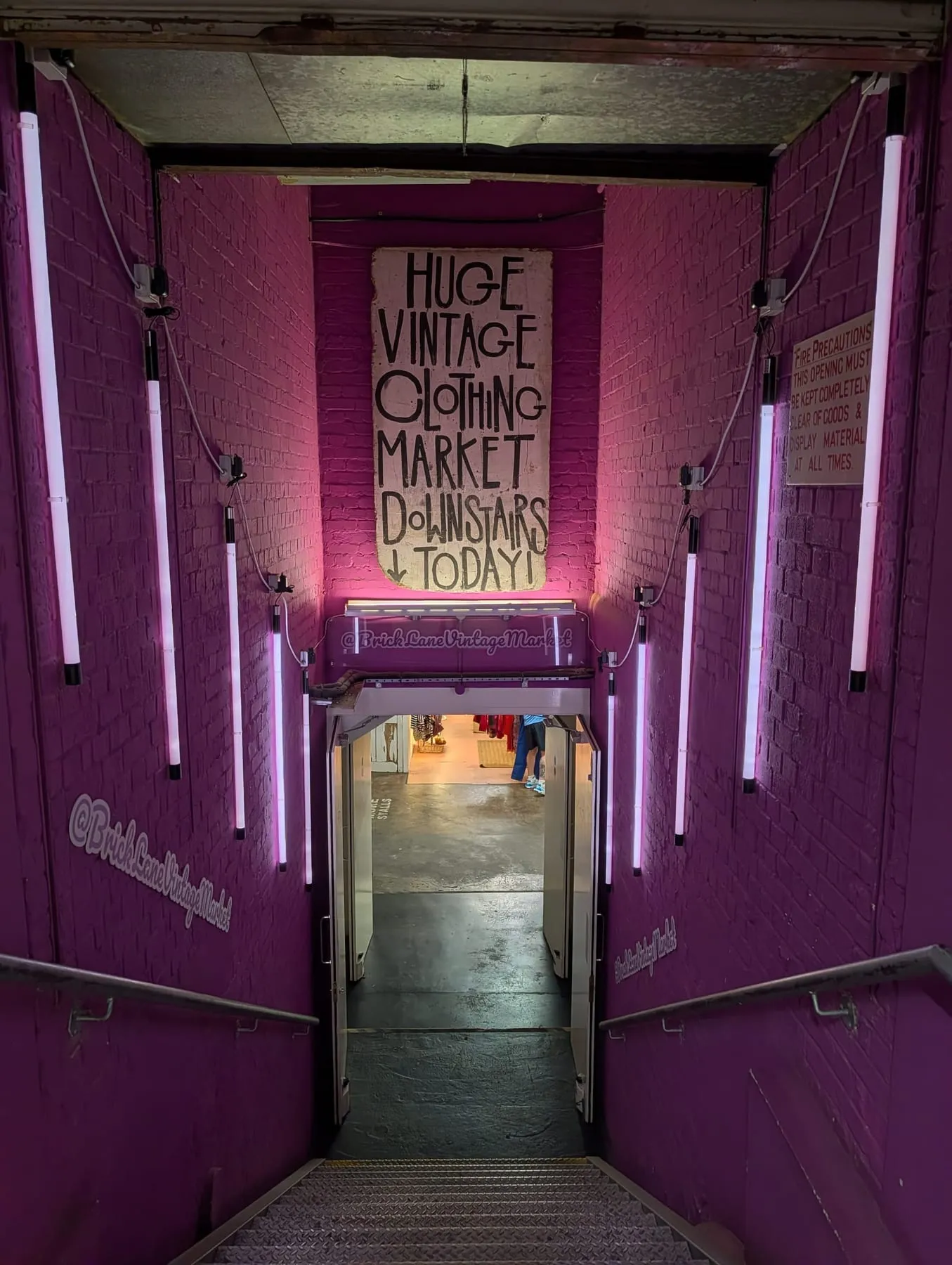
Brick Lane Market, Shoreditch
Sundays for the whole stretch · the Vintage Market daily
On Sundays the whole stretch turns into a patchwork of markets — Upmarket, Backyard Market and the Old Truman Brewery yards — selling vintage clothes, records, antiques and some of the best street food in east London. Chaotic, crowded and much larger than it looks from the street.
The Brick Lane Vintage Market itself runs seven days a week, in the basement at F Block, 85 Brick Lane: Mon–Fri 11am–6.30pm, Sat 11am–6pm, Sun 10am–6pm. It is the biggest vintage market in London and covers the 1920s to the 1990s — so if you only want the clothes and records, come on a weekday and skip the crowds entirely.
Go early on a Sunday if you want the vintage, late if you want the food. Our Shoreditch and Spitalfields walking route → strings Columbia Road, Brick Lane, Spitalfields and Petticoat Lane into one numbered walk with the days set out stop by stop.
Alfies Antique Market, Marylebone
Tue–Sat · Church Street
Britain’s largest indoor antiques market, four floors of it in an old Edwardian department store on Church Street, with a rooftop café most people never find — go to the top rather than stopping at the first floor.
Twentieth-century design, vintage fashion and jewellery rather than genuine antiques in the auction-house sense, spread across around a hundred independent dealers who each keep their own unit.
Closed Sundays and Mondays, open Tuesday to Saturday — which is the reverse of most London markets and the reason people turn up to a locked door at the weekend.
Church Street around it is the rest of the trade, with more antiques shops either side, so the market is the anchor of a street rather than the whole of it.
Edgware Road and Marylebone stations are each about eight minutes.
Brixton Village and Market Row, Brixton
Daily · covered arcades
Two covered arcades off Electric Avenue that went from near-derelict to one of the best places to eat in south London — and still hold the Caribbean grocers, fishmongers and butchers that were there first.
The mix is local: a Colombian bakery next to a record shop next to a family greengrocer, and the restaurants pay rent alongside the market traders rather than replacing them.
Most of the food is small, independent and cash-friendly rather than card-only, and the units seat a dozen people, so an evening here means eating early or waiting.
Both arcades are covered and open most days, though individual traders keep their own hours and the restaurants run later than the shops — so a daytime visit and an evening one give you two different places.
Brixton station is two minutes and Electric Avenue is directly outside, which Eddy Grant named the song after.
Victoria Park Market, Hackney
Sundays · east London
Street food, groceries, fashion and cut flowers on the edge of Victoria Park, and the one east London market still mostly locals rather than visitors — no vintage stalls, no tour groups, and prices to match.
Sundays only, roughly 10am to 4pm, on Bonner Gate Plaza at the western edge of the park.
Combine it with the park. Victoria Park is the oldest public park in Britain, and the natural plan is to buy lunch at the market and walk into it — there is a boating lake and a pavilion café inside.
Hackney Wick and Bethnal Green are each about fifteen minutes’ walk: there is no station close, and that is precisely why it has stayed a local market.
Covered and historic
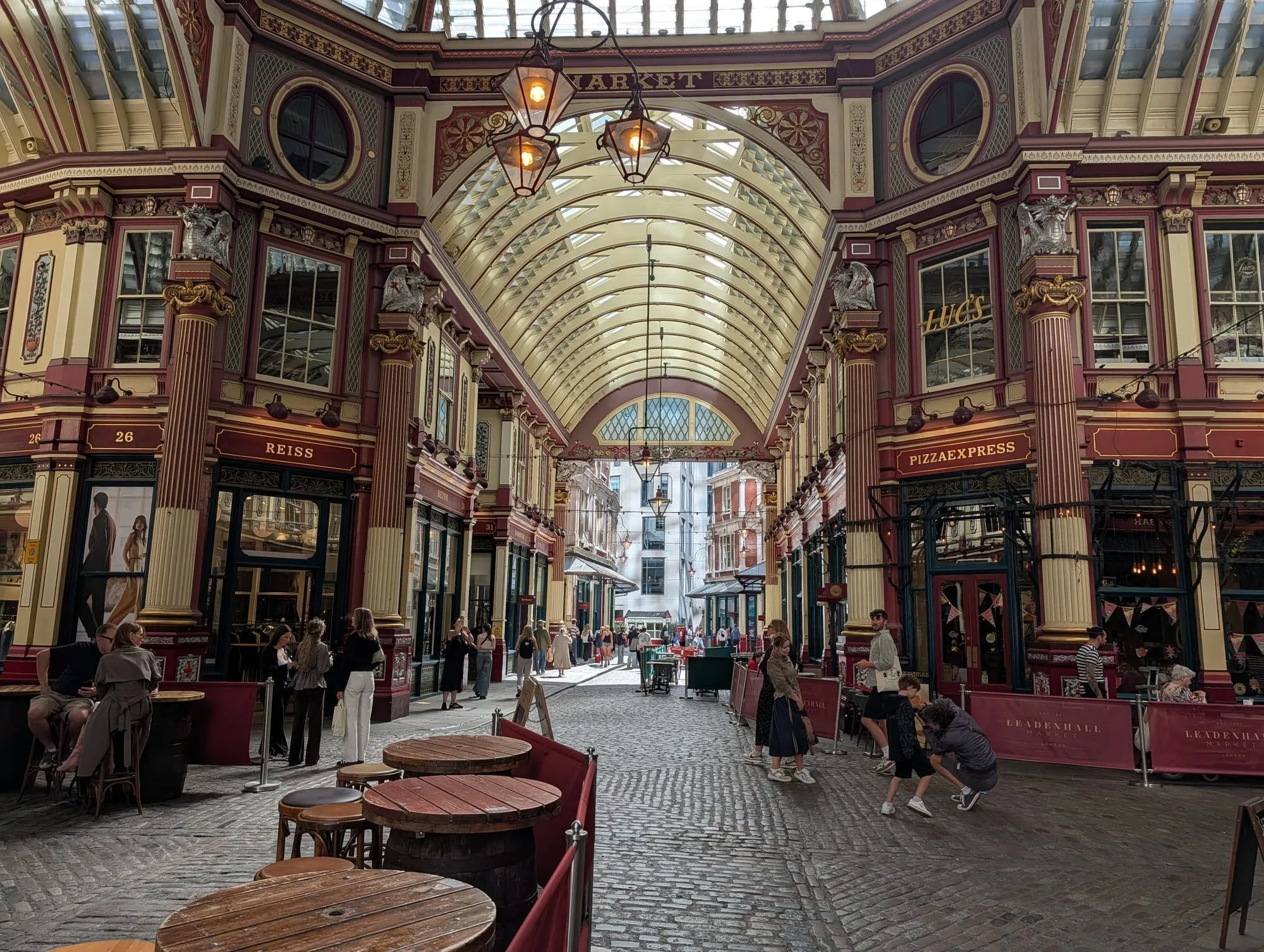
Leadenhall Market, City of London
Free · weekdays
An 1881 covered market in cream, maroon and green wrought iron, standing on the site of the Roman forum and rebuilt by Horace Jones, who also designed Billingsgate and Tower Bridge. It played the London streets leading to the Leaky Cauldron in the first Harry Potter film, and the blue door used as the Leaky Cauldron entrance, on Bull’s Head Passage, is now the Two Eyes Coffee House.
It is not really a market any more. The stalls are gone; what trades now is shops, bars and restaurants under the ironwork, so come for the building rather than to buy anything.
⚠️ It keeps City hours and is effectively dead at weekends. Monday to Friday is when the units are open, and around six on a weekday evening is when it is fullest and best. A Sunday visit gets you a beautiful empty arcade and nothing else.
Gracechurch Street EC3V 1LT, two minutes from Bank or Monument. Free, roofed, and open to walk through at any hour even when the shops are shut.
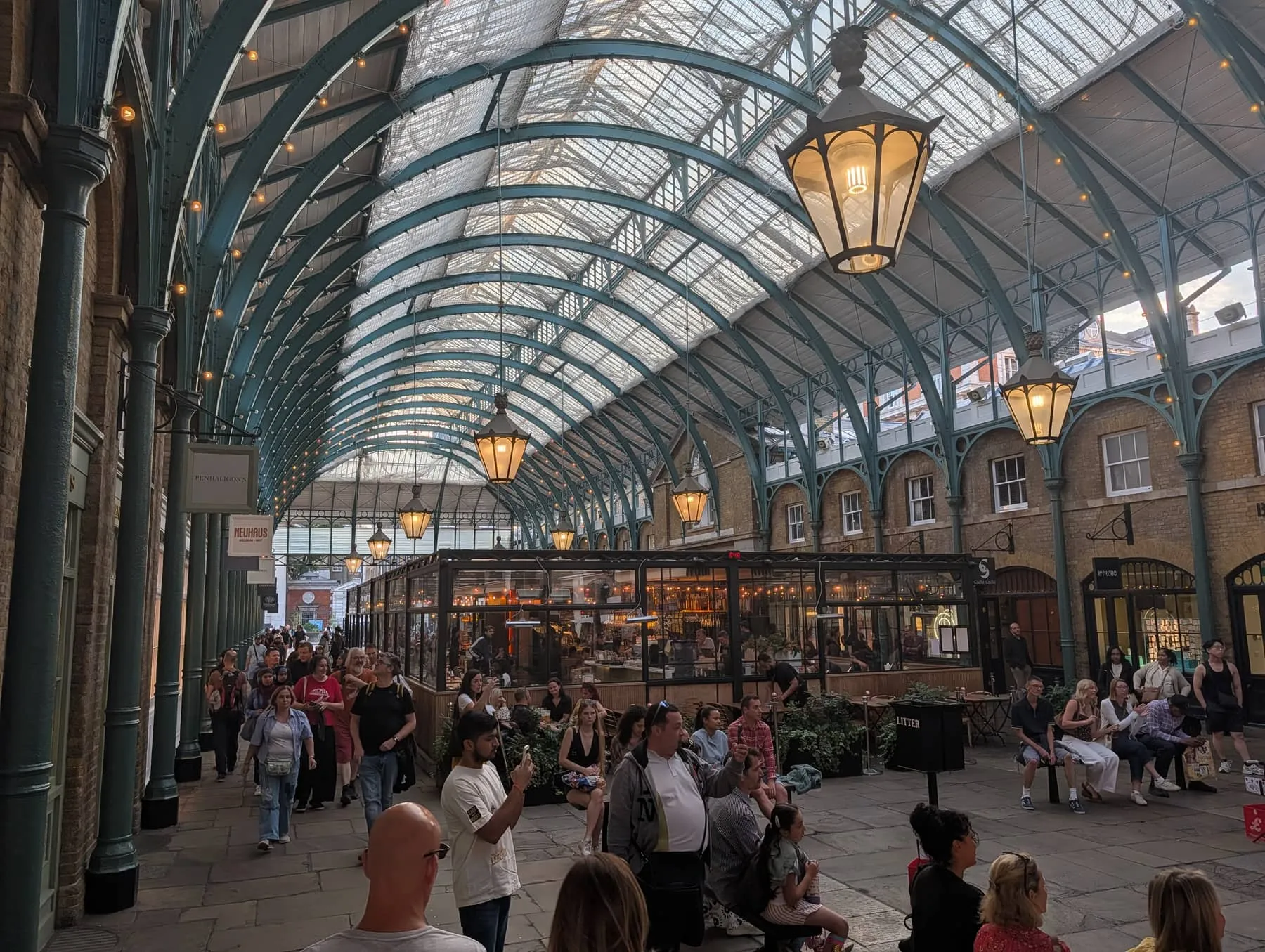
The Apple Market, Covent Garden
Daily
Under the glass roof of Charles Fowler’s 1830 market building — antiques on Monday, crafts and general goods the rest of the week, from about 10am to 6pm daily.
Monday is the day worth planning around. The antiques dealers only appear then, and it is also the quietest day in Covent Garden, so you get the better stalls and room to look at them.
The traders are vetted and many make what they sell, which is the difference between this and the Jubilee Market hall on the south side — that one is cheaper and closer to a general market.
The street performers under the glass in the North Hall are classical musicians rather than jugglers, because those pitches are balloted separately. Free to watch; they pass a hat.
Free to walk through, roofed, and open every day, which makes it a reliable wet-weather hour. Covent Garden station is two minutes, but it is exit-only at busy times — Leicester Square is often faster.
Not markets, but sold as them
Check the difference before you plan a morning around one.
- Battersea Power Station — 150 shops and restaurants inside Gilbert Scott’s power station. A shopping centre in an extraordinary building.
- The King’s Road, Chelsea — a shopping street with history rather than a market. Mary Quant opened Bazaar here in 1955.
- Coal Drops Yard, King’s Cross — Heatherwick’s converted coal drops, now retail.
What things cost, and the free part
Markets are the cheapest good food in London and one of the few free things to do that is not a museum.
- Walking round costs nothing. Borough, Spitalfields, Columbia Road, Portobello, Camden and Leadenhall are all free to enter and worth an hour on their own. Columbia Road on a Sunday morning is one of the best free hours in London.
- Street food runs roughly £8–£14 a dish across Borough, Maltby Street and Brick Lane — cheaper than a restaurant, more expensive than a supermarket, and the quality at the top end matches restaurants charging double.
- Go at closing time for flowers. Columbia Road traders cut prices hard in the last hour, and the shouting is half the entertainment.
- Borough’s free samples are real. The cheese, charcuterie and oil stalls expect you to taste, and a slow circuit of the market is close to a free lunch, though buying something is the decent thing.
- Billingsgate is free to walk into and over by 8am. Bring cash and a cool bag.
- Maltby Street is cheaper than Borough for the same standard of food, ten minutes away, at weekends only.
What to know
- Check the day. Columbia Road is Sunday, Broadway Market is Saturday, Leadenhall trades on City hours, so weekdays. See our markets by day page.
- Borough on a Tuesday is a completely different and better experience than Borough on a Saturday.
- Columbia Road’s last hour is when the prices collapse.
- Billingsgate is over by 8am. It is not a late-morning activity.
- Most food markets take cards, but a few of the smaller antiques dealers still prefer cash.
Continue planning your London trip
- 🇵🇭 The Best Filipino Restaurants in London — the Filipino counters at Seven Dials and both Boxparks
- 🥥 The Best Sri Lankan Restaurants in London
- 🛍️ Shopping in London — the streets, stores and arcades around the markets- 🛍️ London Markets by Day
- 💷 Cheap Eats in London
- 🍽️ Eat in London: Restaurants, Food Markets & Quick Food Hub
- 🎪 Free Things to Do in London
- 🎨 Shoreditch Area Guide
- 🎭 Camden Area Guide
Common questions
What is the best market in London?
Borough Market for food, Columbia Road for flowers, Portobello for antiques and Broadway Market for a Saturday. Which is best depends entirely on what day you are there — several only exist one day a week.
Which London markets are open every day?
Borough, Camden, Greenwich, Leadenhall and Old Spitalfields all trade most days. Columbia Road is Sunday only and Broadway Market is Saturday only — turning up on the wrong day is the most common way to waste a morning here.
Where can I eat at a London market?
Maltby Street is built around hot food. Borough has both traders and produce. Columbia Road and Portobello are shopping markets where the food is incidental — good, but not the reason to go.
Is Camden Market worth visiting?
Yes, but know what it is — Camden Lock, the Stables and Hawley Wharf run together into the best-known collection of street vendors in Britain. It is busy, touristy and still enjoyable. Go on a weekday morning if you dislike crowds.
Can you visit Billingsgate Fish Market?
Yes. It is the UK's largest inland fish market, trades before dawn a few minutes from Canary Wharf, and the public can buy. Go very early — it is finished by about 8am.