In this guide
More than a thousand official blue plaques exist in London, and the pleasure of them is entirely in the specifics: Mozart wrote his first symphony in Belgravia aged eight, Engels hosted Marx in Primrose Hill for twenty years, and Handel and Hendrix lived in adjoining Mayfair houses two centuries apart.
This is a guide to the ones worth building a walk around.
🗺️ See every one of them on our interactive map →. Every London plaque, official and unofficial — search by name or inscription, filter by colour or subject, and find what’s near you.
💡 The Short Version: Belgravia has Mozart, Mary Shelley, Fleming and Tennyson in one short walk. Bloomsbury has Dickens, Darwin and Keynes. Mayfair has Handel and Hendrix next door to each other, and both houses are open as one museum. St James’s has the oldest surviving plaque in London, put up in 1867 while its subject was still alive and still ruling France.
📘 How we choose these (editorial note). No paid placements. These are drawn from a wide spread of sources rather than any single list - the food and travel press, the big listings sites, independent blogs and specialists, video, and what Londoners recommend themselves - and cross-referenced against each other. These are English Heritage plaques unless noted. Nearly all mark private homes, not anywhere you can go inside.
Where they are
| If you are near… | Who lived there |
|---|---|
| Belgravia | Mozart, Mary Shelley, Ian Fleming, Tennyson |
| Bloomsbury | Dickens, Darwin, Keynes, the Bloomsbury Group |
| Mayfair | Handel, Jimi Hendrix |
| Marylebone | Dickens, Elizabeth Barrett Browning |
| Primrose Hill & Camden | Engels, Sylvia Plath, Orwell |
| Bayswater | J.M. Barrie |
| Chelsea | Oscar Wilde, Bram Stoker |
| Hampstead | Keats, Sigmund and Anna Freud |
| St James’s | Napoleon III — the oldest surviving plaque |
| Kensington | T.S. Eliot |
| Soho | Karl Marx, Willy Clarkson |
| Stockwell | Vincent van Gogh |
The oldest one, and the one that is not there
The scheme is the oldest of its kind in the world, and English Heritage did not start it. The Society of Arts did, after the MP William Ewart proposed the idea in Parliament in 1863. It was founded in 1866 and the first plaques went up in 1867. Custody passed to the London County Council in 1903, the Greater London Council in 1966, and English Heritage in 1986.
The early plaques were not blue. Makers experimented with brown, terracotta, green, bronze, lead and stone; blue ceramic only became standard in 1921, and the simplified design still used today was drawn in 1938 by an unnamed student at the Central School of Arts and Crafts.
The first plaque: Lord Byron, Holles Street
⚠️ It is not there. The very first plaque of the scheme marked Byron’s supposed birthplace on Holles Street, off Cavendish Square. The house was demolished in 1889 and John Lewis occupies the site. No evidence has ever been found that Byron was actually born at that number, so it may have been wrong from the start.
Napoleon III, 1c King Street, St James’s
Free · 1867 · the oldest surviving plaque in London
NAPOLEON III LIVED HERE 1848, in nine words on the wall of a building in St James’s.
It is the earliest surviving plaque in London and the only one ever put up while its subject was still alive — he was ruling France at the time. Under today’s rules, which require twenty years to have passed since the subject’s death, it could not exist.
Free, on a public street, visible at any hour. It is on King Street between St James’s Square and St James’s Street, and it is easy to walk past: the wording is terse and the plaque is set higher than most.
Three more of London’s oldest plaques are within ten minutes, which makes St James’s the best short walk for anyone interested in the scheme itself, not the people on it. Green Park and Piccadilly Circus are each about five minutes.
Only 15% of London’s blue plaques commemorate women. Since 2016, more than half of new awards have gone to women, which is the scheme trying to correct a hundred and fifty years of arithmetic.
Belgravia: Mozart, Fleming and Mary Shelley
Four plaques and fifteen minutes, and the tightest cluster in the city — Mozart at 180 Ebury Street and Ian Fleming at 22 are eight minutes apart on one residential street.
🗺️ We have this as a full walking route → — eleven numbered stops from Cheyne Walk to Belgrave Square with a map, a Google Maps link and the opening days, joining these Belgravia plaques to the Chelsea ones. The two areas together hold 184 blue plaques, which is the denser story.
Mozart’s Belgravia Home
Mozart composed his first symphony here in 1764, aged eight, during his family’s fifteen-month stay in London — written while his father was ill and the children were forbidden to touch the harpsichord, which is why it exists at all.
180 Ebury Street. A private house, so this is a look from the pavement — free, at any hour, and there is nothing to go into.
Ebury Street alone carries two of the plaques on this page: Mozart at 180 and Ian Fleming at 22, about eight minutes apart on the same street. Walking between them is the most efficient plaque-hunting in London.
Victoria and Sloane Square stations are each about ten minutes from the middle of it.
Mary Shelley’s Belgravia Home
Shelley spent her last years here, decades after writing Frankenstein at eighteen — a very different London chapter from the Gothic summer everyone knows, and she died in this house in 1851.
24 Chester Square, one of Belgravia’s grand stucco garden squares. A private residence, viewable from the pavement only, free and at any hour.
The square garden itself is private and railed, so you look at the house across it rather than walking through.
It is about five minutes from the Ebury Street pair, which makes a four-plaque Belgravia walk — Mozart, Fleming, Tennyson and Shelley — comfortable in half an hour. Sloane Square is the nearest station.
Ian Fleming’s Belgravia Home
Fleming was born and grew up on this street — the creator of James Bond, in a setting rather more respectable than anything he wrote.
22 Ebury Street. Private, pavement-only, free, no hours.
It is the same street as Mozart’s, eight minutes apart, which is the best coincidence in London’s plaque scheme: the composer of a first symphony at eight and the inventor of a fictional spy, commemorated on the same Belgravia terrace.
For the Bond connection you can actually go inside, Rules in Covent Garden is written into Spectre as his regular, and Dukes Bar in St James’s makes the martini — both about twenty minutes away and both covered elsewhere on this site.
Lord Tennyson’s Belgravia Home
Tennyson stayed here during his decades as Poet Laureate, the period that produced The Charge of the Light Brigade and In Memoriam.
9 Upper Belgrave Street. Private, viewable from the street, free and unrestricted — like almost every plaque in this section.
This is the quietest corner of the Belgravia walk. Upper Belgrave Street runs between Belgrave Square and Eaton Square, both private garden squares, and there is almost no through traffic and nothing commercial — which makes it pleasant to walk and completely dead if you wanted a coffee.
Hyde Park Corner is the nearest station, about six minutes, and Victoria about ten.
Bloomsbury
Charles Dickens’s Bloomsbury Home
Now a museum
Dickens wrote Oliver Twist and Nicholas Nickleby here — the only one of his London homes still standing, and the only plaque on this page you can walk into.
48 Doughty Street, now the Charles Dickens Museum: a paid museum with set opening hours, not a street plaque, laid out as the house was when he lived in it, with his desk and the rooms in sequence.
He was here under three years, from 1837 to 1839, which is a remarkably short tenancy for the amount of work that came out of it.
Check the day before travelling — it is a small independent museum and does not open every day of the week. Russell Square and Chancery Lane are each about eight minutes’ walk.
John Maynard Keynes’s Bloomsbury Home
Keynes was part of the Bloomsbury Group centred on Gordon Square, and his economic theory reshaped twentieth-century policy from an address most people walk past without looking up.
46 Gordon Square, now university buildings — viewable from the pavement, free, and the campus is generally open to walk through in the daytime.
Gordon Square is the densest plaque square in London. Virginia Woolf, Vanessa Bell, Lytton Strachey and Keynes all lived on it at various points, and the group takes its name from the district around it. The garden in the middle is public and open in daylight.
It is two minutes from Euston Square and five from Russell Square, and it is the natural centre of the Bloomsbury walk below.
Charles Darwin at UCL
A rare institutional plaque rather than a home address, marking Darwin’s connection to the university, not a house he slept in.
On the Biological Sciences Building, UCL, Gower Street. Free, viewable from the street, and the campus is generally open to walk through in the daytime — so you can get closer than you can to most plaques on this page.
This one is unusual. The scheme overwhelmingly marks homes, so an institutional plaque means the connection was to the work, not the address — Darwin’s own Bloomsbury house on Gower Street was demolished long ago.
UCL’s front quad is two minutes away and stood in for the British Museum’s exterior in The Mummy Returns. Euston Square and Warren Street are both about five minutes.
The Bloomsbury squares — Russell, Bedford, Gordon, Tavistock and Bloomsbury — can be walked in an hour, and between them carry the highest concentration of literary plaques in the city.
Mayfair: Handel and Hendrix
Two musicians, adjoining houses, two centuries apart — and both are open to visit, which almost no other plaque address is.
Handel lived and composed Messiah at 25 Brook Street, W1K 4HB. Jimi Hendrix lived next door at 23 Brook Street, W1K 4HA in 1968–69, and reportedly went out and bought a copy of Messiah when he found out who his neighbour had been.
The two houses are now a single museum, Handel Hendrix House, and it is the only place in London where you can walk from one plaque’s interior into the other’s.
English Heritage say 18 houses in London carry two official plaques. This pair is on adjoining buildings, not one, but it is the famous example.
Primrose Hill and Camden
Friedrich Engels’s Primrose Hill Home
Engels lived here for over twenty years, hosting Karl Marx regularly — a plaque for one half of one of history’s most consequential collaborations, in what is now one of the most expensive streets in north London.
122 Regent’s Park Road. Private, pavement-only, free, no hours.
Marx’s own Soho plaque is at 28 Dean Street, and the pairing is this: Marx living in two rooms above what is now a restaurant while Engels, who was funding him, had a comfortable villa up here. They are about forty minutes apart on foot, or fifteen on the Northern line.
Chalk Farm is five minutes away, and Primrose Hill itself is two streets up — one of the protected panoramas, free, and open 24 hours except on summer weekend nights.
Sylvia Plath’s Primrose Hill Home
Plath and Ted Hughes lived here from 1960 to 1961, early in their marriage. The Yeats house is round the corner at 23 Fitzroy Road, where she moved after they separated, taking it as a good omen that W.B. Yeats had lived there as a boy, and where she died in 1963.
3 Chalcot Square. Private, viewable from the pavement, free at any hour.
The square is the one from the Paddington films, its pastel terraces used for the Brown family’s Windsor Gardens and, from the other side, Phoenix Buchanan’s house in the sequel. So the same fifty metres carries a Plath plaque and two films, and almost nobody visiting for one knows about the others.
It is a residential square where people live — look from the pavement, do not linger on doorsteps. Chalk Farm is five minutes, and the Engels plaque is about eight minutes away.
George Orwell’s Kentish Town Home
One of several Orwell addresses across London, marking a working writer’s lodgings rather than a grand literary residence.
50 Lawford Road, Kentish Town. Private, pavement-only, free.
He has more London plaques than almost anyone, because he moved constantly and wrote about all of it. This one covers the period when he was working in a Hampstead bookshop, the experience behind Keep the Aspidistra Flying.
It is the least visited plaque on this page and there is nothing else on the street — an ordinary Victorian terrace in a residential pocket. Kentish Town station is about eight minutes, and it only makes sense combined with the Primrose Hill pair, not as a trip of its own.
Kensington
T.S. Eliot, 3 Kensington Court Gardens
Free · W8 5QE
“Lived and died here” — one of the small number of plaques that marks both, and in Eliot’s case it covers the last eight years of his life. He moved into the mansion flat after marrying Valerie Fletcher in 1957 and died there in January 1965.
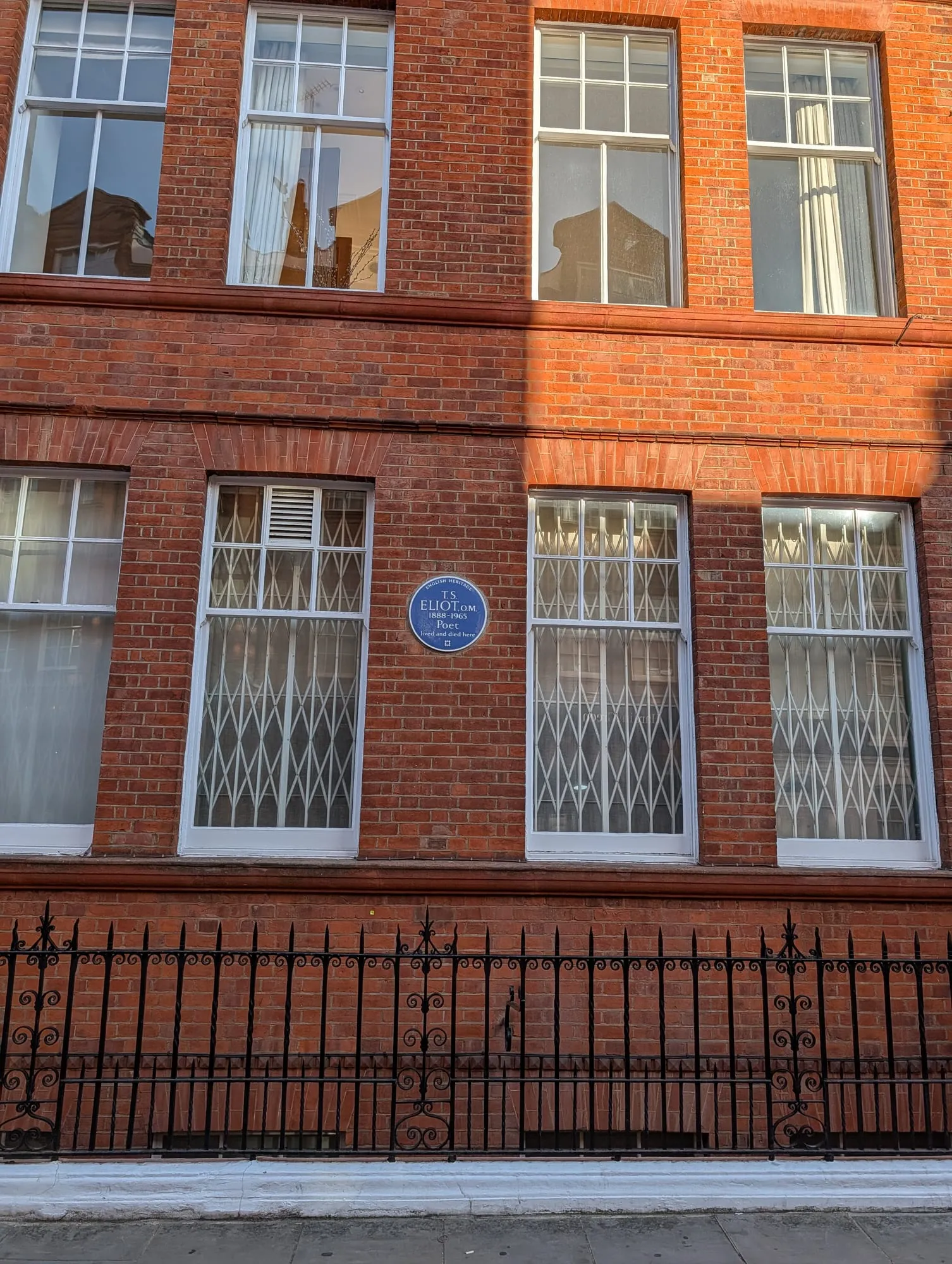
Free and visible from the pavement, on a quiet residential street a few minutes from High Street Kensington. The plaque sits at first-floor level on plain red brick, which makes it easier to photograph than most — no scaffolding, no shopfront, no crowd.
It is a very ordinary building for a very large reputation, which is rather the point of the scheme. Kensington Gardens is ten minutes north if you want to make a walk of it.
Soho and the City
Karl Marx, 28 Dean Street, Soho
Free · W1D 3RY
Marx lived here in poverty in the 1850s, in two rooms with his family, walking daily to write in the British Museum Reading Room. It is the surviving Marx plaque — the earlier one at 41 Maitland Park Road in Belsize Park was vandalised twice by fascist sympathisers, the owner refused to have a third put up, and the house was later demolished.
Free and visible from the pavement. The ground floor is now Quo Vadis, the restaurant celebrating its centenary in 2026, so this is one of the few plaques with a good lunch directly beneath it — the smoked eel sandwich at the bar is £18.50 and needs no booking.
Engels’s plaque is at 122 Regent’s Park Road, and the contrast is this: Marx in two Soho rooms, funded by Engels in a Primrose Hill villa. Fifteen minutes apart on the Northern line.
Marx’s plaque is stop three on our Soho and Chinatown walk, which also passes Mozart’s on Frith Street, Baird’s on the Bar Italia building and Ronnie Scott’s at his first club on Gerrard Street.
Willy Clarkson, 41–43 Wardour Street, Soho
Free · W1D 6PY
A theatrical wigmaker to the Victorian and Edwardian stage, and the plaque says simply that he “lived and died here.” The building’s foundation stone was laid by Sarah Bernhardt in 1904, and the coping stone is credited to Henry Irving the following year, though historians doubt he did it in person.
Free, on Wardour Street, visible at any hour — and worth looking down as well as up, because both ceremonial stones are still in the frontage.
It is the most Soho plaque in the scheme: a man who made wigs and false beards for the entire West End, commemorated on a street that is now bars and post-production houses. Clarkson also supplied disguises to rather less theatrical clients, which is part of why the name survives.
Piccadilly Circus and Leicester Square are each about four minutes, and the Karl Marx plaque is five minutes north.
Dr Samuel Johnson, 17 Gough Square
Free · and not blue
The only plaque the official scheme has inside the City of London, put up by the Society of Arts in 1876 — and it is brown terracotta, from the years before the design was standardised.
The reason there is only one is jurisdictional, not historical: the City is excluded from the English Heritage scheme because the City of London Corporation runs its own, with around 140 plaques of its own — so the City is not short of plaques, just of these ones.
Gough Square is a genuine hidden square, reached down narrow alleys off Fleet Street and easy to miss entirely. Dr Johnson’s House at number 17 is a museum you can go into — the garret where he compiled the Dictionary is the top floor — and it is ticketed with limited opening days.
Hodge, Johnson’s cat, has his own statue in the square, sitting on a copy of the Dictionary beside a pair of oyster shells. Free, always there, and the best thing in the square.
Chancery Lane is about five minutes; Ye Olde Cheshire Cheese, Johnson’s local, is two.
Vincent van Gogh, 87 Hackford Road, Stockwell
Free · SW9 0RE
Where Van Gogh lodged as a young art dealer in his twenties, years before he had painted anything at all. One of the very few plaques marking somebody before they became the person the plaque is for.
87 Hackford Road, Stockwell. Free and visible from the pavement — a plain south London terrace with nothing else to see, which is itself the point.
The house was restored and has opened for occasional public visits, run as an artists’ residency rather than a museum, so access is by advertised event, not fixed hours. Do not turn up expecting a door to open.
It is the furthest plaque on this page from the others and does not combine with anything. Stockwell is about ten minutes’ walk, Oval about the same — go because you want this one, not as part of a route.
Elsewhere
- J.M. Barrie, Bayswater — lived facing Kensington Gardens, where Peter Pan is set and where his statue of the character stands.
- Oscar Wilde, Chelsea — the Tite Street house he was living in when he was arrested.
- Bram Stoker, Chelsea — where Dracula was written.
- Keats, Hampstead — Keats House is open, and the garden has a descendant of the plum tree he wrote Ode to a Nightingale under.
- Sigmund and Anna Freud, 20 Maresfield Gardens, Hampstead NW3 5SX — father and daughter on one house, now the Freud Museum, with his actual couch. Anna lived and worked there for 44 years.
- George Bernard Shaw and Virginia Woolf, 29 Fitzroy Square — two literary giants, the same front door, different decades.
⚠️ One to admire from a distance. The best inscription in London is Luke Howard’s at 7 Bruce Grove, Tottenham: “Namer of Clouds”, for the man who gave us cumulus, stratus and cirrus. English Heritage’s own page states the plaque is not on view to the public, so do not build a walk around it.
Beyond the walk: names famous the world over
The guide above is organised around proximity — plaques worth detouring for because several sit close together. This list is organised around something else: people whose fame has nothing to do with London at all, gathered here because their London plaque is often the only physical marker of them anywhere. Every name below is also starred on the interactive map.
Science
- Isaac Newton, 87 Jermyn Street — laws of motion and gravity, the foundation of classical physics.
- Michael Faraday, 48 Blandford Street — electromagnetic induction, behind every electric motor and generator since.
- Alexander Fleming, 20a Danvers Street — discovered penicillin.
- Alan Turing, 2 Warrington Crescent — his birthplace; father of computer science and a WWII Enigma codebreaker.
- Guglielmo Marconi, 71 Hereford Road — pioneer of wireless communication, Nobel laureate.
- James Watson, 18 Vincent Square, and Francis Crick, 56 St George’s Square — separately plaqued, joint discoverers of the structure of DNA.
Music
- John Lennon, 34 Montagu Square — the Beatles, still the best-selling band in history.
- Paul McCartney, 9 Kingly Street — where he met Linda Eastman in 1967, at the Bag O’Nails club.
- David Bowie, 157 High Street, Beckenham — where his career launched at the Three Tuns pub, 1969–73.
- Freddie Mercury, 22 Gladstone Avenue, Feltham — his childhood home.
- Bob Marley, 34 Ridgmount Gardens — lived here in 1972; reggae’s best-known global ambassador.
- Fela Kuti, Greenwich Peninsula — father of Afrobeat.
- Frédéric Chopin, 4 St James’s Place — left this house in 1848 for his final public performance.
Literature
- William Shakespeare, 5 St Andrew’s Hill — bought lodgings near here in 1613, the only London property he’s known to have owned.
- Agatha Christie, 58 Sheffield Terrace — the best-selling novelist of all time, outsold only by the Bible and Shakespeare.
- Mark Twain, 23 Tedworth Square — lived here 1896–97.
- Rabindranath Tagore, 3 Villas on the Heath, Hampstead — stayed here in 1912; first non-European Nobel laureate in Literature, and author of two national anthems (India’s and Bangladesh’s).
- Natsume Soseki, 81 The Chase, Clapham — lived here 1901–02; considered Japan’s most important modern novelist, and once the face on the ¥1,000 note.
Film and dance
- Charlie Chaplin, East Street, Walworth — born here; the most recognisable figure of the silent-film era worldwide.
- Alfred Hitchcock, 153 Cromwell Road — lived here 1926–39, already directing before his most famous films.
- Rudolf Nureyev, 27 Victoria Road — widely considered the greatest male ballet dancer of the 20th century.
Art
- Pablo Picasso, Floral Street — painted a ballet backdrop here in 1919 for Diaghilev’s Ballets Russes.
- J.M.W. Turner, 40 Sandycoombe Road, Twickenham — designed and lived in this riverside house himself.
- Henry Moore, 11a Parkhill Road — lived and worked here 1929–40, before becoming Britain’s most internationally exhibited sculptor.
Politics and world leaders
- Winston Churchill, 28 Hyde Park Gate — lived and died here.
- Mahatma Gandhi, Kingsley Hall, Tower Hamlets — stayed here in 1931.
- Charles de Gaulle, 4 Carlton Gardens — set up the Free French Forces’ headquarters here in 1940.
- Simón Bolívar, 4 Duke Street — lodged here in 1810, decades before leading much of South America to independence.
- Ho Chi Minh, Haymarket — worked in 1913 at the Carlton Hotel, which stood on this site.
- Vladimir Lenin, 16 Percy Circus — stayed on this site in 1905.
Exploration
- Captain James Cook, 88 Mile End Road — a house on this site was his for some years before his Pacific voyages.
- Ernest Shackleton, 12 Westwood Hill — the Antarctic explorer of the Endurance expedition.
- Robert Falcon Scott, 56 Oakley Street — “Scott of the Antarctic.”
Other
- Robert Baden-Powell, 9 Hyde Park Gate — founded the Scouting movement, active in nearly every country today.
- Emmeline and Christabel Pankhurst, 50 Clarendon Road — mother and daughter, leaders of the women’s suffrage movement.
Not every plaque is an English Heritage plaque
Most people assume any blue disc is official. Most are not: the official scheme, with the councils that ran it before English Heritage, accounts for about a quarter of the plaques on our map of London. The City of London Corporation, the Nubian Jak Community Trust, the Heritage Foundation and several boroughs all use blue too, and a few genuine English Heritage plaques are brown, black or stone.
The quick test: if it commemorates a shop, a band, an event, a building or somebody still alive, it is not an English Heritage plaque.
For the full breakdown of the schemes, the colours and the rules, see our guide to how London’s plaques work.
What it costs
Nothing at all. Every plaque in this guide is on a public street and free to look at, which makes this the cheapest way to spend a day in London.
- The official English Heritage scheme has put up more than 1,000 plaques since its first in 1867 and is the oldest of its kind in the world. Its online map is free and searchable.
- Other bodies run their own — councils, the City of London Corporation, the Heritage Foundation, the Nubian Jak Trust and dozens of local societies — so a plaque that is not blue is not necessarily unofficial.
- Combine them with a walk. Marylebone, Bloomsbury, Chelsea and Hampstead have the highest density, and a plaque route through any of them costs nothing and takes an afternoon.
- The buildings are usually private homes. The plaque on the wall is the whole of the visit.
What to know
- The criteria are strict — 20 years since death, a surviving building outside the City, visible from the street. Churches, schools and theatres are not normally considered because too many people passed through them. The full rules, and how the other schemes differ.
- English Heritage publish a searchable map of every official plaque, which is more complete than any guide.
- Four addresses are open to the public: Handel Hendrix House, the Charles Dickens Museum, Keats House and the Freud Museum. Everything else is somebody’s front wall.
- New plaques go up every year. 2025 brought Audrey Hepburn and Marc Bolan among others; the 2026 round includes the astronomer Cecilia Payne-Gaposchkin in Notting Hill and Laurence Olivier in Pimlico. Announcement and installation are not the same day, so check before travelling for a brand-new one.
Continue planning your London trip
- 🗺️ Every plaque in London on one map
- 🎬 London Filming Locations
- 🏰 Historic Houses in London
- 🎪 Free Things to Do in London
- 📚 Bloomsbury Area Guide
- 🌳 Hampstead Area Guide
- 🛍️ Mayfair Area Guide
Common questions
How many blue plaques are there in London?
More than 1,000 under the official English Heritage scheme, plus several thousand more from borough councils, the City of London Corporation and independent bodies. This guide picks out the ones worth building a walk around, not trying to list them all.
What is the oldest blue plaque in London?
The oldest survivor marks Napoleon III at 1c King Street, St James's, and dates from 1867. The very first plaque went up the same year for Lord Byron on Holles Street, but that house was demolished in 1889 and John Lewis stands on the site.
Which London area has the most blue plaques?
Marylebone, Bloomsbury and Belgravia have the densest concentrations. Belgravia alone has Mozart, Mary Shelley, Ian Fleming and Tennyson within a short walk.
Can you go inside blue plaque houses?
Almost never — nearly all are private homes. The exceptions are the ones that became museums: Handel Hendrix House in Mayfair, the Charles Dickens Museum in Bloomsbury, Keats House in Hampstead and the Freud Museum.
How do you get a blue plaque?
English Heritage require that at least 20 years have passed since the subject died, that a building associated with them survives in Greater London outside the City, that it survives in a form they would recognise, and that it is visible from a public highway. Only one plaque is put up per person and no more than two on any one building. Anyone can nominate.
Which world-famous, non-British figures have blue plaques in London?
More than you'd expect — Mahatma Gandhi, Vladimir Lenin, Simón Bolívar, Ho Chi Minh, Charles de Gaulle, Mark Twain, Rabindranath Tagore and Natsume Soseki all lodged, worked or stayed in London long enough to earn one. See the 'Beyond the walk' section above for the full list, alongside worldwide names in science, music, film and art.