In this guide
At a glance
- Vibe
- Academic and leafy, with the calmest streets in central London
- Time needed
- Half a day, or a full day with the British Museum
- Best day
- Weekdays; the British Museum is busiest at weekends
- Travel zone
- 1
- Walkability
- 5/5
- Typical spend
- ££
Best for
Nearest stations
- Russell SquarePiccadilly
- HolbornCentralPiccadilly
- Tottenham Court RoadElizabeth lineCentralNorthern
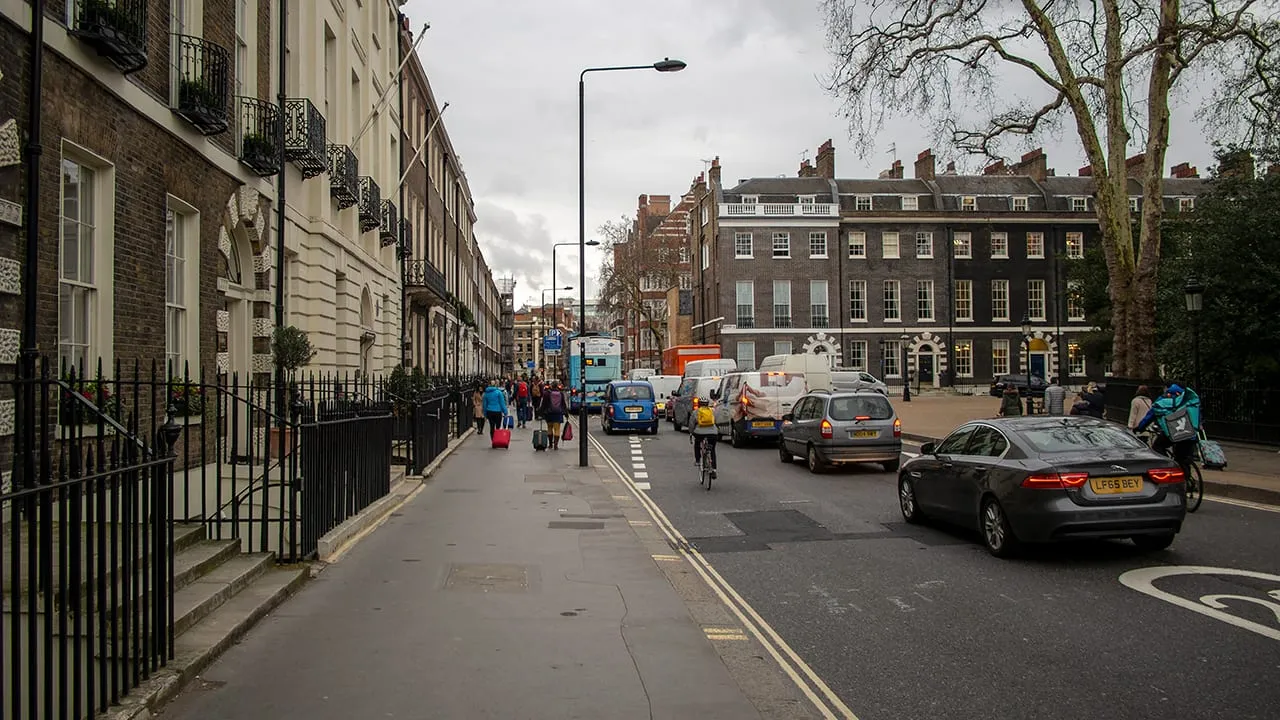
Bloomsbury is the quietest central district in London and the one with the most books in it. Between the British Museum, the University of London and a run of Georgian garden squares, it is dense with libraries, bookshops and blue plaques.
Almost everyone comes for the British Museum and leaves immediately afterwards. The squares three minutes north are empty by comparison.
Bloomsbury has its own share of the commemorative plaques marking where notable people lived or worked - see them on our interactive map.
Why visit — and who should skip it
Come here if you want the British Museum, or you want somewhere calm to walk in Zone 1. Bloomsbury is the only part of central London where you can sit in a garden square in silence and still be ten minutes from Covent Garden.
Skip it if you want evening life. Bloomsbury largely closes after office and university hours. Come during the day and eat in Soho or Covent Garden afterwards.
Top sights and activities
- The British Museum — Around eight million objects, of which roughly 50,000 are on display. The Rosetta Stone, the Parthenon sculptures, the Sutton Hoo helmet and the Egyptian galleries. Free. Use the Montague Place entrance.
- The Great Court — Norman Foster’s glazed roof over the old reading room courtyard, and the largest covered square in Europe. Free to walk into even without visiting the galleries.
- The garden squares — Russell, Bedford, Gordon, Tavistock and Bloomsbury Squares. Most are open to the public and almost all are empty.
- The Charles Dickens Museum — The Doughty Street house where he wrote Oliver Twist and Nicholas Nickleby, kept as a home, not a display.
- Lamb’s Conduit Street — A pedestrianised independent shopping street of menswear shops, a good bookshop and The Lamb, a Victorian pub with original snob screens.
- The Foundling Museum — The story of Britain’s first children’s charity and its Hogarth collection. Small, moving and rarely busy.
- The Cartoon Museum and the Wellcome Collection — Two small free museums on the edges. The Wellcome’s medical curiosities are strange.
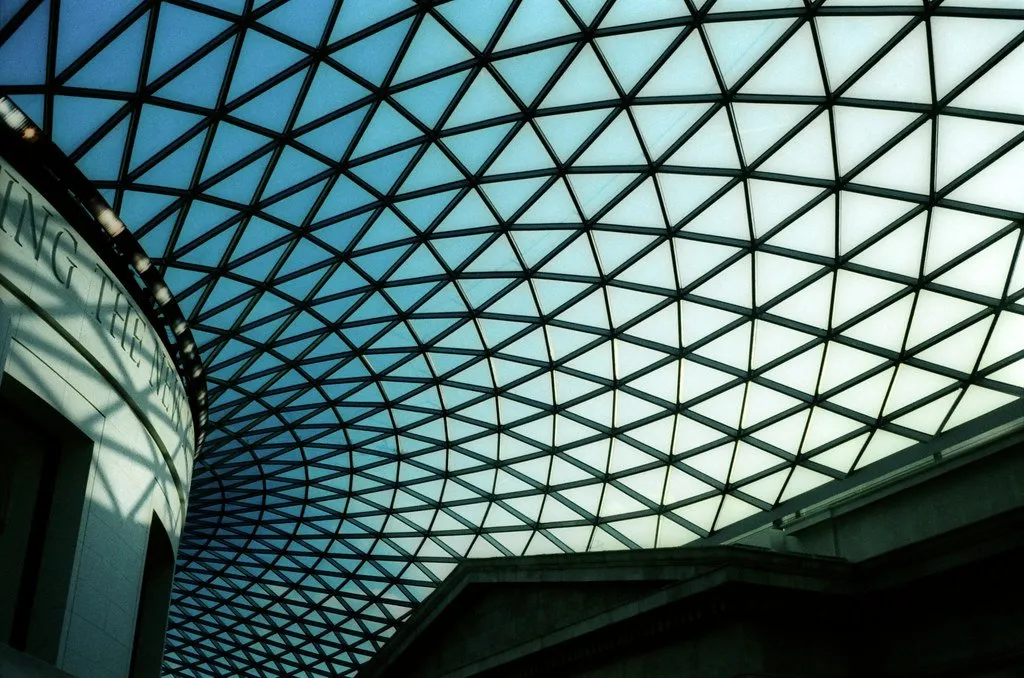
The Great Court roof. Photo: rbrwr, CC BY-SA 2.0.
Key streets and micro-districts
Great Russell Street and the museum precinct
The British Museum frontage, the souvenir shops opposite, and the busiest two hundred metres in Bloomsbury by a wide margin. The colonnade is the photograph; go in for the Great Court behind it.
The museum is free and needs no ticket. Use the back entrance: the queue forms on Great Russell Street, but the Montague Place door at the back is the same building and usually a walk-in. Friday is the late night.
For lunch on this street rather than off it, Dalloway Terrace at 16–22 Great Russell Street is the one with the flowers over the terrace, and it takes bookings — everything else here is priced for people who will never come back.
The garden squares
Seven of them, and they are not interchangeable. Russell Square is the biggest, has a café and a fountain children run through in summer, and is the one to sit in. Gordon and Tavistock Squares, north-west and two minutes further, are the quietest in central London and carry most of the Bloomsbury Group plaques — Virginia Woolf lived on both.
Tavistock Square also holds the Gandhi statue and a conscientious objectors’ stone, and is where people leave flowers on 7 July.
All are free and open in daylight hours, and the gates are locked overnight — which catches out anyone planning a late walk. Bedford Square, the only complete Georgian square left in Bloomsbury, is private and railed off: you can look, not enter.
Lamb’s Conduit Street
The best street in Bloomsbury and the one visitors never find, running north from Theobald’s Road towards Coram’s Fields. Half-pedestrianised, independent almost end to end.
Eat and drink: Noble Rot at 51 is a wine bar with a serious kitchen attached and needs booking; Honey & Co at 54 does Middle Eastern cooking in a room with about twenty seats; Redemption Roasters at 84b roasts its coffee in a young offenders’ institution, and that is its purpose.
Persephone Books reprints forgotten twentieth-century women writers with grey covers and patterned endpapers, and The Lamb is a Victorian pub with the original etched snob screens still in place.
It is a weekday street. Most of the shops are closed on Sundays and it is noticeably quiet, so come Tuesday to Saturday. Russell Square and Holborn are both about seven minutes.
Store Street and Marchmont Street
Two small local shopping streets, north-west and north of the museum, with better cafés than anything on Great Russell Street and a fraction of the people.
Café Deco at 43 Store Street runs from morning coffee through to dinner and is the most reliable meal in this part of Bloomsbury. Fortitude Bakehouse at 35 Colonnade, tucked in a mews off Marchmont Street, does the pastries.
Store Street also has Gay’s the Word, Britain’s oldest LGBTQ+ bookshop, open since 1979 and the shop the film Pride is about.
Both streets are five minutes from Russell Square or Goodge Street, and both go quiet at weekends because they serve the universities more than tourists — which is exactly why they are pleasant on a weekday.
Museum Street
A short run of antiquarian bookshops, print dealers and map sellers between the museum and Holborn — the last concentrated survival of the trade Bloomsbury was known for.
Browsing is free and expected. These are specialist dealers, not second-hand shops, so prices run from a few pounds for a loose print to four figures for a first edition, and nobody minds you looking at either.
Cocoro at 25 Coptic Street, on the corner, is the neighbourhood Japanese and a considerably better lunch than the museum café.
Most keep short hours — roughly 11am to 6pm, and several close on Sundays and Mondays. This is a street to walk down on the way out of the museum, not a destination in itself.
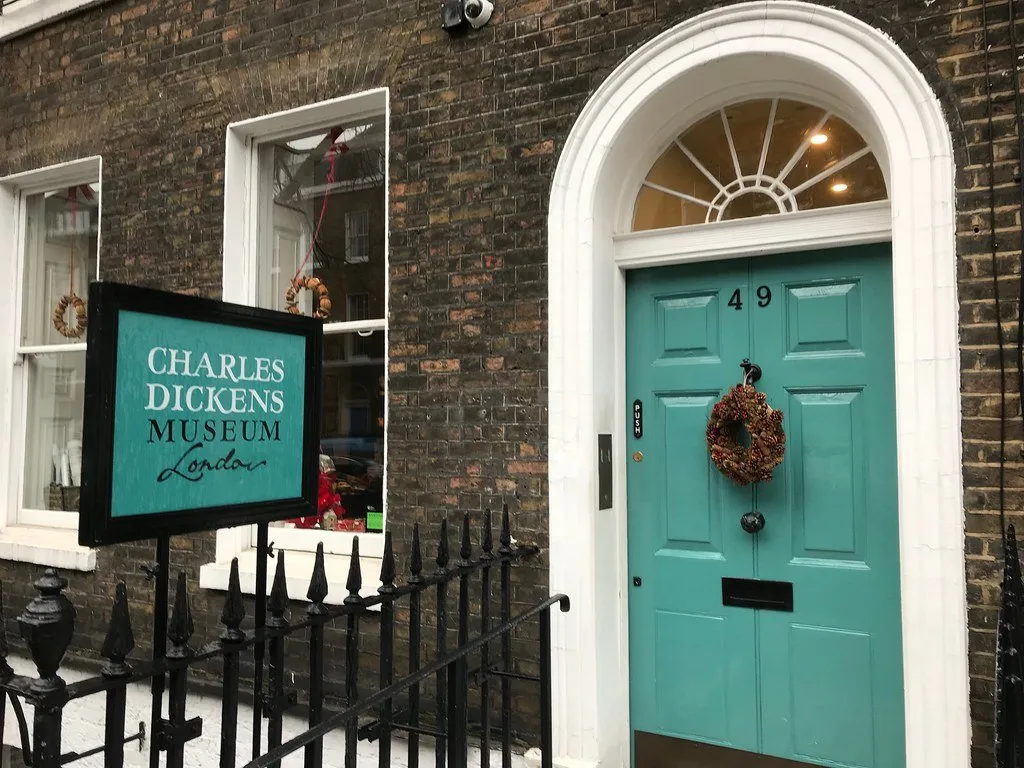
48 Doughty Street. Photo: Matt From London, CC BY 2.0.
Go deeper
- The best museums in London — how to do the British Museum without the crush, and the smaller collections nearby.
- London’s blue plaques — Bloomsbury has one of the densest concentrations in the city, and a walkable route through them.
Where to eat and drink
| Spot | Style | Price | Why go |
|---|---|---|---|
| The Lamb | Victorian pub | ££ | Lamb’s Conduit Street; original etched snob screens at the bar |
| Ciao Bella | Italian | ££ | Long-running Lamb’s Conduit trattoria with a pianist |
| Store Street Espresso | Coffee | £ | The area’s best coffee, five minutes from the museum |
| The Espresso Room | Coffee | £ | Tiny counter on Great Ormond Street |
| Bloomsbury Coffee House | Cafe | £ | Basement cafe under a student hall; quiet and cheap |
| Seven Dials Market | Food hall | £ | Ten minutes south when Bloomsbury’s options run out |
See all 13 places to eat and drink in Bloomsbury
Getting there
By Tube. Russell Square (Piccadilly) is closest to the squares. Holborn (Central, Piccadilly) and Tottenham Court Road (Elizabeth line, Central, Northern) are both about seven minutes from the British Museum and better connected.
Best exit. For the British Museum, come from Tottenham Court Road and approach along Great Russell Street — or better, walk round to the Montague Place entrance on the north side, which is far quieter.
On foot. Twelve minutes to Covent Garden, twelve to Soho, fifteen to King’s Cross St Pancras.
How long to spend, and when to go
| If you have | Do this |
|---|---|
| Two hours | British Museum highlights via Montague Place |
| Half a day | Add the garden squares and Lamb’s Conduit Street |
| A full day | Add the Dickens Museum, the Foundling Museum and the Wellcome Collection |
Best time: Weekday mornings at opening. The British Museum’s late Friday opening is also much calmer than a weekend afternoon.
Avoid: Weekend middays at the museum, when the Great Russell Street queue is at its longest.
Map of Bloomsbury
Open the map32 places: 11 places to eat · 12 things to do · 6 hidden spots · 3 places to stay
The map loads when you open this section.
Eat & drinkThings to doHidden LondonStay
What's on in Bloomsbury
Limited runs and the annual fixtures. Anything already finished is removed automatically.Links marked ad are affiliate links. If you book through one we may earn a commission, at no extra cost to you. It never affects what goes on this list.
Declaring Independence: USA 250
Not open yetFree and timed to the US semiquincentennial - a different angle for American visitors than the museum's ancient-world halls.
Pairs with the ticketed Bayeux Tapestry loan in the same building from September.
Korea
Not open yetKorean art at a scale London rarely sees, overlapping the Bayeux Tapestry in the same building for four months - book both for one visit.
Price not yet published - check when booking opens.
The Bayeux Tapestry
Not open yetThe actual Bayeux Tapestry, leaving France for the first time in nearly a thousand years. The single biggest cultural loan London has hosted in decades, and the one exhibition this year to plan a trip around.
Opens 10 September 2026 and runs to July 2027. Expect the tightest booking of anything on this page.
Coming up near Bloomsbury
Gigs, shows and exhibitions in the next fortnight at venues closest toRussell Square, Holborn, Tottenham Court Road. See everything on the What's On page.
Thursday22 October
-
18:45HAM
Soho Theatre · Tottenham Court Road Zone 1
£26–£28 Venue site -
19:00Katie Pritchard is Sir Elton Scone
Museum of Comedy · Holborn Zone 1
-
19:00KHAKIKID
The Lower Third · Tottenham Court Road Zone 1
-
19:00ROLEPLAY
Soho Theatre · Tottenham Court Road Zone 1
£18–£22 Venue site -
19:00Stranger Things: The First Shadow
Phoenix Arts Club · Tottenham Court Road Zone 1
-
19:15Dina Martina: Halloweena!
Soho Theatre · Tottenham Court Road Zone 1
£17–£24 Venue site -
19:30Avenue Q
Shaftesbury Theatre · Tottenham Court Road Zone 1
-
19:30RB Dance Company, Stories
Peacock Theatre · Holborn Zone 1
-
20:30Rachel Parris: Tour Preview
Museum of Comedy · Holborn Zone 1
-
Until21 NovRomuald Hazoumè: My Blue Period
October Gallery · Russell Square Zone 1
Things to do in Bloomsbury
Beyond eating and drinking. Free things are listed first.Links marked ad are affiliate links. If you book through one we may earn a commission, at no extra cost to you. It never affects what goes on this list.
Grant Museum of Zoology
FreeOne cramped room of UCL's zoological teaching collection - 68,000 specimens including a jar packed with preserved moles and the bones of a quagga, an animal that no longer exists.
Free and tiny. University hours, so it closes over the holidays when most visitors are around - check before walking over.
Museum of Comedy
Free16+A small museum of British comedy memorabilia in a Georgian church crypt that doubles as a working stand-up venue most nights - genuinely the only place in London combining the two.
The museum itself is a modest single room - the real draw is the nightly comedy programme in the same space.
Petrie Museum of Egyptian Archaeology
FreeWhere the British Museum has the monuments, the Petrie has the ordinary things - the world's oldest dress, the earliest metal from Egypt, and a lot of it in the original wooden cases.
Free, hidden inside a UCL building and easy to walk past. University opening hours. They hand out torches for the dim cases, which tells you the register of the place.
Sir John Soane's Museum
FreeSoane's own house, preserved by Act of Parliament exactly as he left it in 1837 - mirrors, top-lit wells, Hogarth's Rake's Progress on hinged panels, and a sarcophagus in the basement.
FREE, which almost nobody expects. Small and dark by design, so entry is limited and timed slots are worth booking. Narrow stairs; not accessible.
The Bloomsbury Squares
FreeRussell, Bedford, Gordon, Tavistock and Bloomsbury squares in one walk, with the blue plaques of the Bloomsbury Group - Woolf, Keynes, Strachey - clustered round Gordon Square.
Free and takes about an hour at a slow pace. Some squares are private and locked; Russell, Gordon and Bloomsbury are all open to anyone.
The British Museum
FreeThe Rosetta Stone, the Parthenon sculptures and the Sutton Hoo helmet under Foster's glass-roofed Great Court - and none of it costs anything.
Free but book a slot at busy times. It is far too big for one visit - pick three galleries and accept you will not see the rest. Fridays are open late.
Wellcome Collection
FreeFree, genuinely strange, and built around Henry Wellcome's collection of medical objects - which runs from Napoleon's toothbrush to a Peruvian mummy.
Free and needs no booking. The Reading Room upstairs is open to anyone to sit in, and almost nobody goes up.
Bloomsbury Lanes
18+ in the eveningFive karaoke rooms beside eight bowling lanes under the Tavistock Hotel, hired by the hour rather than the head and half price on Sunday, Monday and Tuesday.
Card only. No under-18s after 8pm (7pm Friday and Saturday). No refunds; a booking can be moved with 72 hours' notice.
Charles Dickens Museum
The Georgian terrace where Dickens wrote Oliver Twist and Nicholas Nickleby, laid out as he lived in it, down to the desk.
A townhouse over four floors with no lift. Small enough for an hour, and the garden cafe is open without a ticket.
Faulty Towers: The Dining Experience
A three-course dinner served by Basil, Sybil and Manuel entirely in character, with about seventy per cent of it improvised around the room.
Running for decades and in a hotel near Russell Square. You are part of the show whether or not you want to be.
Flight Club Bloomsbury
18+ in the eveningCameras track every dart to sub-millimetre accuracy and run the scoring for you, so nobody needs to be able to play or add up.
Booked by the oche rather than per head, so a full group is much better value. Under-18s are admitted only at limited daytime slots.
The Foundling Museum
The story of the Foundling Hospital, founded 1739, told partly through the scraps of fabric mothers left as tokens so they could one day identify the child they gave up.
The tokens are the reason to come and they are quietly devastating. Hogarth and Handel both backed the hospital, so the art and music collections are far better than the size suggests.
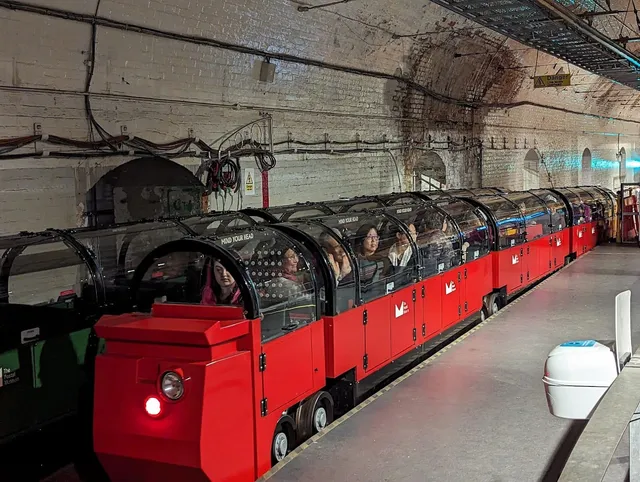
The Postal Museum and Mail Rail
A miniature train ride through the actual tunnels of the Post Office's own underground railway, closed in 2003 and reopened with passenger cars built to fit.
The Mail Rail ride is a separate timed ticket from the museum and sells out first. The cars are small and enclosed - not for anyone uneasy in confined spaces.
Book The British Museumad
Hidden Bloomsbury
Free, self-guided and easy to walk past without knowing it's there.
Charles Darwin at UCL
Blue plaqueCharles Darwin (1809–1882), naturalist
Marks Darwin's connection to UCL rather than a home address - a rare institutional plaque for the author of On the Origin of Species.
On a university building - viewable from the street, campus generally open to walk through in daytime.
Charles Dickens's Bloomsbury Home
Blue plaqueCharles Dickens (1812–1870), novelist
Dickens wrote Oliver Twist and Nicholas Nickleby here - the only one of his London homes still standing, now the Charles Dickens Museum.
Now the Charles Dickens Museum - a paid museum with set opening hours, not just a street plaque.
Duke's Road
Filming locationCruella (2021) - the Dalmatians are taken from the grooming salon
The short street dressed as Roscoe's Grooming Salon for the dognapping. Its real landmark is The Place, the contemporary dance theatre in the old Artillery drill hall.
Free, a public street, always open. Euston, five minutes. There is nothing marking the location.
John Maynard Keynes's Bloomsbury Home
Blue plaqueJohn Maynard Keynes (1883–1946), economist
Keynes was part of the Bloomsbury Group centred on Gordon Square - his economic theory reshaped 20th-century policy far beyond the square itself.
A private/institutional building - viewable from the street only.
Sherlock's 221B (North Gower Street)
Filming locationBBC Sherlock - 221B Baker Street exterior and Speedy's Cafe
The BBC series filmed its 221B exterior here rather than on the real, much busier Baker Street - the flat above a genuine sandwich bar, Speedy's, which leaned into the connection and is still trading.
Speedy's Cafe is a real, working sandwich bar with normal daytime hours - go in and get a coffee, not just a photo.
The British Museum
Filming locationThe Mummy Returns (2001) - the museum sequence
Filmed at the museum itself, though the exterior shots used UCL's front quad up the road because the real facade was behind scaffolding at the time. Two Bloomsbury buildings, one museum, in the same film.
Free and open daily. Use the Montague Place entrance at the back to avoid the main queue.
The Imitation Game's MI6 (Lethaby Building)
Filming locationThe Imitation Game (2014) - MI6 headquarters interiors
A Central Saint Martins building doubled as MI6's wartime headquarters for Benedict Cumberbatch's Alan Turing to walk through - a working art-school building most passersby would never connect to the film.
A working educational building - viewable from the street only.
William Morris's Red Lion Square Home
Blue plaqueWilliam Morris (1834–1896), designer and decorative artist
Morris founded his decorative arts firm from this address in 1861, before the patterns that now cover half of Britain's National Trust properties existed.
A private/commercial building - viewable from the street only.
Where to stay
One of the best-value central bases in London: quiet, walkable and close to the Eurostar.
- Russell Square and Bedford Place — Georgian townhouse hotels around the squares. Central and calm.
- Gower Street — A long run of small hotels at lower prices, walkable to the West End.
- King’s Cross — Fifteen minutes north, better transport, more open in the evening.
Our Bloomsbury hotel guide compares the hotels across every price band.
Cheapest first. Prices are a typical starting rate per night, not a quote.Links marked ad are affiliate links. If you book through one we may earn a commission, at no extra cost to you. It never affects what goes on this list.
Generator London
£HostelSeven hundred and fifty rooms, a bar built into a bus, and a 24-hour reception - the default answer if the point of the trip is meeting people.
It is a party hostel and does not pretend otherwise. Wrong choice for an early start or light sleepers; female-only dorms are available.
Morgan Hotel
££HotelBreakfast includedA family-run hotel across two buildings on Bloomsbury Street, a couple of minutes from the British Museum, where the one-bed and family apartments run to 48 and 51 sq m - four times the size of its own single room and far more space than central London usually sells at this price.
No lift, in the operator's own words, and it adds that the rooms "may not be appropriate for those who require wheelchair access". Breakfast is included and the rooms are air-conditioned.
Zedwell Tottenham Court Road
££HotelAccessible roomsCarved out of a disused underground car park beneath Great Russell Street - 206 soundproofed cocoons and London's first hotel that is entirely below ground.
Windowless is the whole concept rather than a compromise, since the building has no surface at all. It undercuts the Piccadilly flagship by £16 to £81 a night for the same product, two Tube stops away. Two minutes from the British Museum and a short walk to the Elizabeth line. The second person costs £8-£9 here whatever the room costs. Rooms run to Cocoon 4 only, so large groups have to go to Piccadilly.
Bertrand's Townhouse
£££TownhouseA townhouse on Bedford Place, the quiet Georgian run between Russell Square and the British Museum, themed on Bertrand Russell and the Bloomsbury Set - a cigar garden on the terrace, a bar called Ottie's Salon and jazz nights.
The operator claims a place in The Times' 50 Best Places to Stay in the UK, one of only six London hotels on it; that claim is the hotel's own.
Kimpton Fitzroy London
£££HotelIt fills a whole block down the eastern side of Russell Square - a 19th-century landmark with a Palm Court, a lobby cafe and three Fitz's bars and restaurants inside it. Dogs stay free, up to 35kg by the hotel's own FAQ.
Dogs stay free with no deposit (the hotel's FAQ caps them at 35kg), with a loaner pet bed, bowls and a door hanger thrown in - which is why the dog-friendly guides keep naming it. It is Bloomsbury rather than the West End, so quiet at night and a walk or a bus to the theatres.
The Bloomsbury Hotel
£££HotelA minute along Great Russell Street from the British Museum, and it drinks better than it needs to - three separate rooms of its own, the Coral Room off the lobby, the Bloomsbury Club Bar and Dalloway Terrace outside.
The operator markets it as 'The Bloomsbury'; 'The Bloomsbury Hotel' is the name in its own structured data.
The Hoxton, Holborn
£££BoutiqueBreakfast includedAccessible roomsThe same lived-in lobby format as the Shoreditch original, minutes from the British Museum rather than the bar strip - the calmer of the two.
Breakfast bag included, same as the other Hoxtons. Recently refreshed rooms across the estate - ask whether a specific room has had the update if it matters.
The Montague on the Gardens
£££HotelNext door to the British Museum, with a raised garden terrace over a private square - Bloomsbury's one hotel that makes something of the garden squares rather than just sitting among them.
Red Carnation, the same group as The Rubens and The Milestone.
The Zetter Bloomsbury
£££BoutiqueThe Zetter's newest house, opened in April 2026 across a run of Georgian townhouses on Montague Street beside the British Museum, with a garden, a gym and the Parlour and Orangery for long cocktail afternoons.
Not The Zetter Townhouse Marylebone: the group runs three houses, in Clerkenwell, Marylebone and Bloomsbury. Opened April 2026, so it is thinly reviewed and the operator's own page still carries an "Opening April 2026" line.
Make a day of it
Combine Bloomsbury with
Walking times are from the centre of Bloomsbury. Each of these works as an afternoon once you have finished here.
King's Cross
15 min walkNorth for Coal Drops Yard, the British Library and the canal.
Covent Garden
12 min walkSouth through Holborn for the Piazza and the theatres.
Soho
12 min walkWest across Tottenham Court Road for dinner.
Fitzrovia
8 min walkWest across Tottenham Court Road for Charlotte Street and the best restaurant strip nearby.
Suggested two-hour walking route
- Start: Tottenham Court Road station. East along Great Russell Street.
- British Museum: Go round to the Montague Place entrance. The Great Court and two galleries.
- The squares: North to Russell Square, then Gordon and Tavistock Squares for the blue plaques.
- Lamb’s Conduit Street: East for the independent shops and The Lamb.
- Finish: South to Holborn, or on to Covent Garden.
Common mistakes to avoid
- Using the main museum entrance at peak times. Montague Place on the north side has the same access and a fraction of the queue.
- Trying to see the whole British Museum. Pick two or three galleries. It cannot be done in a day.
- Eating on Great Russell Street. The cafes opposite the museum are poor value. Store Street or Marchmont Street are three minutes away.
- Coming in the evening. Bloomsbury empties after work. It is a daytime area.
- Missing the squares entirely. Most visitors never walk the three minutes north, which is where the character is.
- Assuming the small museums are shut. The Foundling, Cartoon and Wellcome are all open and mostly free.
Common questions
Is the British Museum free?
Yes. General admission is free and always has been. Only the major temporary exhibitions charge. Booking a free timed slot is recommended at weekends and in school holidays but is not required.
How do I avoid the crowds at the British Museum?
Go at opening on a weekday, and use the **Montague Place** entrance on the north side rather than the main Great Russell Street gate. It is the same museum with a fraction of the queue. Late-opening Friday evenings are also much quieter than weekend afternoons.
How long do you need at the British Museum?
Two hours for the headline objects — the Rosetta Stone, the Parthenon sculptures, the Egyptian galleries and the Sutton Hoo helmet. A full day barely scratches it: there are around eight million objects and roughly 50,000 on display. Pick two or three galleries rather than attempting a circuit.
What was the Bloomsbury Group?
A circle of writers, artists and thinkers who lived around these squares in the early twentieth century — Virginia Woolf, John Maynard Keynes, E. M. Forster, Lytton Strachey and others. Blue plaques mark many of their houses, particularly around Gordon Square and Tavistock Square.
Is Bloomsbury a good area to stay in?
One of the best in central London for value. It is quiet at night, central, walkable to the West End, and a short walk from King's Cross St Pancras for the Eurostar. The trade-off is that it is residential and academic, so there is little nightlife.