In this guide
At a glance
- Vibe
- A rebuilt industrial landmark with a very good park next door
- Time needed
- Half a day
- Best day
- Weekdays are calmer; the park is best on a clear weekend morning
- Travel zone
- 1
- Walkability
- 4/5
- Typical spend
- ££
Best for
Nearest stations
- Battersea Power StationNorthern
- Nine ElmsNorthern
- Battersea ParkNational Rail
For forty years Battersea Power Station was a ruin with four chimneys — the most recognisable derelict building in Britain, familiar from the cover of Pink Floyd’s Animals. It reopened in 2022 after one of the largest restoration projects in Europe, and you can now walk into both turbine halls for free.
Fifteen minutes west is Battersea Park, which was here long before the power station and is the better half of the visit.
Battersea has its own share of the commemorative plaques marking where notable people lived or worked - see them on our interactive map.
Why visit — and who should skip it
Come here if you like industrial architecture, or you want a park with a river view that is not full of tourists. The two turbine halls are impressive and cost nothing to walk into.
Skip it if you dislike shopping centres. Beyond the shell and the turbine halls, much of the Power Station is a mall — a very handsome one, but a mall. If shopping does not interest you, the park alone justifies the trip.
Top sights and activities
- Battersea Power Station — Free to enter. Turbine Hall A is restored 1930s art deco; Turbine Hall B is 1950s, plainer and more industrial. Walk from one hall to the other to compare them.
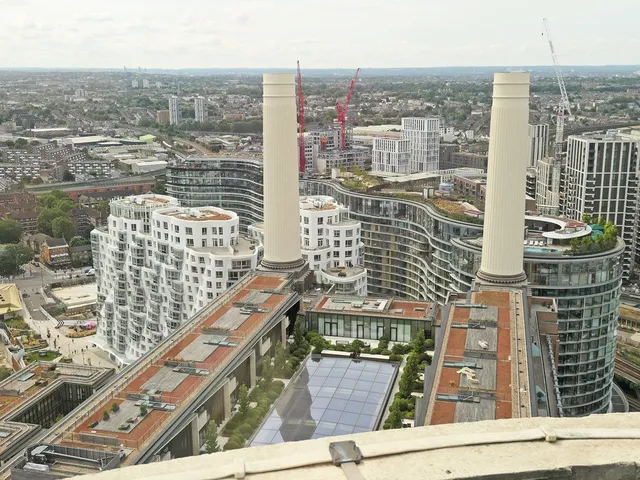
- The Chimney Lift — A glass lift 109 metres up inside the north-west chimney, opening at the top for a 360-degree view. Renamed from Lift 109. Adult tickets from £16 online against £24 on the day.
- Battersea Park — 200 acres with a boating lake, a Grade II listed Victorian layout, and a riverside path facing Chelsea.
- The Peace Pagoda — A Buddhist monument given to London in 1985, built by monks to mark 40 years since Hiroshima and Nagasaki. On the riverside path, with a resident monk.
- Albert Bridge — Cast-iron, painted pink and green, and still signed asking troops to break step. Closed to motor traffic since February 2026 after a crack was found in a cast-iron component; pedestrians and cyclists still cross, and reopening to vehicles is promised for 2027.
- Battersea Park Children’s Zoo — Small, well run and good for young children. Ticketed.
- The Thames Path — East towards Vauxhall and Westminster, west towards Wandsworth. Flat the whole way.
- Glide ice rink — Three linked rinks and a 200-metre riverside skate trail in front of the Power Station, 6 November 2026 to 3 January 2027; dates and children’s rules for it and the other rinks are in our London ice skating guide.
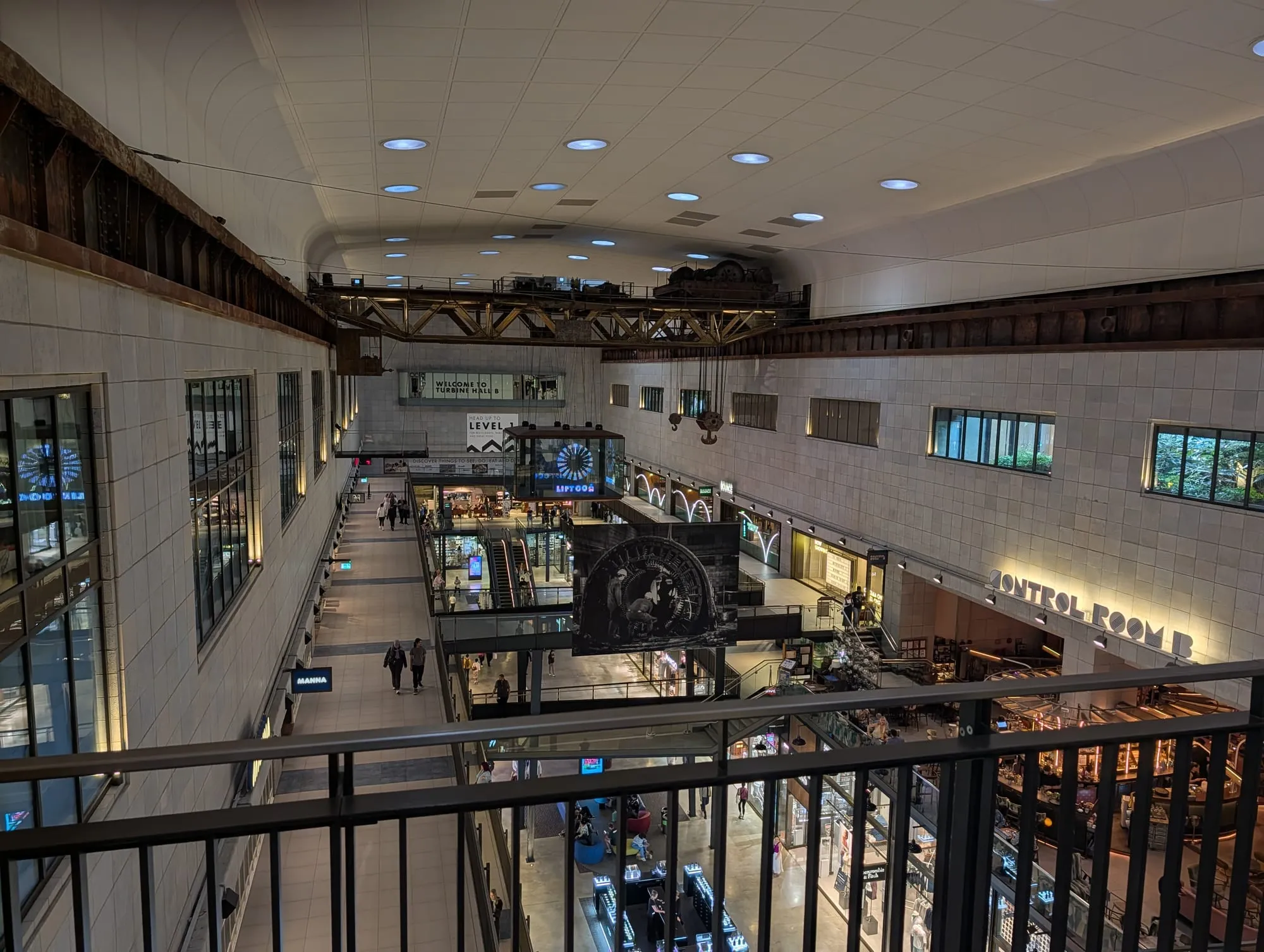
Inside Battersea Power Station.
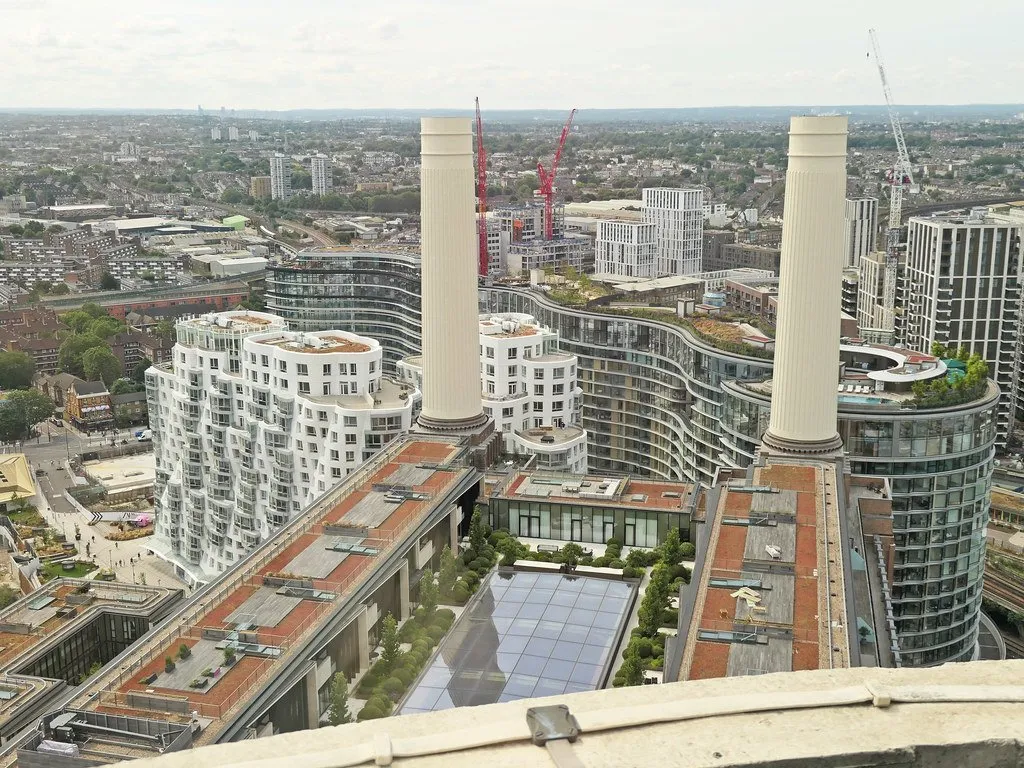
The view from the Chimney Lift. Photo: amandabhslater, CC BY-SA 2.0.
Key streets and micro-districts
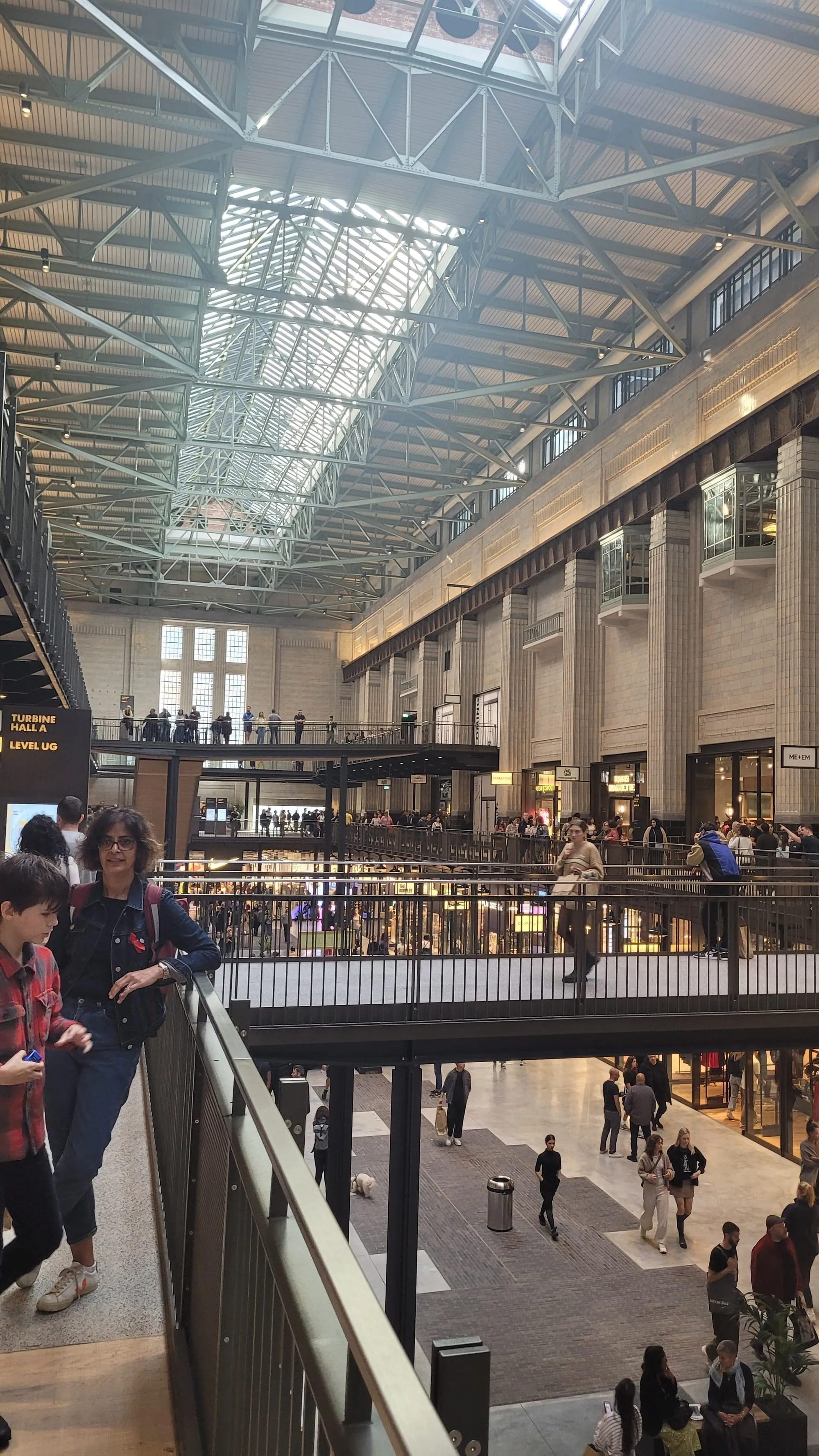
Turbine Hall A.
The Power Station and Electric Boulevard
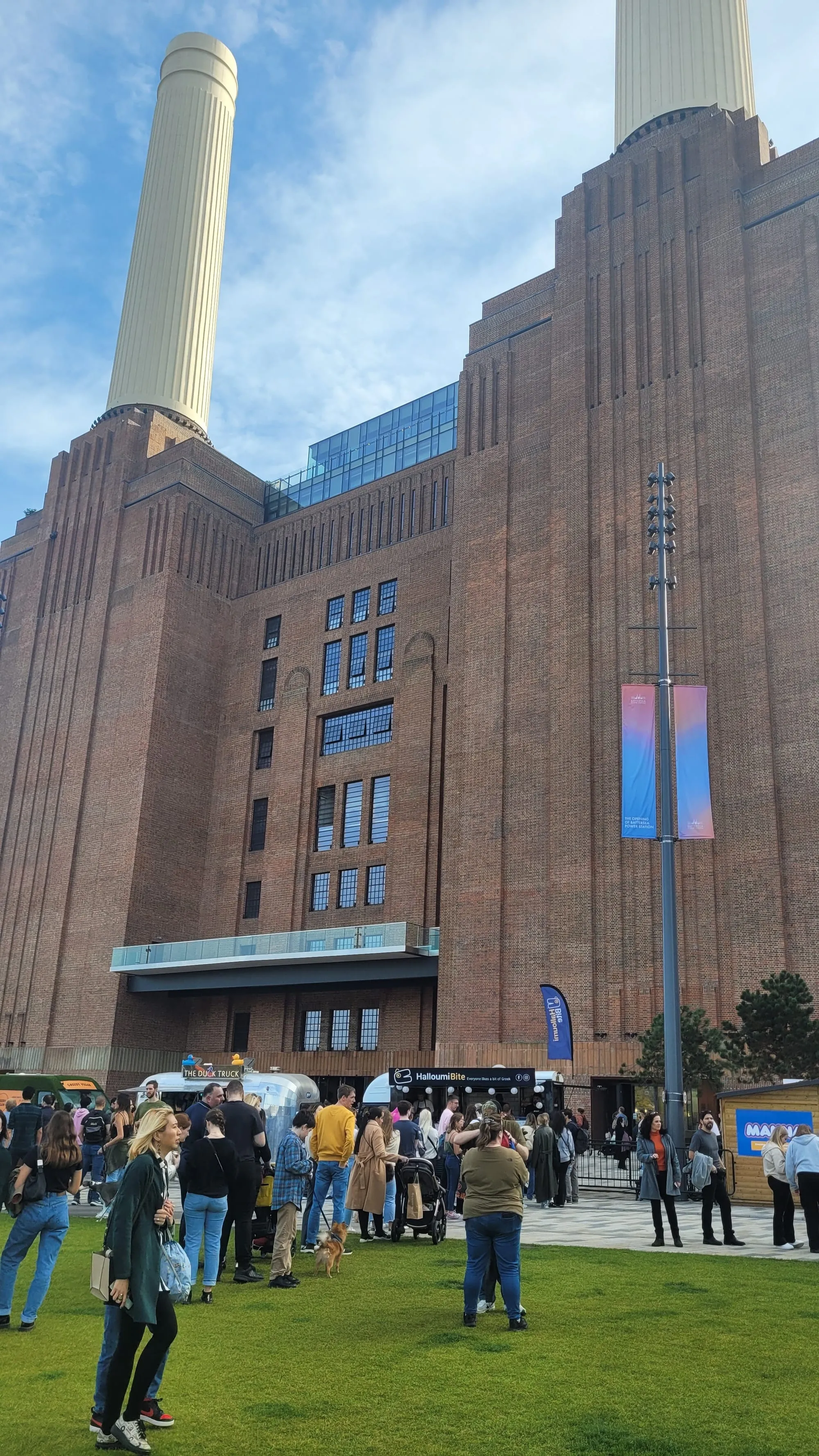
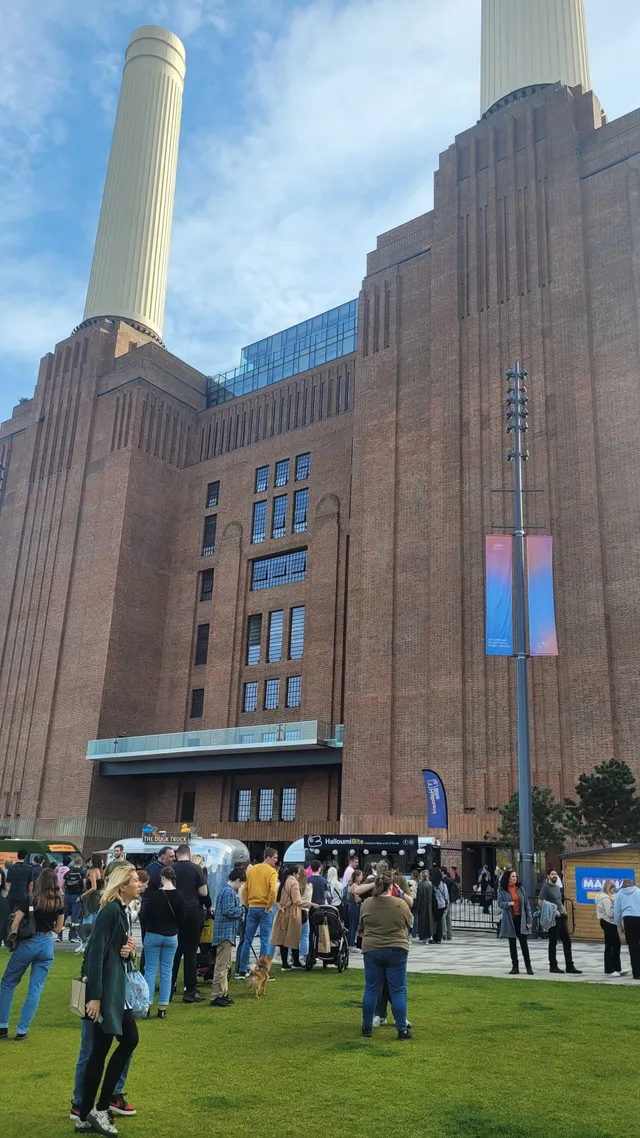
Battersea Power Station’s brick facade.
The building reopened in October 2022 after decades derelict, and walking into it is free. Over 170 shops, bars and restaurants now fill it, but the restored fabric of the building is on show for nothing: only the Chimney Lift, the cinemas and the ticketed exhibitions cost anything.
Walk between the two turbine halls, because they are not the same building. Turbine Hall A is the 1930s one — Art Deco, restrained, the better room. Turbine Hall B is 1950s, plainer and frankly industrial, built when the money and the mood had changed. Standing in one and then the other is the clearest architectural lesson in the place and it costs nothing.
Control Room B is a bar on a mezzanine over Turbine Hall B, surrounded by the original 1950s dials and switchgear, and anyone can walk in — children welcome until 5pm. Control Room A is not open in the same way: it is a private events space, and the only way in is the official guided tour, which runs on Mondays only and releases tickets four weeks ahead.
The free heritage bits people miss: the Power of Place exhibition on Level 1, the original plant machinery displayed as sculpture across Power Station Park, and a cut section of one of the original chimneys taken down during the rebuild.
Electric Boulevard is the pedestrian street running south, with its own Tube entrance since October 2025. Two Frank Gehry-designed buildings are still to come and construction started in summer 2026, so expect hoardings — roughly half the 42-acre site is still a building site.
Circus West Village
The first phase, opened before the Power Station itself and laid out along the railway arches beside the Grosvenor Bridge viaduct. It is the part that feels least like a shopping centre, and it is where most of the good eating is.
The restaurants are in the arches rather than in the Power Station, which catches people out: Cinnamon Kitchen for Vivek Singh’s pan-Indian, Roti King for Malaysian, Tonkotsu for ramen, Battersea Brewery in a working micro-brewery, and a run of riverside rooms — Brindisa, Wright Brothers, Fiume — with outdoor tables facing the water.
There are two cinemas on the estate, not one — the Cinema in the Arches here, and a separate one inside the Power Station. NEON is the big immersive exhibitions venue on this side, and there is padel and ping pong if you want something to do rather than something to eat.
Arriving from Chelsea Bridge, come down the steps on the south side and along the river walk; the enormous “POWER” installation by Morag Myerscough is the landmark. One thing to note: the 100-seat Arches Lane Theatre closes at the end of September 2026 after the landlord exercised a break clause, so the estate is about to have no theatre.
Nine Elms and the riverside
East towards Vauxhall, and the least finished part of the area. The US Embassy moved here from Grosvenor Square in 2018 — a translucent glass cube by KieranTimberlake, with no public access and nothing to visit; the pond and public realm around it are what you get.
The Thames Path is not continuous here, whatever the maps suggest. Heathwall Quay opened in October 2025 and removed one diversion, but walking west you still have to leave the river, go along Battersea Park Road and up Pump House Lane, round the east side of the Power Station, before dropping back down. Past the Power Station it runs cleanly under the railway bridge into Battersea Park.
The “linear park” that plans show running from here to Vauxhall is being built plot by plot and is not finished, so do not plan a green walk along it. The Sky Pool — the transparent pool slung between two towers at Embassy Gardens — is residents only, and not a sight.
This is the largest regeneration zone in central London, 227 hectares of it, and it reads that way: worth walking through for the scale and the strangeness; there is nothing specific at the end.
Battersea Park
200 acres, laid out between 1854 and 1870, Grade II* listed, and the reason a lot of people come to Battersea at all. Open 8am until dusk.
The boating lake is ten acres with rowing and pedal boats from a kiosk by the Pear Tree Cafe — weekends, bank holidays and school holidays only, roughly March to September, weather permitting, and no booking: first come, first served. Prices are posted at the kiosk rather than online.
The Peace Pagoda on the riverside path was built in 1985 by fifty monks, nuns and volunteers of the Nipponzan Myohoji order to mark forty years since Hiroshima and Nagasaki. A monk still tends it. The upper platform is not open to the public — it is his to maintain, and the Buddhas in the alcoves are sacred objects rather than climbing frames. While they were building it the monks lived in what is now the Children’s Zoo, and the temple the monk uses is a converted council storeroom in the trees near the Old English Garden.
Also here: the Pump House Gallery in an 1861 water tower, free and showing contemporary art; a Victorian bandstand; the Children’s Zoo (adult £17.50, child £13.95, no booking needed); Go Ape, mini golf and a boules pitch; and the Millennium Arena for athletics.
The park’s 1860s Pulhamite cascades have not run in nearly a century and are being restored with Heritage Fund money, to run on solar power.
Battersea Village and Battersea Square
South-west past the park, and the actual old Battersea — low-rise, unglamorous, and a useful corrective if the Power Station has left you thinking the whole area was built in 2022.
St Mary’s Battersea on the riverbank is the anchor and the only Grade I listed church in Wandsworth. There has been a church on the site since the eighth century; the present one opened in 1777, and the east window is older still, dating from 1379 and moved from the previous building. William Blake married Catherine Boucher here in 1782, and Turner painted from the churchyard — both are commemorated in modern stained glass. It is generally open on weekday daytimes rather than to a fixed schedule.
Battersea High Street and Battersea Square have the pubs, including The Woodman, and the buildings are the scale the whole area used to be. It is a fifteen-minute walk from the Power Station and almost nobody makes it, which is rather the point.
A neat coincidence for anyone doing both: Blake married in Battersea, and as a boy claimed to have seen a vision of angels on Peckham Rye — and the 345 bus runs directly between Battersea High Street and Peckham.
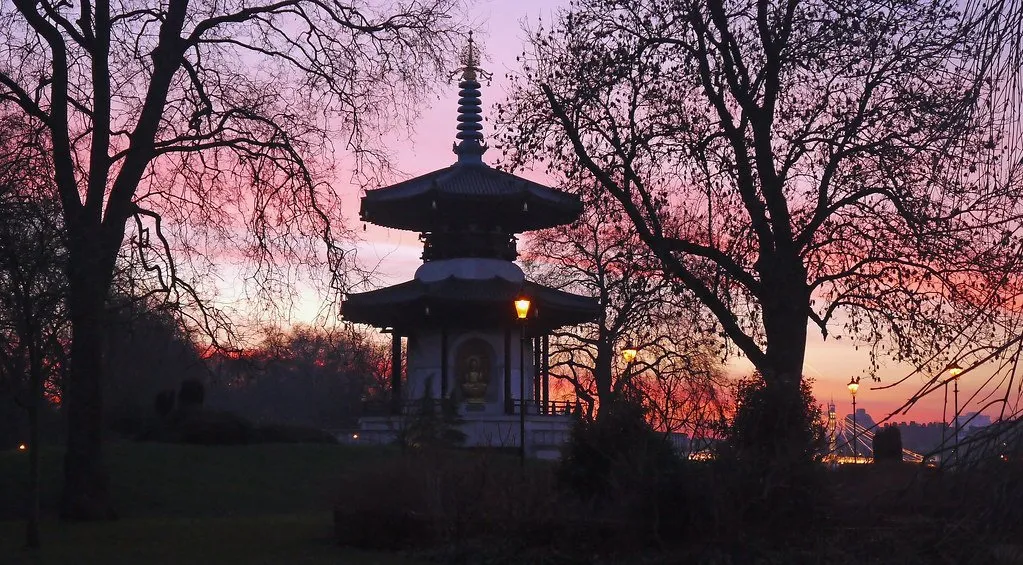
The Peace Pagoda. Photo: It’s No Game, CC BY 2.0.
Where to eat and drink
| Spot | Style | Price | Why go |
|---|---|---|---|
| Arcade Battersea | Food hall | ££ | Inside the Power Station; a dozen kitchens, no booking |
| Cinnamon Kitchen | Indian | ££ | In the Power Station with terrace seating |
| Pear Tree Cafe | Park cafe | £ | Beside the boating lake in Battersea Park |
| Circus West Village | Mixed | ££ | Railway-arch restaurants with outdoor tables |
| The Woodman | Traditional pub | £ | Battersea High Street; the old Battersea, away from the development |
| Battersea Power Station market | Street food | £ | Weekends on Electric Boulevard |
At Christmas the Power Station adds a riverside skate trail and winter food huts in Malaysia Square, and in 2025 a makers’ market on three weekends; see our London Christmas markets guide.
See all 7 places to eat and drink in Battersea
Getting there
By Tube. The Northern line was extended here in 2021, with stops at Nine Elms and Battersea Power Station. Both are on the Charing Cross branch — check the front of the train, as Bank-branch services will not come here.
By rail. Battersea Park station (National Rail) from Victoria takes about four minutes and is closest to the park itself.
By river. A pier serves the Power Station with Uber Boat services east to Westminster and the City. Slower but far better looking — see the river boats guide.
On foot. Fifteen minutes across Albert Bridge to Chelsea, twenty-five along the river to Westminster.
How long to spend, and when to go
| If you have | Do this |
|---|---|
| One hour | Both turbine halls and Electric Boulevard |
| Half a day | Add Battersea Park, the pagoda and the boating lake |
| A full day | Add the Chimney Lift and the walk over Albert Bridge into Chelsea |
Best time: Late afternoon. The park faces north across the river, so the light on Chelsea and Albert Bridge in the evening is the best of the day.
Book ahead: the Chimney Lift is timed entry and sells out at weekends — and check it is open at all, as it closes for maintenance.
Map of Battersea
Open the map14 places: 5 places to eat · 5 things to do · 3 hidden spots · 1 places to stay
The map loads when you open this section.
Eat & drinkThings to doHidden LondonStay
What's on in Battersea
Limited runs and the annual fixtures. Anything already finished is removed automatically.Links marked ad are affiliate links. If you book through one we may earn a commission, at no extra cost to you. It never affects what goes on this list.
Affordable Art Fair - Battersea Autumn
Not open yetOne of Frieze Week's satellite fairs, priced and pitched at collectors buying their first piece rather than six-figure lots.
Private view Wednesday 14 October, 5-9pm; general admission runs Thursday 15 to Sunday 18 October.
Things to do in Battersea
Beyond eating and drinking. Free things are listed first.Links marked ad are affiliate links. If you book through one we may earn a commission, at no extra cost to you. It never affects what goes on this list.
Battersea Power Station
FreeGilbert Scott's brick cathedral of a power station, derelict for forty years, now holding 150 shops and restaurants with both original Turbine Halls opened up.
Free to walk into, and worth it for Turbine Hall A's art deco alone even if you buy nothing. Its own Northern line station puts it fifteen minutes from the West End.
Battersea Park Children's Zoo
Meerkats, monkeys, otters and a barnyard, scaled deliberately for under-tens - small enough to finish without anyone melting down.
Much smaller and cheaper than London Zoo and better for very young children for exactly that reason. Reduced winter hours.
Go Ape Battersea Park
Zip wires and rope bridges through the trees of Battersea Park - the only high-ropes course this close to central London.
Book ahead; sessions are timed and sell out at weekends and in school holidays. Minimum heights apply and vary by course, so check before travelling with younger children. Runs in most weather but can close in high wind.
Lift 109
A glass lift that rises 109 metres up inside the north-west chimney of Battersea Power Station and out of the top, after a walk through the restored art deco Turbine Hall A.
Timed tickets and the lift itself is only a few minutes - the history displays before it are most of the visit. Not one for anyone uneasy in a glass box.
The Thieves
The old Four Thieves, reopened as The Thieves in October 2025 with arcade games, darts, pool and private karaoke booths it calls Singpods.
Hidden Battersea
Free, self-guided and easy to walk past without knowing it's there.
Battersea Flower Station
Point of interestA flower shop that opens into a long, hidden garden-centre corridor
Looks like an ordinary flower shop from the street; walk through and it opens into a long outdoor corridor of plants, bunting and fairy lights - a garden centre that was shut off to the public for 30 years before reopening. A second entrance exists on Winders Road.
Free to browse, normal shop hours. A genuinely photogenic detour rather than a destination in itself.
Peace Pagoda, Battersea Park
Point of interestA 1985 Buddhist peace pagoda gifted to London, on the Thames path
Built by Buddhist monks and nuns of the Nipponzan Myohoji order and unveiled in 1985, this gilded pagoda sits right on the river inside Battersea Park - a striking landmark most people walking or cycling the Thames path have never actually stopped for.
Free, always accessible within the park's opening hours. Best approached along the riverside path.
Pink Floyd's Animals Power Station
MusicPink Floyd, Animals (1977) - the album cover, and the inflatable pig
The Animals sleeve put an inflatable pig between the chimneys in 1976. It broke loose on the second day of the shoot, drifted into Heathrow's flight path and grounded aircraft - which is why the cover is a composite of two days' photographs.
The building is now a shopping and office development, free to walk into. Turbine Hall A is the art deco one worth seeing even if you buy nothing.
Where to stay
New, well connected since the Tube extension, and quiet in the evening.
- Battersea Power Station and Nine Elms — Modern hotels and apartments, direct on the Northern line.
- Battersea Park — Quieter, older streets near the park, four minutes from Victoria by rail.
- Chelsea — Across the bridge, more attractive, considerably more expensive.
Cheapest first. Prices are a typical starting rate per night, not a quote.Links marked ad are affiliate links. If you book through one we may earn a commission, at no extra cost to you. It never affects what goes on this list.
art'otel London Battersea Power Station
££££HotelAccessible roomsJaime Hayon's bold, colourful design throughout, a rooftop pool over the Power Station chimneys, and named Hotel of the Year 2025 by The Caterer.
Inside the Battersea Power Station development itself, so the shops, bars and Lift 109 are all a lift ride away rather than a walk.
Make a day of it
Combine Battersea with
Walking times are from the centre of Battersea. Each of these works as an afternoon once you have finished here.
Chelsea
15 min walkNorth across Albert Bridge for King's Road, the Physic Garden and Cheyne Walk.
Westminster
25 min walkNorth-east along the river, or two stops on the Northern line.
South Kensington
30 min walkNorth across the river for the museum quarter.
South Bank
35 min walkEast along the Thames Path past Vauxhall towards Westminster Bridge.
Suggested half-day route
- Start: Battersea Power Station station (Northern line, Charing Cross branch).
- The turbine halls: Both of them — art deco first, then the 1950s hall.
- Electric Boulevard: South through the new street, then back to the river.
- Battersea Park: West along the Thames Path to the Peace Pagoda.
- The boating lake: Into the park proper for the Victorian layout.
- Finish: North over Albert Bridge into Chelsea, ideally at dusk when it is lit.
Common mistakes to avoid
- Taking a Bank-branch Northern line train. Battersea is on the Charing Cross branch only.
- Assuming you have to pay to get in. The Power Station and both turbine halls are free. Only the Chimney Lift, the cinemas and the ticketed exhibitions charge.
- Turning up for the Chimney Lift without checking. Timed entry, weekends sell out, and it shuts for maintenance — it was closed through August 2026.
- Skipping the park. It is the better half of Battersea and fifteen minutes west.
- Missing the Peace Pagoda. It is on the riverside path and easy to walk past.
- Coming only for the shops. The architecture is what stands out; the retail is incidental.
Common questions
Can you go inside Battersea Power Station?
Yes. It reopened to the public in October 2022 after a long restoration and is free to enter as a shopping and dining destination. The two turbine halls are open — Turbine Hall A restored in 1930s art deco, Turbine Hall B in 1950s style. Only the Chimney Lift up the chimney is ticketed.
What is the Chimney Lift, and what happened to Lift 109?
The same attraction, renamed. A glass lift rises 109 metres up inside the north-west chimney, opening out at the top for a 360-degree view over London. Adult tickets start at £16 booked online against £24 on the day, and the whole visit takes about 45 minutes including the exhibition below. It closes periodically for maintenance — it was shut through August 2026 — so check before travelling.
How do I get to Battersea Power Station by Tube?
The Northern line was extended to Battersea Power Station in September 2021, with an intermediate stop at Nine Elms. It runs on the Charing Cross branch, so check the front of the train. Journey time is about five minutes from Victoria via a change, or fifteen from Tottenham Court Road direct.
Is Battersea Park worth visiting?
Yes — 200 acres with a boating lake, a Grade II listed Victorian layout, a small children's zoo and the Peace Pagoda on the riverside. It is quieter than Hyde Park and one of the best places in London to watch the sun set over the river. It is a fifteen-minute walk west of the Power Station.
What is the Peace Pagoda in Battersea Park?
A Buddhist monument given to London in 1985 by the Nipponzan-Myōhōji order, built by monks and volunteers to mark the 40th anniversary of Hiroshima and Nagasaki. It stands on the riverside path with gilded Buddhas on four sides. A monk still lives on site and tends it.