In this guide
Most Banksy maps of London send you to walls where the work no longer exists. Pieces get removed, painted over, stolen, sold with the wall attached, or covered in perspex that makes them impossible to photograph.
This guide says which are gone, which saves a wasted trip.
It covers two things. The first half is Banksy — what survives, what has been removed, and the indoor collections showing work that has come off walls. The second half is the rest of London’s street art, which is where most of the city’s best painting actually is and none of which needs a ticket.
Fifteen Banksys are still viewable as originals in situ: the Cannon Street rat, the I Love London rat on Chiswell Street, the two Basquiat tributes, the two Foundry pieces now on the front of art’otel Hoxton, the Pink Car at the Old Truman Brewery, the Bermondsey fishing boy, the Royal Family in Stoke Newington, the Chelsea elephants, the Walthamstow pelicans, the Charlton rhino, the Finsbury Park tree, the Stargazing Children at Centre Point, and Blind Patriotism at Waterloo Place. Everything else you will read about has been removed, stolen, boarded over, scrubbed off or replaced with a replica.
💡 The Short Version: Ten of the fifteen are on one route — our Banksy route runs from Blind Patriotism at Waterloo Place to the Royal Family in Stoke Newington in about three and a half hours, with one Tube ride and one Overground train. The best-preserved rat is on Chiswell Street. The 2024 animal series left work across the city, though six of the nine have gone. Leake Street is legal graffiti under Waterloo and repainted constantly. And Shoreditch is still the densest area.
📘 How we choose these (editorial note). No paid placements. These are drawn from a wide spread of sources rather than any single list - the food and travel press, the big listings sites, independent blogs and specialists, video, and what Londoners recommend themselves - and cross-referenced against each other. Street art is impermanent by nature. Everything here was checked in August 2026, the Banksys again in September 2026, and we have flagged what had already been removed — but a piece can disappear the week after publication, so treat any single work as provisional.
Where they are
| If you are near… | What to see |
|---|---|
| The City | Cannon Street rat, Chiswell Street rat, two Basquiat tributes |
| Shoreditch & Brick Lane | The densest concentration in London, changing constantly — plus the two Foundry Banksys on art’otel Hoxton and the Pink Car |
| Stoke Newington | Banksy’s Royal Family, one of his earliest and best-preserved |
| Waterloo | Leake Street tunnel — legal, and repainted continuously |
| Chelsea | Banksy’s elephants |
| Walthamstow | Banksy’s pelicans, the best-preserved of the 2024 series |
| Charlton | Banksy’s rhinoceros |
| Bermondsey | Banksy’s fishing boy, on the Thames Path |
| Trafalgar Square | Blind Patriotism, the 2026 statue |
| Hackney Wick | Large-scale murals along the canal |
| Brixton | The Bowie mural, protected and locally listed |
See ten of them in one day → Eight stops from Waterloo Place to Stoke Newington, with a map, the Tube and Overground legs, and what you can actually see at each. The short version is at the bottom of this page.
For every Banksy ever recorded in London, including the ones that have gone, Banksy Map plots them all with photographs. Treat its status labels as a starting point, not a verdict: in September 2026 it still showed the Kew goat, cut out in February 2025, as in place, and the Foundry rat on art’otel Hoxton as boarded up three years after it came back into view.
Banksy, and what survives
Cannon Street Rat, City of London
Free · faded
One of Banksy’s earliest surviving London rats, stencilled in Steelyard Passage, the footpath that takes the Thames Path underneath Cannon Street station — a reminder of how much of his early-2000s stencil work has been painted over, prised off or built on since.
Free and on a public riverside path. There is no marker, no protective perspex and nothing to tell you it is there, which is half the reason it has survived. It is also small and faded, so walk the passage slowly: Londonist reported it still visible in May 2026, but it is easy to walk straight past.
It is a few minutes from Cannon Street station, and it is easiest to combine with the Basquiat pair at the Barbican and the I Love London rat on Chiswell Street — about half an hour’s walk north, and stops 3 to 5 of our Banksy walk.
Go on a weekend if you want the street to yourself. This is the City, so the pavements are impassable at 8.30 on a weekday and deserted on a Sunday.
The Basquiat pair, City of London
Free · still in place
Painted in 2017 to coincide with a Basquiat exhibition at the Barbican: a ferris wheel reworking Basquiat’s crown motif, and a police officer frisking a crowned Basquiat-style figure — a pointed comment placed a few metres from the gallery showing his work.
Both are in the Beech Street tunnel under the Barbican, which makes them the easiest Banksy pair in London to see together — they are perhaps thirty seconds apart.
Free, and they are among the best-preserved Banksy pieces in the city, largely because the tunnel roof has kept the weather off them.
⚠️ Beech Street is a road tunnel, not a walkway. There is a pavement, but it is narrow, loud and used by traffic, so it is an unpleasant place to linger. Go, look, photograph and move on. Barbican station is two minutes at the western end.
The I Love London rat, Chiswell Street
Free · still in place · behind plastic
The best-preserved of Banksy’s early rats. A rat wearing a medallion holds up a placard declaring I Love London, on the wall at 52 Chiswell Street, where Beech Street comes out of its tunnel.
It is behind a plastic cover and has still been attacked several times. The blacked-out word under “London” once read “Robbo”, the graffiti writer Banksy feuded with for years, and a sticker tagger has since written over it.
Free and visible from the pavement at any hour, and three minutes on foot from the Basquiat pair, so the two are one stop. Of the three rats in this part of London it is the one worth photographing.
The Foundry pair, Shoreditch
Free · still in place
Two stencils from 2004 — a giant rat carrying a knife and fork, and a television thrown through a window — painted on a wall behind The Foundry, the alt-culture bar that stood on the Old Street roundabout. They were boarded over for around twelve years when the bar closed, and were salvaged during demolition.
They are now mounted on the front of art’otel London Hoxton, which was built on the site, above the entrance on the Great Eastern Street corner. Free, outdoors, and visible from the pavement — you do not need to go into the hotel.
Fishing Boy, Bermondsey
Free · Thames Path · very faded
A 2008 piece showing a boy fishing, stencilled right on the Thames Path at Bermondsey Wall. His catch was once a hypodermic needle.
It is now so faded it is hard to make out, so do not make the trip for this alone. It is free, outdoors and on a public riverside path that never closes.
Do it as a walk, not a destination. The Thames Path runs east from Tower Bridge past Shad Thames and Butler’s Wharf, and the piece is about fifteen minutes along it — with the Angel pub and the remains of Edward III’s manor house on the same stretch.
Bermondsey station on the Jubilee line is about ten minutes inland; London Bridge is fifteen minutes west along the river.
Elephants, Chelsea
Free · still in place · one of the 2024 animal series
Two elephant heads stencilled reaching toward one another from a pair of bricked-up windows, so the bricked openings read as the space between them. One of the most visually striking and best-preserved pieces of the nine-day August 2024 animal series, and one of only three still in place.
It is at the junction of Edith Terrace and Edith Grove, off the western end of the King’s Road — residential, unmarked, and a good twenty-five minutes’ walk from Sloane Square.
Free and visible from the pavement at any hour, but this is a quiet residential street where people live, so look rather than linger.
Take the bus. The 11, 19 and 22 run the length of the King’s Road, and there is no station at this end — which is exactly why so few people who read about this piece ever go and see it.
The Royal Family, Stoke Newington
Free · still in place · since the early 2000s
One of Banksy’s earliest London works, and one of the best preserved. A mock royal family waves from a balcony halfway up the side of a building on Stoke Newington Church Street, where it has been since 2001.
It has survived several attempts to remove it. In 2009 the council started painting the wall black, until locals realised what was happening and got the work stopped — which is why the family is now surrounded by black paint.
Free and visible from the pavement at any hour, on Stoke Newington Church Street, about 15 minutes’ walk from Stoke Newington station on the Weaver line. It is the last stop on our Banksy route.
The 2024 animal series: what is left
Banksy put up nine animal works across London over nine days in August 2024. Six are gone — removed, stolen, dismantled or swapped for a copy. It is routinely written up as a walkable trail. It is not one.
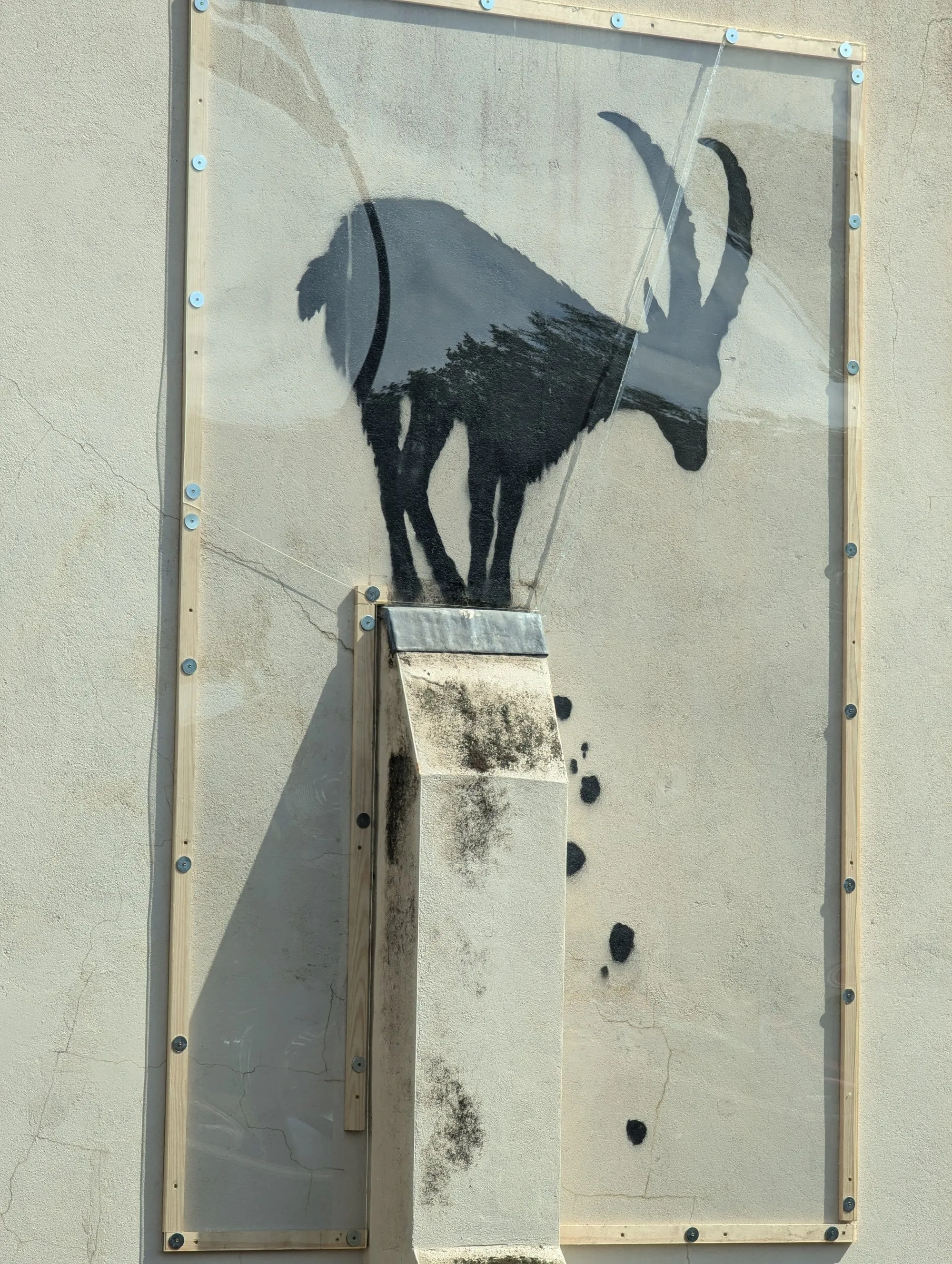
The goat near Kew Bridge.
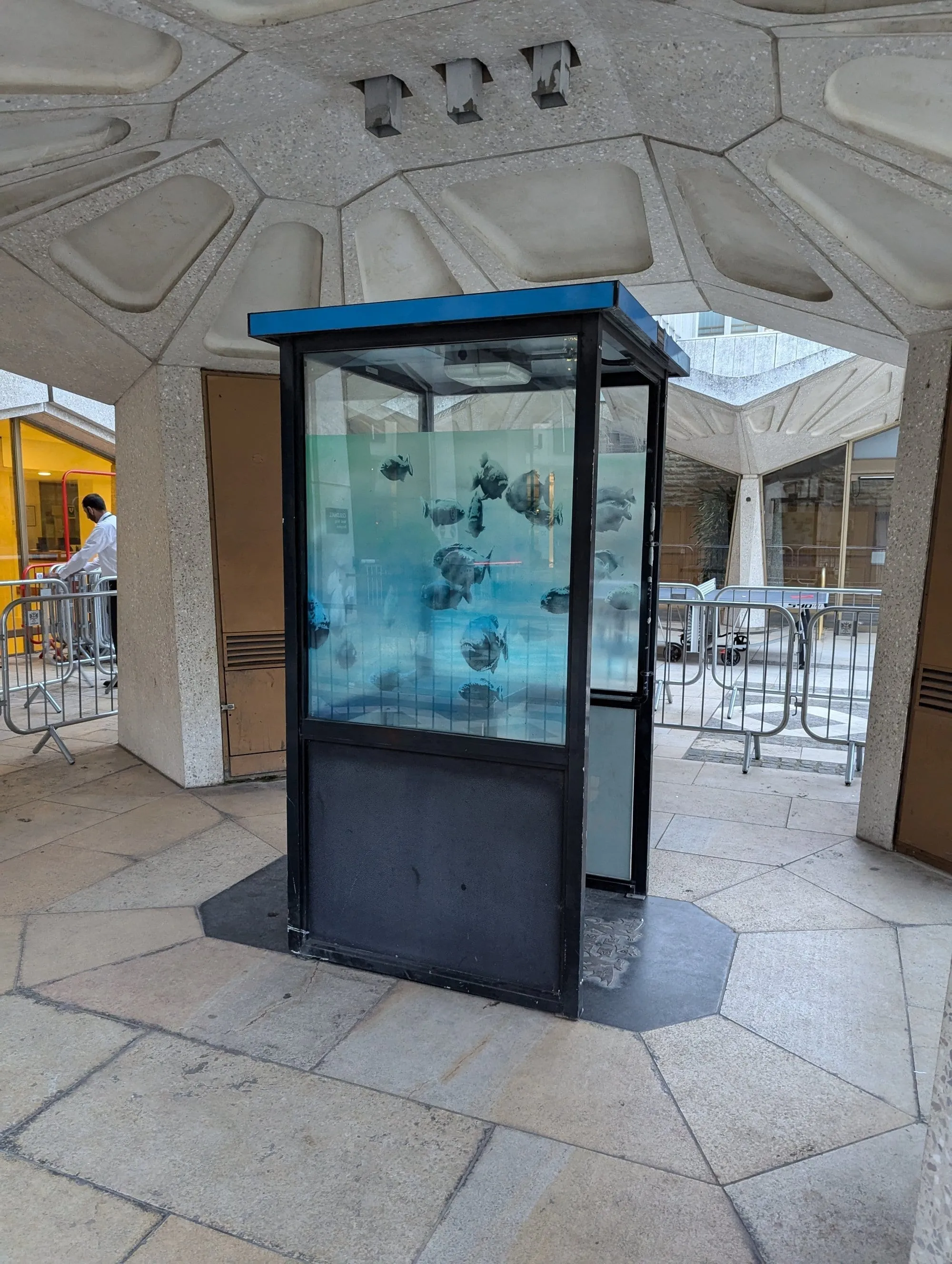
The piranhas at Guildhall Yard.
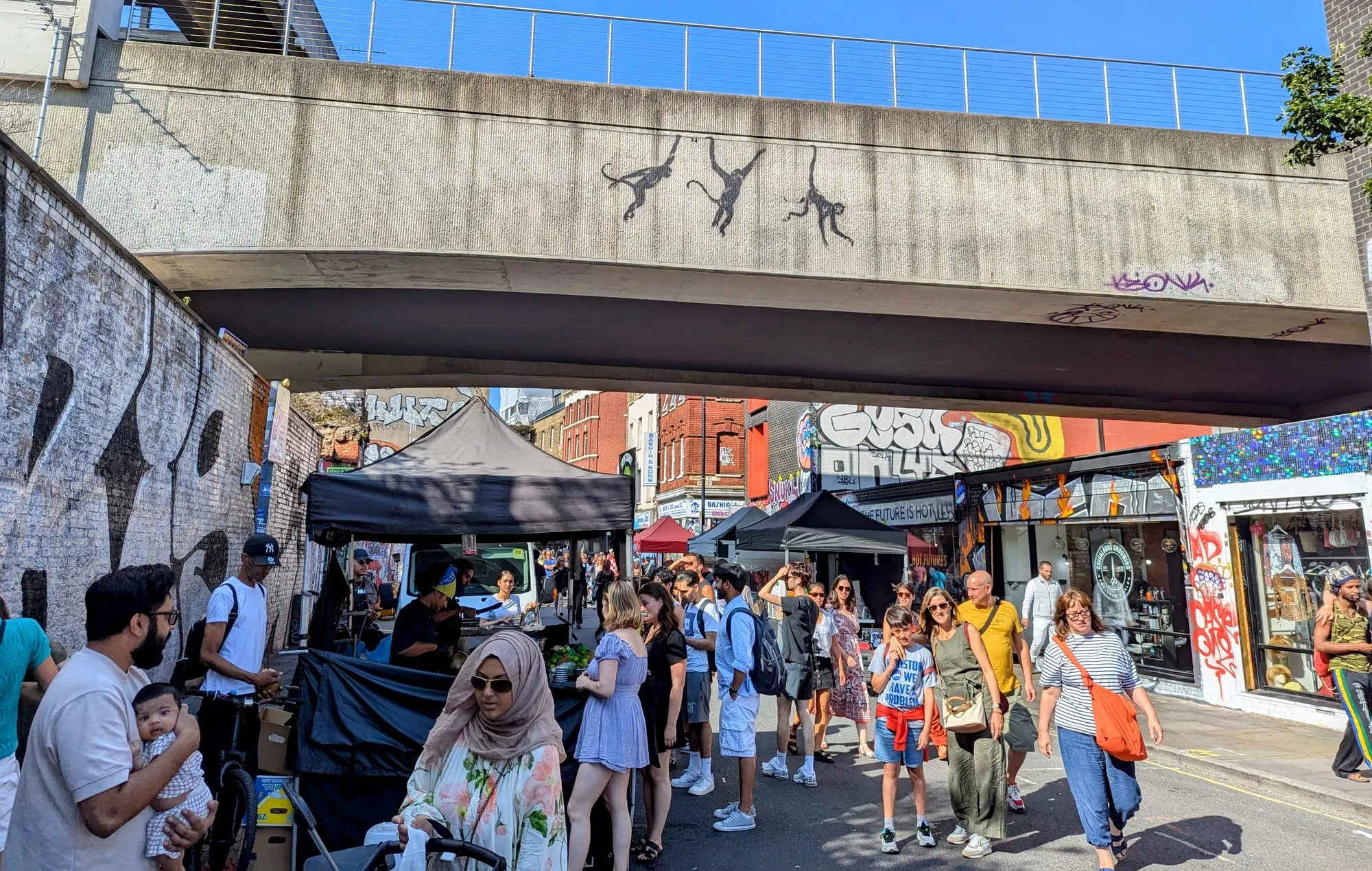
The monkeys on Brick Lane railway bridge.
| The work | Where | What is there now |
|---|---|---|
| Elephants | Edith Grove, Chelsea | Still there. Defaced and since repaired |
| Pelicans | Bonners Fish Bar, Walthamstow | Still there, and the best preserved of the nine |
| Rhinoceros | Westmoor Street, Charlton | Partly there. The wall stencil survives; the car it was mounting has gone |
| Goat | Kew Green | Cut out and removed, February 2025, by the building’s owner “for protection during building works”. Not returned as of January 2026, when the bare wall was found daubed with paint |
| Monkeys | Brick Lane railway bridge | Removed by Transport for London, December 2024 |
| Wolf | Rye Lane, Peckham | Stolen within about an hour. No arrests |
| Big cat | Edgware Road, Cricklewood | Dismantled over billboard safety concerns |
| Piranhas | Police sentry box, Ludgate Hill | In storage — free display at the London Museum from 28 November 2026 |
| Gorilla | London Zoo shutter, Regent’s Park | Original removed. What is on the shutter is a replica |
Go to Chelsea, Walthamstow and Charlton. The other six are a wasted journey.
Later work, and what happened to it
Blind Patriotism, Waterloo Place
Free · April 2026 · in place, behind barriers
The newest Banksy in London and the easiest to see. A suited figure stepping down off his plinth, holding a flag that blows back and covers his own face. It went up overnight on 29 April 2026 near Trafalgar Square and he confirmed it the next day.
Westminster City Council has spent almost £60,000 on it and is still deciding whether to make it permanent. It stands behind barriers, in the open, free to walk up to at any hour.
It is the one to see if you only see one. No ticket, no fence to peer through, no residential street to feel awkward on, and it is two minutes from Piccadilly Circus and five from Trafalgar Square — so it costs you nothing but the walk.
Go soon rather than eventually. Nothing about its future is settled: the council has not committed to keeping it, and the barriers are a holding measure, not a decision.
The Finsbury Park tree
Free · March 2024 · damaged but visible
Green paint sprayed across a wall behind a pollarded cherry tree, so the wall reads as the foliage the tree has lost. It was defaced with white paint within days; Islington Council fenced it, installed CCTV and sent patrols.
Still there, still fenced, still damaged. It is on Hornsey Road in Islington.
Free and visible from the pavement, but the fencing and the CCTV mean you are looking at it through a barrier rather than standing in front of it, and the white paint over the green is not coming off.
The tree changes with the seasons. The piece only works when the cherry is bare, because the green wall behind is standing in for the foliage it has lost — go between November and March and it reads as intended. In summer the real leaves come back and the joke disappears.
Finsbury Park station is about ten minutes’ walk.
Stargazing Children — two versions
Free · December 2025 · one visible, one boarded over
Two identical murals of children lying on their backs, one pointing upward, widely read as a comment on the housing crisis. Often listed with the animal series; they came more than a year later.
- New Oxford Street, in front of Centre Point, at the northern tip of Soho where it meets St Giles — behind transparent protection, and damaged, but visible. Free, on a public pavement, two minutes from Tottenham Court Road station, and the only one of the two you can actually see.
- Queen’s Mews, Bayswater — boarded over. It physically survives behind the boarding and you cannot see any of it. There is nothing to photograph and no way in; do not make the journey.
So there is one to visit, not two. Guides that list both as attractions are describing a wall you cannot look at.
Royal Courts of Justice, the Strand
⚠️ Gone. A judge striking a cowering protester, painted on the Grade I listed Royal Courts of Justice on 8 September 2025 and scrubbed off within two days because the building is heritage-protected. Over £85,000 has been spent removing it and a faded trace is still there behind screens.
Girl with Balloon is not where people look for it, and has not been for twenty years. The original stencil was under Waterloo Bridge in 2002, with the words “There is always hope” beside it, and the council painted over it. The famous self-shredding at auction in 2018 was a framed canvas — a different object entirely. There is nothing to see at Waterloo.
Where street art actually lives
Banksy is a fraction of it, and the rest is more interesting.
Leake Street, Waterloo
Free · legal · always changing
A three-hundred-metre tunnel under Waterloo station where graffiti is legal and repainted continuously. It is the only place in London where you can reliably watch work being made, not just look at it — on any given afternoon somebody is painting, and they are happy to be watched.
Free, open at all hours, and roofed, which makes it one of the best wet-weather hours in central London. Nothing lasts: a wall painted on Monday may be gone by Friday, so what you photograph is yours alone.
Bring nothing and buy nothing — there is no shop, no ticket and no guide. There are bars, a bowling alley and a restaurant in the arches off it if you want to stay.
It is two minutes from Waterloo station, down the ramp off Lower Marsh, and the entrance is easy to miss.
The rules, which are published and almost never mentioned. Painting here is not merely tolerated, it is actively encouraged, and you do not need permission. But discriminatory content and political messaging are both removed, as is unauthorised advertising. Keep noise down after 10pm. Organised events, filming and photoshoots need clearing in advance. And anything you paint may be painted over within days — the tunnel is managed by Platform4, and that is the deal.
Do not come looking for a Banksy. He ran the Cans Festival here in 2008, but with constant repainting it should be assumed none of that work survives.
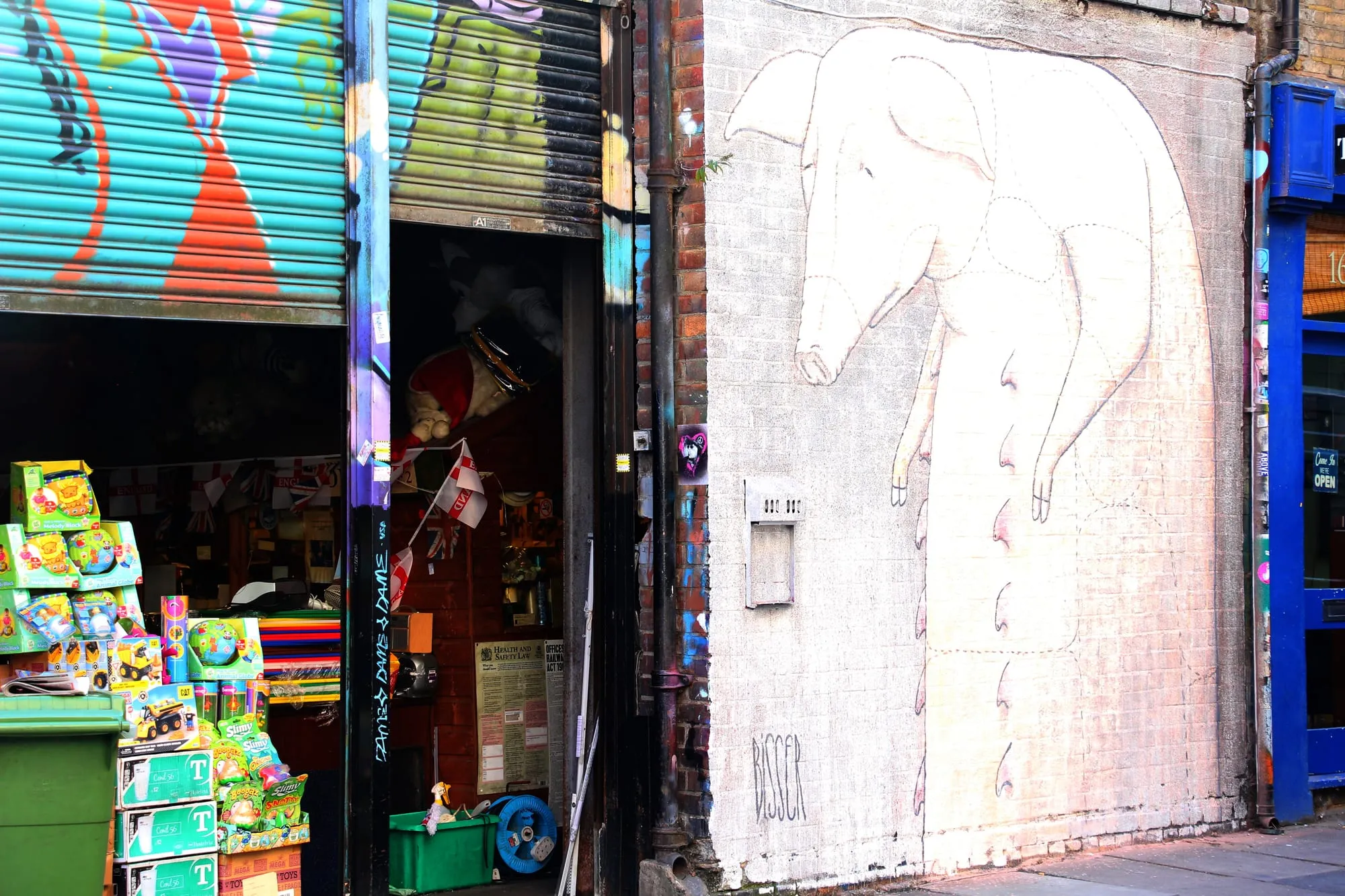
Shoreditch and Brick Lane
Free · best on a Sunday · walkable in two hours
The densest concentration in London, and it changes month to month. Rivington Street, Redchurch Street, Hanbury Street and the Brick Lane side streets are the core, and you can walk the lot in about two hours without a guide.
Rivington Street is where the Banksys are. The knife-and-fork rat and the television out of a window are mounted on the front of art’otel London Hoxton on the Great Eastern Street corner — outdoors, free, and visible from the pavement without going into the hotel.
The Pink Car is in Ely’s Yard at the Old Truman Brewery, just off Brick Lane: weathered, sealed in a perspex box and parked beside the food trucks, which makes it easy to combine with the market and the curry houses.
Sunday is the day. Brick Lane, Columbia Road and Spitalfields markets all run, the streets fill, and the area is at its best. Shoreditch High Street and Liverpool Street are both a few minutes’ walk.
Our numbered Shoreditch and Spitalfields walking route → takes in both mural clusters with a map and a day-by-day table of what is open.
Hackney Wick
Free · canal towpath · open at all hours
Large-scale murals along the Lee Navigation towpath, on warehouse walls and canal bridges, produced by a working artists’ community, not commissioned for tourists — which is why the scale and the standard are both higher than Shoreditch and the crowd is a fraction of it.
Walk it from Hackney Wick station south to the Olympic Park, about twenty-five minutes, and the murals are more or less continuous. The towpath is flat, free and never closes.
It is a different experience from Shoreditch. Nobody is running tours here, there is no map, and much of the best work faces the water, not the street — so you see it from the towpath and not from anywhere else.
The warehouses hold breweries and canalside bars that open at weekends and are mostly shut midweek. Hackney Wick on the Overground is the station.
Camden
Free · busiest at weekends
The Stables Market walls and the canal bridges either side of Camden Lock, plus a run of shop-front murals along Camden High Street that have been repainted more times than anyone has counted.
The Amy Winehouse mural is the one people come for. Pegasus’s Fallen Angel, showing her as a winged figure, is on the side of the canalside visitor information centre at Camden Lock Place — the wall became an unofficial shrine after her death and people still leave things at it. There is also a bronze statue of her in the Stables Market.
Free and outdoors, but the market buildings around it keep retail hours and the lanes are impassable on a Saturday afternoon.
Come on a weekday morning if you want to photograph anything, or arrive by canal — the towpath from Little Venice takes about an hour and puts you in beside the lock.
Brixton
Free · the Bowie mural, Tunstall Road
James Cochran’s Aladdin Sane portrait on the side of Morleys, painted in 2013 and now a permanent shrine — flowers appear against it every January.
It is behind protective glass and has been locally listed by Lambeth Council since 2016, so it cannot be altered or demolished without planning permission. Almost uniquely for London street art, this one is not going anywhere — which makes it the only entry on this page you can plan a trip around months ahead.
Free, outdoors, on a public pavement, and lit at night. It is on the Tunstall Road side of Morleys department store, thirty seconds from Brixton station, so it needs no detour at all.
Go in January if you want to see what it means to people. Flowers, candles and notes appear against it around the anniversary of his death, and the pavement in front becomes a shrine.
Brixton Village and Pope’s Road murals are five minutes away if you want to make a walk of it.
Walthamstow
Free · Wood Street Walls
One of the real hubs of large-scale London street art, built up over a decade by the Wood Street Walls project, which has put dozens of community-backed murals on gable ends across E17 — negotiated with residents, not imposed, which is why they have lasted.
It also has one of the three surviving pieces from Banksy’s 2024 animal series: the Pelicans on Pretoria Avenue, two birds painted above a fish and chip shop and seemingly eyeing up the fish inside. Free, outdoors and still in place.
The murals are spread across residential E17, so this is a walk of an hour or more rather than a single street. Wood Street and Walthamstow Central are the two stations, about fifteen minutes apart on foot.
Combine it with Sunday. Walthamstow’s market — the longest daily street market in Europe — runs along the High Street, and God’s Own Junkyard, the neon warehouse, opens Friday to Sunday only.
Dulwich
Free · the Dulwich Outdoor Gallery
The quiet alternative to east London, and much the strangest idea on this page. International street artists were invited to reinterpret Baroque Old Masters from the Dulwich Picture Gallery collection, and the results are painted on gable ends and garage doors through ordinary residential streets. Founded by the late Ingrid Beazley.
The point is the pairing. You are looking at a Murillo or a Poussin rendered at four metres on the side of a suburban house, a few minutes from the gallery that owns the original — so the trip works best if you do the gallery first and then walk out to find them.
Free and outdoors, but you need the map. The pieces are scattered and unmarked, and without the Dulwich Outdoor Gallery’s own trail you will find two and miss ten.
Dulwich Picture Gallery is closed on Mondays, which is worth checking since it is the anchor. West Dulwich is about twelve minutes by train from Victoria.
Croydon
Free · RISE Gallery and the Croydon Collection
Rarely walked by visitors, and that is what recommends it. RISE Gallery, founded in 2014, brokered most of it — negotiating between artists and building owners rather than painting illegally — and The Croydon Collection is the umbrella name for the borough’s permanent murals.
The scale is what surprises people. These are full building-side works on office blocks and car parks, not shutter art, and several are visible from the tram.
Free, outdoors, and concentrated enough to walk in an hour around the town centre, which is a different proposition from Dulwich’s scattered trail.
East Croydon is fifteen minutes from Victoria or London Bridge and considerably faster than most of the outer entries here — it is closer in journey time than Walthamstow or Penge, which is not what anyone expects.
Penge
Free · Penge High Street · open at all hours
Dozens of murals along and around the high street, coordinated locally over several years, not commissioned in one go — which is why the styles vary so much and why they keep appearing.
This is the least visited entry on this page by a wide margin, and that is the appeal: an ordinary south London high street that decided to paint itself, with no tour groups and nothing charging admission.
Free, outdoors and permanently accessible, and it takes about forty minutes to walk the lot.
Penge East and Penge West are different stations on different lines — East for Victoria and Blackfriars, West for London Bridge and the Overground — and they are about ten minutes apart, so check which one your train actually serves before setting off.
Seeing Banksy indoors
Everything else in this guide is on a wall in the street, free, and might be gone within a week. These are the opposite: originals indoors, where they are not going anywhere.
Two are public museums holding single works that came off the street: the piranhas at the London Museum and a rat at the London Transport Museum. The third is a private collection, Moco Museum. It is not run by Banksy; it is assembled from resale pieces and mounted commercially. That is not a criticism, but understand it before you pay: you are seeing a collector’s holdings, not an artist’s show.
The piranhas, London Museum, Smithfield
Free · opens 28 November 2026
The one piece of the 2024 animal series you will be able to see up close. Banksy painted a shoal of piranhas on the glass of a City of London police sentry box on Ludgate Hill, so it read as an aquarium; it was moved to Guildhall Yard, then into storage.
It goes on display when the new London Museum opens at Smithfield on 28 November 2026. The museum is free to enter, and it is about 11 minutes’ walk from the Basquiat pair in the Beech Street tunnel, which makes it an easy detour on our Banksy route.
The Croydon rat, London Transport Museum
Annual pass £27, under-18s free · Covent Garden Piazza · daily 10am–6pm
A rat dangling from a clock face, painted in October 2019 on the door of a Transport for London signal cabinet in Croydon. TfL removed the door to protect it, and since August 2025 it has been on show in a glass case at the museum.
Entry is an annual pass, £27 for an adult with under-18s free, plus a free timed ticket for the day. Last entry is 5.15pm. Worth it if you would go anyway; the museum is about ten minutes’ walk from Centre Point, the second stop on the route.
Moco Museum London, Marble Arch
From £16.90 · Marble Arch 1-4, W1H 7EJ · daily 10am–7pm
Moco is a private modern-art museum with sister sites in Amsterdam and Barcelona, and its London building sits beside Marble Arch. Banksy is the anchor but not the whole show — Basquiat, Warhol and a rotating contemporary programme share the floors, which is the difference between this and a single-artist exhibition.
Allow 90 to 120 minutes, which is their own estimate and about right for the building.
Tickets start at £16.90 and run through roughly £23.90 and £28.90 tiers depending on the day and what is bundled; booking online saves up to £5 a ticket against the door. Under-4s go free.
Open every day, 10am to 7pm, with no closing date and no residency to run out. Marble Arch is the nearest station.
The gift shops
Moco has one, and it is the realistic souvenir answer. The shop is a substantial part of the visit, not a rack by the exit. It sells no original Banksy work — for that, see Where to buy it below — but a poster costs a fraction of a Di-Faced Tenner and is labelled as what it is.
Where to buy it
There are two completely separate markets here and they have almost nothing to do with each other.
In east London, prints by working street artists cost less than a nice dinner. These are galleries and print studios where the artists are alive, the editions are current, and you can walk in off the street and take something home the same day.
In Mayfair, Banksy screenprints are a secondary-market asset sold by appointment, priced on enquiry, and bought by people who are not thinking about their hallway. Both are legitimate. Only one of them is a souvenir.
The east London print galleries
| Gallery | Where | Open | What it is |
|---|---|---|---|
| Nelly Duff | 156 Columbia Road E2 7RG | Wed–Fri 9am–6pm, Sat 11am–6pm, Sun 9am–5pm; Mon–Tue by appointment | Print gallery on the flower-market street, with its own framing service and gift vouchers |
| Jealous Gallery | 53 Curtain Road, Shoreditch EC2A 3PT | Mon–Sat 10am–6pm, closed bank holidays | Gallery and screenprint publisher. The print studio at 2a Luke Street EC2A 4NT is where the work is actually made, open Mon–Sat 9.30am–6pm |
| StolenSpace | 17 Osborn Street E1 6TD | Check before travelling | The long-standing Brick Lane-end street art gallery |
| Pure Evil | 108 Leonard Street EC2A 4XS | Thu–Sat 10am–6pm, Wednesday by appointment only | Artist-run, and the one most likely to have the artist in it |
Nelly Duff is the one to do on a Sunday, because Columbia Road Flower Market is happening outside the door and the gallery opens at 9am to catch it. It is the only gallery here with useful Sunday hours.
⚠️ StolenSpace shows its prices before VAT. Add 20% to anything you see there before deciding what you can afford — it is the most expensive assumption to get wrong on this page.
If it is a Banksy you want
You are in a different price bracket and a different postcode. Banksy has not sold new work through a London gallery since Pictures on Walls wound up, so everything on the market is resale.
- Maddox Gallery — Maddox Street W1S 2QE and Shepherd Market W1J 7QE. Stocks signed Banksy screenprints alongside Hockney and Warhol. Prices are on enquiry, which is itself the answer.
- Grove Gallery — Berkeley Square House, Berkeley Square W1J 6BD. Same model, same names.
- Quantus Gallery — Shoreditch, and the one that actually publishes figures. A Di-Faced Tenner is £2,450, which is the cheapest genuine Banksy object you are likely to see priced openly.
💡 The Di-Faced Tenner is the sane entry point. It is a printed banknote from the 2004 stunt rather than a signed edition, so it costs low thousands instead of tens of thousands, and it is unambiguously the real thing. Anything cheaper claiming to be Banksy is a poster.
⚠️ Authentication counts for more here than anywhere else in art. Banksy’s own body, Pest Control, is the only issuer of certificates, and unauthenticated work is effectively unsaleable. Never buy a Banksy on the strength of a gallery’s word alone — ask for the Pest Control paperwork before money moves.
Gift shops rather than galleries
Jealous and Nelly Duff both sell at gift-shop prices as well as gallery ones — small unframed editions, cards and prints in the tens, not the hundreds — which makes them the realistic answer to “I want to take some London street art home”. Nelly Duff also does framing, so you can walk out with something ready to hang.
Leake Street has no shop, which surprises people. The tunnel is legal and constantly repainted but entirely uncommercial, so the spray-paint shops around Shoreditch and Brick Lane are where the artists themselves buy.
What it costs
Nothing. This is completely free, and one of the very few things to do in London that changes week to week.
- Walk it yourself. Shoreditch, Hackney Wick, Camden, Brixton, Croydon and Penge all reward an aimless hour, and everything in this guide is on a public street.
- Guided tours run roughly £15–£30 and are worth it once, because the good guides know which pieces are painted over what, and who fell out with whom. The free walking tours are tip-based rather than actually free. Our walking tours guide covers Alternative London’s two, with and without a spray-painting workshop.
- Leake Street tunnel under Waterloo is legal, free, open all hours, and repainted constantly — the only place in London you can watch it being made.
- The indoor Banksys are mostly the exception to the free rule. Moco Museum is from £16.90 and runs year-round; the London Transport Museum’s rat needs a £27 annual pass. The piranhas at the London Museum, from 28 November 2026, are free.
- Buying it is a different question entirely. A print by a working street artist from a Shoreditch gallery runs from the low tens to a few hundred pounds. A resale Banksy starts around £2,450 for a Di-Faced Tenner and climbs steeply from there. See Where to buy it above.
- Nothing here is permanent. Everything in this guide was checked in August 2026 and a piece can go the week after publication, which is the nature of the form, not a flaw in it.
The best Banksy route
Ten of the fifteen surviving Banksys fit into one day, on foot with two train rides where walking would drag. The full stop-by-stop version, with a map, is our Banksy route.
- Blind Patriotism, Waterloo Place — start near Piccadilly Circus.
- Stargazing Children, Centre Point — walk, 15 minutes.
- Take the Central line from Tottenham Court Road to Bank — about 27 minutes door to door to the Cannon Street rat in Steelyard Passage.
- The Basquiat pair, Beech Street tunnel — walk, 25 minutes. From 28 November 2026, detour 11 minutes to the piranhas at the London Museum.
- The I Love London rat, Chiswell Street — 3 minutes.
- The Foundry pair, art’otel Hoxton — 15 minutes.
- The Pink Car, Ely’s Yard off Brick Lane — 15 minutes. Eat here.
- Take the Weaver line from Liverpool Street to Stoke Newington — about 47 minutes door to door to the Royal Family on Stoke Newington Church Street.
About three and a half hours, or two and a half if you stop at the Pink Car. Go on a Sunday, when the City is empty and Brick Lane’s market is on.
Not on it, and why: the Chelsea elephants, the Walthamstow pelicans and the Charlton rhino are each in a different direction, so they are separate trips. The Bermondsey fishing boy is too faded to be worth the detour. The Finsbury Park tree is out of the way too, and only worth it between November and March, when the cherry is bare.
What to know
- All of it is free. It is on the outside of buildings.
- Pieces disappear. Check recent photographs before making a special trip for one specific work.
- Perspex covers protect several Banksys and make them very hard to photograph without reflections. Overcast days are better.
- Leake Street is the reliable one because it is legal and constantly renewed — you will always find something.
- Shoreditch changes fastest. A guided tour is worth it there specifically, because the commentary is about what is new.
- Respect residents. Much of this is on the side of people’s homes and businesses.
- The London Mural Festival runs every four years, not annually — 2020, 2024, and next in 2028. There was no 2022 edition and there is no 2026 one.
Continue planning your London trip
- 🎬 London Filming Locations
- 🎪 Free Things to Do in London
- 🎨 Shoreditch Area Guide
- 🎭 Camden Area Guide
- 🏙️ City of London Area Guide
- 👀 The Best Views in London
Common questions
Where can I see Banksy in London?
Fifteen works are still viewable as originals. Ten of them fit on one route from Waterloo Place to Stoke Newington, walking with one Tube ride and one Overground train: Blind Patriotism, the 2026 statue; the Stargazing Children at Centre Point; the Cannon Street and Chiswell Street rats; two 2017 Basquiat tributes in the Beech Street tunnel; two 2004 stencils rescued from The Foundry on art'otel Hoxton; the Pink Car at the Old Truman Brewery; and the 2001 Royal Family in Stoke Newington. Of the 2024 animal series only the Chelsea elephants, the Walthamstow pelicans and the Charlton rhino remain in place, and the piranhas go on show at the London Museum from 28 November 2026.
Are Banksy works still in place?
Some. Six of the nine 2024 animals have been removed, stolen, dismantled or swapped for a replica, and the Royal Courts of Justice mural was scrubbed off within two days. This guide marks which are gone. Even the maps that track status fall behind — Banksy Map still listed the Kew goat as in place in September 2026, more than eighteen months after it was cut out — which is why people travel to blank walls.
Where is the best street art in London?
Shoreditch and Hackney Wick have the densest concentrations, and both change constantly. Leake Street tunnel under Waterloo is legal graffiti, repainted continuously, and the only place you can watch it being made.
Is street art free to see?
Yes, all of it. It is on the outside of buildings. Some tours charge for the commentary, but nothing here requires a ticket.
What was Banksy's animal series?
Nine pieces on nine consecutive days in August 2024 — a goat, elephants, monkeys, a wolf, pelicans, a big cat, piranhas, a rhinoceros and a gorilla at London Zoo. Six are gone. Only the Chelsea elephants, the Walthamstow pelicans and the Charlton rhino can still be seen in place, so it is not the walkable trail it is often written up as.