One of 20 self-guided London walks on this site. See every walk, from the South Bank to Hampstead Heath.
In this guide
In this part of London the question is not where to go. It is which day.
Columbia Road exists on a Sunday and does not exist on a Tuesday. The Brick Lane street market is a Sunday. Four of the Old Truman Brewery’s eight markets are weekends only. Christ Church Spitalfields opens its doors to visitors for three hours a week. Petticoat Lane is two different markets on two different streets depending on whether it is a weekday or a Sunday. Turn up on a Wednesday with a Sunday itinerary and you will walk past a lot of shutters.
This route runs north to south, from Columbia Road Flower Market down through the Boundary Estate and the length of Brick Lane, and finishes at Petticoat Lane. Eleven numbered stops, 2.6km measured and about 35 minutes of actual walking — call it a half day once the markets get involved. It is free apart from what you buy.
For the wider area — the bars, Hoxton, where to stay — see the Shoreditch area guide. This is the walking route version of it.
💡 The Short Version: Go on a Sunday and start at Columbia Road at 8am, because it shuts at about 3pm and does not run any other day. Walk south the whole way. The stop people miss is the Brick Lane Vintage Market, a basement under the Truman Brewery that is the only thing here open seven days a week. Christ Church lets visitors in on Sunday afternoons only. There are two bagel shops, not one. Finish at Petticoat Lane, then Liverpool Street.
The route
Map of the walk, numbered in walking order
Loading the map…
Open the whole route in Google Maps → — all eleven stops in walking order, set to walking directions, which is the version to put on your phone.
| # | Stop | Cost | Open |
|---|---|---|---|
| 1 | Columbia Road Flower Market | Free to walk | Sunday only, 8am–3pm |
| 2 | Arnold Circus & the Boundary Estate | Free | Always |
| 3 | Redchurch Street | Free to walk | Shop hours; street always |
| 4 | The two bagel shops | Free to walk | Beigel Bake 24 hours, 7 days |
| 5 | The Old Truman Brewery | Free | Eight markets, different days |
| 6 | Brick Lane Vintage Market | Free to enter | Seven days |
| 7 | Hanbury Street & the street art | Free | Always |
| 8 | Brick Lane’s south end & the Jamme Masjid | Free to walk | Street market Sunday only |
| 9 | Fournier Street & Christ Church | Free | Church Sunday 1–4pm only |
| 10 | Old Spitalfields Market | Free | Seven days, themed by day |
| 11 | Petticoat Lane | Free | Sunday and weekdays, two sites |
| + | Dennis Severs’ House | £16 + fee | Friday to Sunday only |
1. Columbia Road Flower Market
Sunday, from 8am until about 3pm. The market’s own site gives the hours as “8am ‘til 3’ish”; Tower Hamlets, which licenses it, has the traders down until 2pm. Treat the last hour as the wind-down, not a guarantee.
There is no midweek version. Six days a week Columbia Road is a quiet Victorian terrace in Bethnal Green; on the seventh it is a solid wall of cut flowers and potted plants with growers shouting over the top of them, and it is the best hour on this walk by a distance.
Go at 8am or after 2pm, and not in between. Early gets you room to move, the pick of the stock and a conversation with the person who grew the thing. The last hour is when traders cut prices hard rather than cart stock home, and it is where the shouting the market is famous for actually happens. Between about ten and one you are wedged in a crowd, unable to carry a plant.
The shops are half the reason to come. The market’s own site counts around sixty independent businesses along the street — galleries, ceramics, vintage, delis, a perfumer, bakeries — and they open on Sunday because the market does. Some also trade during the week, which helps if you are here on a Saturday and want the street without the crush.
⚠️ If you are not walking on a Sunday, start at stop 2 instead. Columbia Road is not a thin version of itself midweek; it is a residential street. Arnold Circus is six minutes’ walk south and the route works perfectly well from there.
2. Arnold Circus and the Boundary Estate
Six minutes south, and the stop nobody has heard of.
Seven streets converge on a raised circular garden with a bandstand on top of it. That is the centre of the Boundary Estate, and Historic England has the whole thing on the register — the gardens as a Grade II registered park and garden, the bandstand listed separately.
The history is worth two minutes. In 1890 the London County Council used the new Housing Act to clear the Old Nichol, a slum on this site, under what became the Boundary Street Improvement Scheme. It covered six hectares and displaced 5,719 people; 4,600 were rehoused in the blocks you are standing among. The revised plan — blocks along tree-lined avenues radiating from a central circus — was approved in 1893 and the scheme was finished by the end of 1900. Historic England calls it the first major initiative the LCC undertook in improving its housing stock, and says the estate “provided the inspiration of many later housing developments”.
The mound itself has a good story attached and a better one on the record: the earth came from the foundations of the new blocks, heaped up at the centre of the radial plan. Saving on cartage was the convenient part; the stated purpose was to give the new community something to be arranged around.
The bandstand went up in 1899. Four sets of steps at the compass points take you up two tiers of terracing to it. It is free, it is open, and on a weekday morning you will have it to yourself.
3. Redchurch Street
Two minutes further and the tone changes completely.
Redchurch Street is the design end of Shoreditch — a short run of independent fashion, skincare, homeware and coffee, the sort of street where a shop sells eight objects and every one of them is beautifully lit. Ten minutes end to end.
It is on the route, not in a shopping guide, because of what runs off it. Chance Street and the alleys around it are walled with murals, and they are repainted constantly. This is where the street art tours end up and where you are most likely to find someone actually working on a wall on a weekday morning.
Do not come with a list. Pieces here last months, not years. The mural you saw online has a decent chance of being gone, and the one that replaced it is what you will see.
4. The north end of Brick Lane and the two bagel shops
You join Brick Lane at the railway bridge, and this is where the walk starts.
There are two bagel shops here, not one, and that catches people out. They are a few doors apart, both with queues, both selling salt beef beigels, and both are separate businesses:
- Beigel Bake, 159 Brick Lane — open 24 hours, seven days a week, which its own site states plainly and which is the fact everyone half-remembers.
- The Beigel Shop, 155 Brick Lane — the yellow-fronted one, four doors down, and a completely separate business.
So “the 24-hour bagel place on Brick Lane” sends you to a street with two bagel shops on it, and telling someone to look for the yellow sign sends them to the other one. Our sandwich guide has the full story → — which family runs which, what each is better at, and what a salt beef beigel costs.
On a Sunday the street around them is a market. Tower Hamlets licenses the Brick Lane street market for Sundays, 10am to 3pm, and it has been running here since 1888 — flea-market stalls, household goods, retro fashion and food, filling the road under and around the bridge. On every other day this stretch is a road with two bagel shops on it.
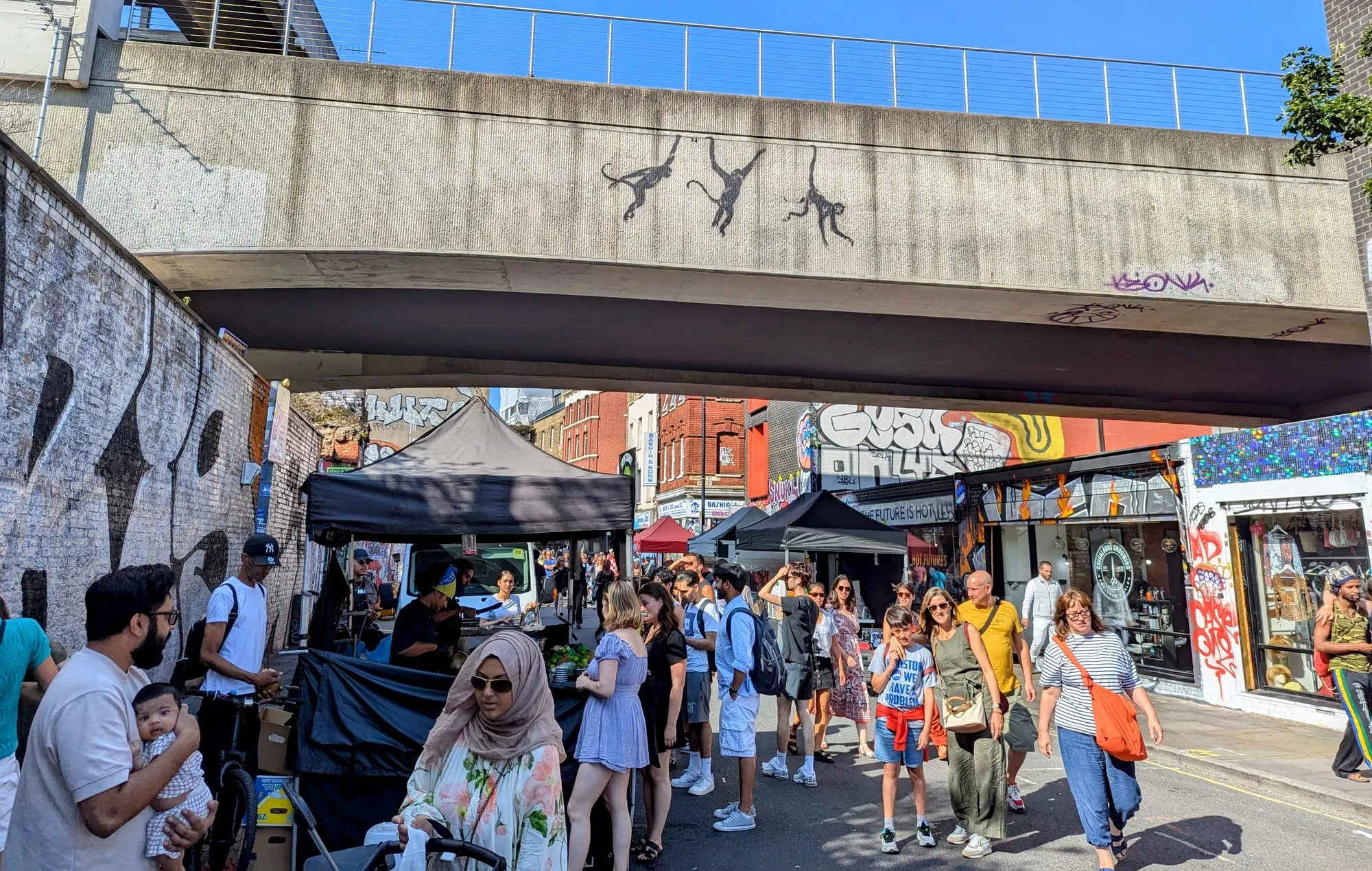
Brick Lane market, under the railway bridge.
5. The Old Truman Brewery
Brewing stopped here in 1989. What replaced it is hard to plan around, so here it is in full.
The brewery’s own site lists eight separate markets across the buildings on both sides of Brick Lane, and they do not run on the same days:
| Market | Where | Days |
|---|---|---|
| Brick Lane Vintage Market | F Block, 85 Brick Lane | Seven days |
| Upmarket | 83 Brick Lane | Seven days |
| Ely’s Yard food trucks | Ely’s Yard | Seven days |
| Artisan | Above the vintage market, 85 + 83 | Thursday to Monday |
| Backyard Market | 146 Brick Lane | Saturday & Sunday |
| The Tea Rooms | Next to 146 Brick Lane | Saturday & Sunday |
| Rinse Showrooms | U Block, by 146 Brick Lane | Saturday & Sunday |
| Provisions | G1 Ely’s Yard | Saturday & Sunday |
Weekend hours across all of them are broadly Saturday 11am–6pm and Sunday 10am–6pm; the seven-day ones open 11am–6pm Monday to Saturday with a 10am start on Sunday. Artisan is the odd one — a curated floor of makers above the vintage market, open Thursday to Monday, so it is the market that catches out a Tuesday or Wednesday visit.
Upmarket, at 83 Brick Lane, is the food answer. Its operator puts it at over forty street food traders — Ethiopian, Korean, arepas, Japanese shaved ice — and it is open every day, with a retail section that only appears at weekends. Ely’s Yard behind it is outdoor food trucks, also seven days.
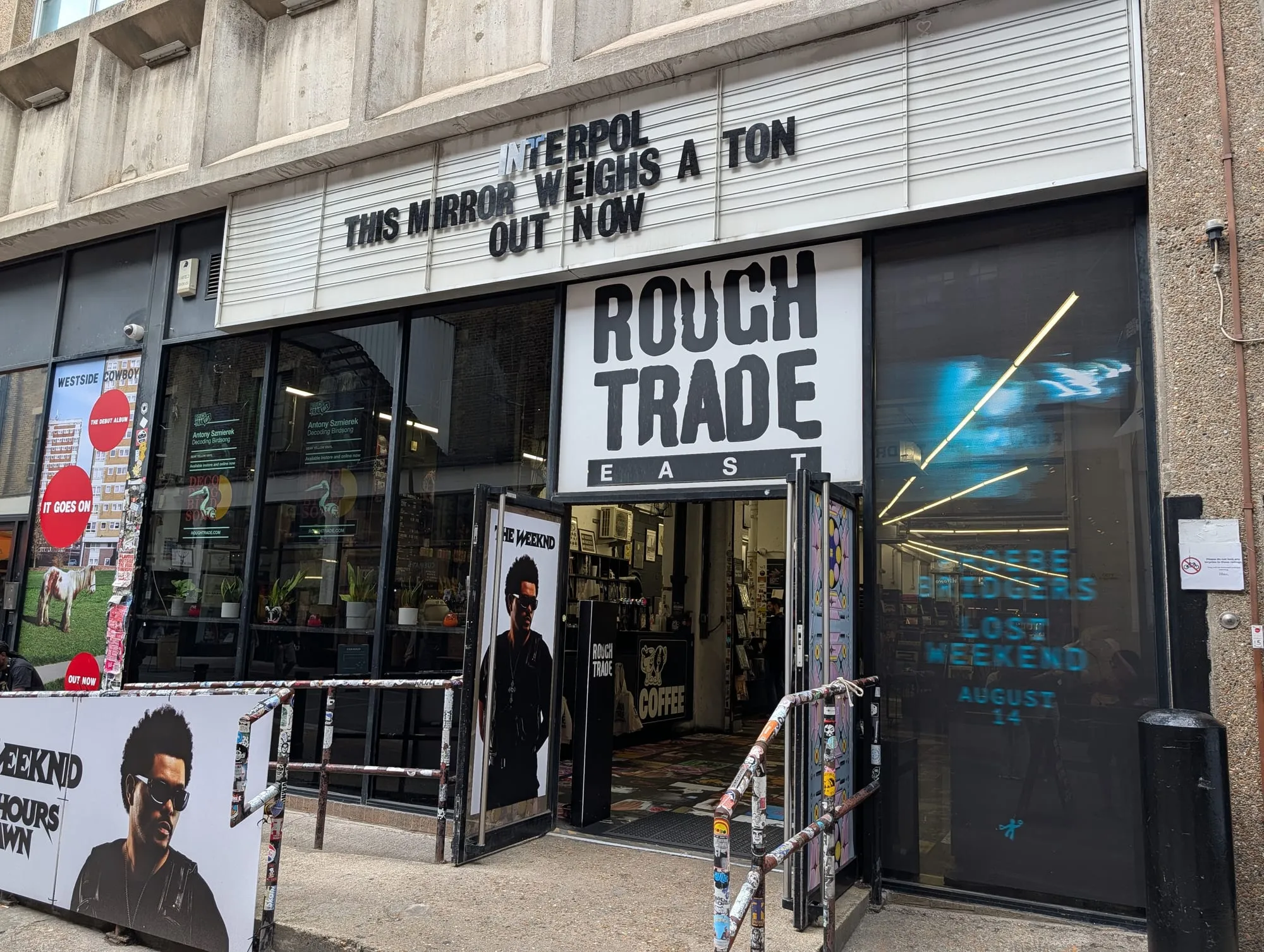
Rough Trade East, Dray Walk.
Rough Trade East is on Dray Walk, inside the complex, and it is open daily. In-store gigs run on the stage at the back and the shop is free to walk into either way.
⚠️ The Boiler House is not one of these. The Boiler House food hall on Brick Lane is no longer one of the Truman Brewery’s markets. Do not plan a lunch around it.
6. The Brick Lane Vintage Market
The one place on this walk that is never shut, and the reason a midweek version of this route still works.
It is underground. You go down a neon-lit staircase off Brick Lane into the basement of F Block at 85 Brick Lane, and the operator’s description of it is “an iconic underground vintage haven and the largest vintage market in the UK” with over 100 shops in it. Traders come from across the UK and Europe, not a rota of local stalls, so each unit is effectively its own boutique with its own eye, and one aisle runs from restrained tailoring to completely mad within a few metres.
The range is much wider than “vintage” implies. The market’s own listing runs from the 1920s through to the 1990s — fur and feather capes, vintage bridal wear, men’s suits, hats, sunglasses, bags and jewellery — with racks of vinyl to flick through between the clothes.
Open every day: Monday to Friday 11am–6.30pm, Saturday 11am–6pm, Sunday 10am–6pm.
💡 Come on a weekday if you actually want to buy something. The Sunday crowd makes it hard to work a rail, and the traders have time for you when it is quiet. This is the single strongest argument on this page for walking the route on a Tuesday.
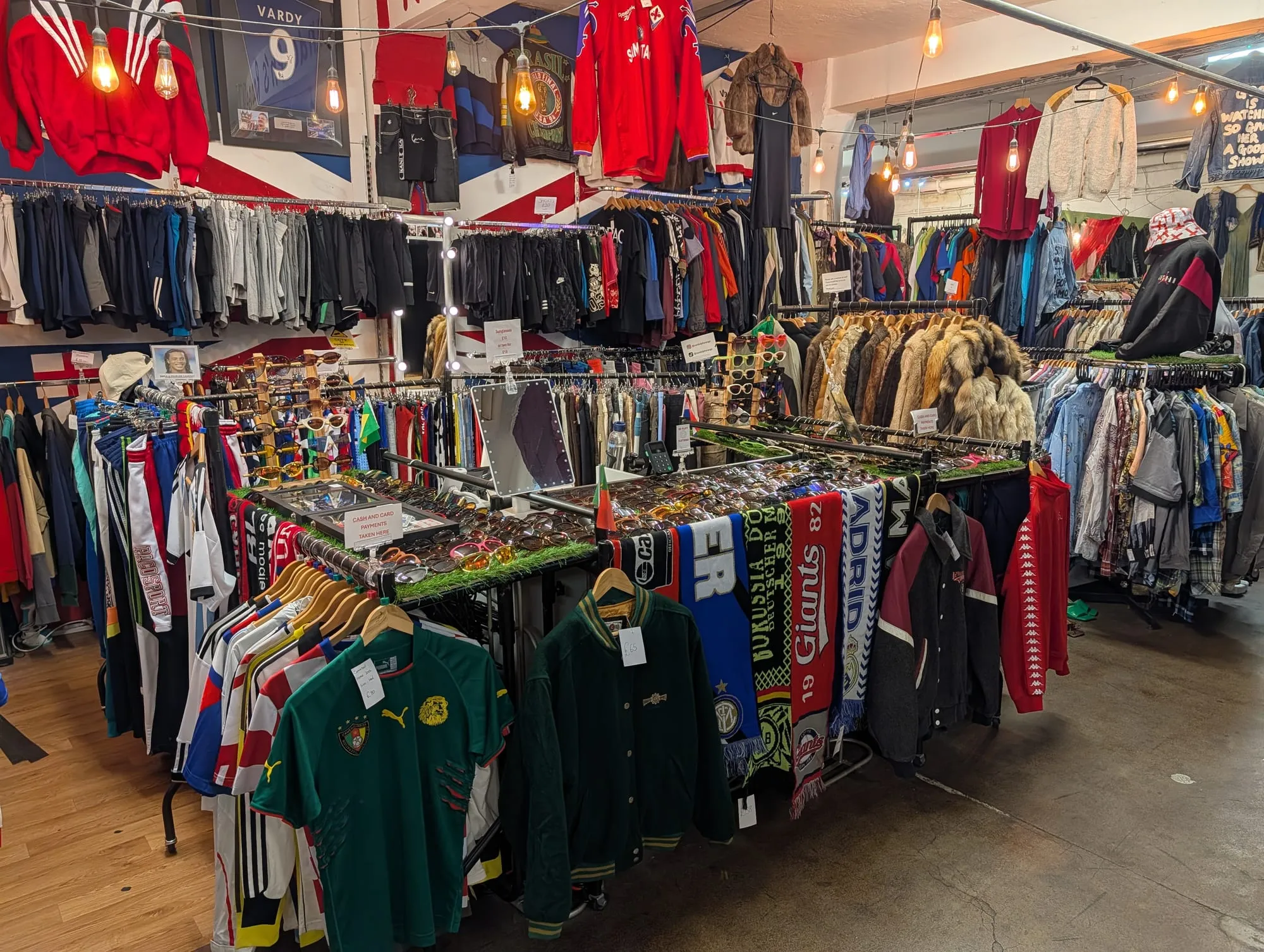
The Brick Lane Vintage Market.
7. Hanbury Street and the street art
Hanbury Street crosses Brick Lane at the vintage market, and the walls both sides of the junction are the second of the two street art clusters on this route.
This is a two-minute detour that most people already do by accident, and it is worth doing deliberately. Walk east off Brick Lane, then back and west, and look up as well as ahead — a good share of the best work here is above shopfront height, on gable ends and the sides of yards.
As with Redchurch Street, treat it as a walk, not a checklist. Pieces get painted over within months, which is the deal the artists work to and the reason the street is worth coming back to.

Street art near Hanbury Street.
8. Brick Lane’s south end and the Jamme Masjid
South of Hanbury Street, Brick Lane changes character for the third time. This is the Bangladeshi restaurant end, the stretch the street is famous for, and it needs a word of caution and a piece of history.
The caution: the restaurants along here vary enormously and some employ touts to work the pavement. A tout is a reliable signal to keep walking — the places worth eating in do not need one. Look for somewhere busy with people who are not visibly on a walking tour.
The history is at 59 Brick Lane, on the corner of Fournier Street, and it is one of the best buildings in London for what it says about the area. It has been a house of worship since 1743 and it has housed three faiths:
- 1743 — La Neuve Église, a chapel for Huguenot Protestants who had fled France.
- 1809 — a Wesleyan Methodist chapel.
- 1898 — the Machzikei Hadath Synagogue, serving the Jewish community of Spitalfields and Whitechapel.
- 1976 — the Brick Lane Jamme Masjid, which today serves thousands of Bengali Muslims and holds around 3,000 for Friday prayers.
Three waves of arrivals, one set of walls, and getting on for three centuries of continuous worship. It is Grade II* listed, and the minaret-like structure alongside it went up in 2009 — so the newest thing on the building is younger than most of the street art you have just walked past.
Find the sundial before you move on. It is set in the pediment of the Fournier Street elevation, it carries the date 1743, and the motto cut beneath it is UMBRA SUMUS — “we are but shadow”. It has watched three congregations come and go and it is still keeping time.
It is a working mosque, not a visitor attraction — visits are arranged for schools, colleges and community groups — so this is a stop you look at from the pavement.
9. Fournier Street and Christ Church Spitalfields
Turn right into Fournier Street and the eighteenth century arrives all at once.
These are the Huguenot silk weavers’ houses, and Historic England has the terrace listed as a group — Grade II, mostly early eighteenth century, red and yellow brick with parapets, three storeys and an attic. Look up: the wide upper windows are weavers’ lofts, put there to get light onto the looms. Many are still lived in. Walk it slowly; it is 200 metres and it is the quietest thing on this route.
At the west end, Christ Church Spitalfields, and this is the day-of-the-week trap of the whole walk.
⚠️ The church opens to visitors on Sundays, 1pm to 4pm. That is the church’s own guidance and it is the only general public opening in the week. The vestibule opens 10am to 3pm on Monday and Tuesday, from which you can see into the nave but not walk into it. Group tours of up to twelve are £60 and need booking at least two weeks ahead. On a Wednesday, Thursday, Friday or Saturday you are looking at the outside.
The outside is not a consolation prize. It is Nicholas Hawksmoor’s, built 1723–29 and opened on 5 July 1729 under the Fifty New Churches Act; Grade I listed since 1950. Historic England’s entry is blunt about the effect — “white ashlar tower and spire dominate the Spitalfields area” — and the western portico of four giant Tuscan columns is where to stand. A restoration finished in 2004 and the redeveloped crypt opened in 2015.
The Ten Bells is on the corner at 84 Commercial Street: Grade II listed, recorded on the list as founded in 1666 with the present building mid-nineteenth century, and the listing singles out the coloured Victorian tiled plaque of an eighteenth or nineteenth-century street scene inside the Commercial Street entrance. See the eating section below for when its kitchen is actually on.
10. Old Spitalfields Market
Two minutes west, under a Victorian roof, and the most misunderstood market on the walk — because it opens seven days a week and is a different market every day.
| Day | What is actually on |
|---|---|
| Monday | Daily market, 10am–6pm |
| Tuesday | Daily market, 10am–6pm |
| Wednesday | Daily market plus Urban Makers Wednesdays, 10am–5pm |
| Thursday | Antiques Market, and the hall opens early at 8am |
| Friday | Daily market — plus the Vinyl Market on the 1st and 3rd Friday only, 10am–5pm |
| Saturday | Daily market plus Urban Makers, 10am–6pm |
| Sunday | Busiest, and the earliest close of the week at 5pm |
The Thursday antiques market is the one to plan for if you are not here on a Sunday. It has been running over fifteen years, it is curated by dealers who bring stock in from around the country and Europe, and the hall opens at 8am for it — the only early start of the week. Ceramics, furniture, ephemera, cameras, militaria, costume jewellery, and prices the market itself describes as the reason to come early.
The Vinyl Market is the trap. It is often written up as “records on Fridays”, which is wrong: the market’s own listing is the first and third Friday of each month, 10am to 5pm. Two Fridays in four you will find the ordinary daily market.
The Kitchens — around a dozen food counters around shared tables — runs 11am to 6pm Monday to Saturday and 11am to 5pm on Sunday, which makes it the most reliable lunch on this route and the one that does not care what day it is.
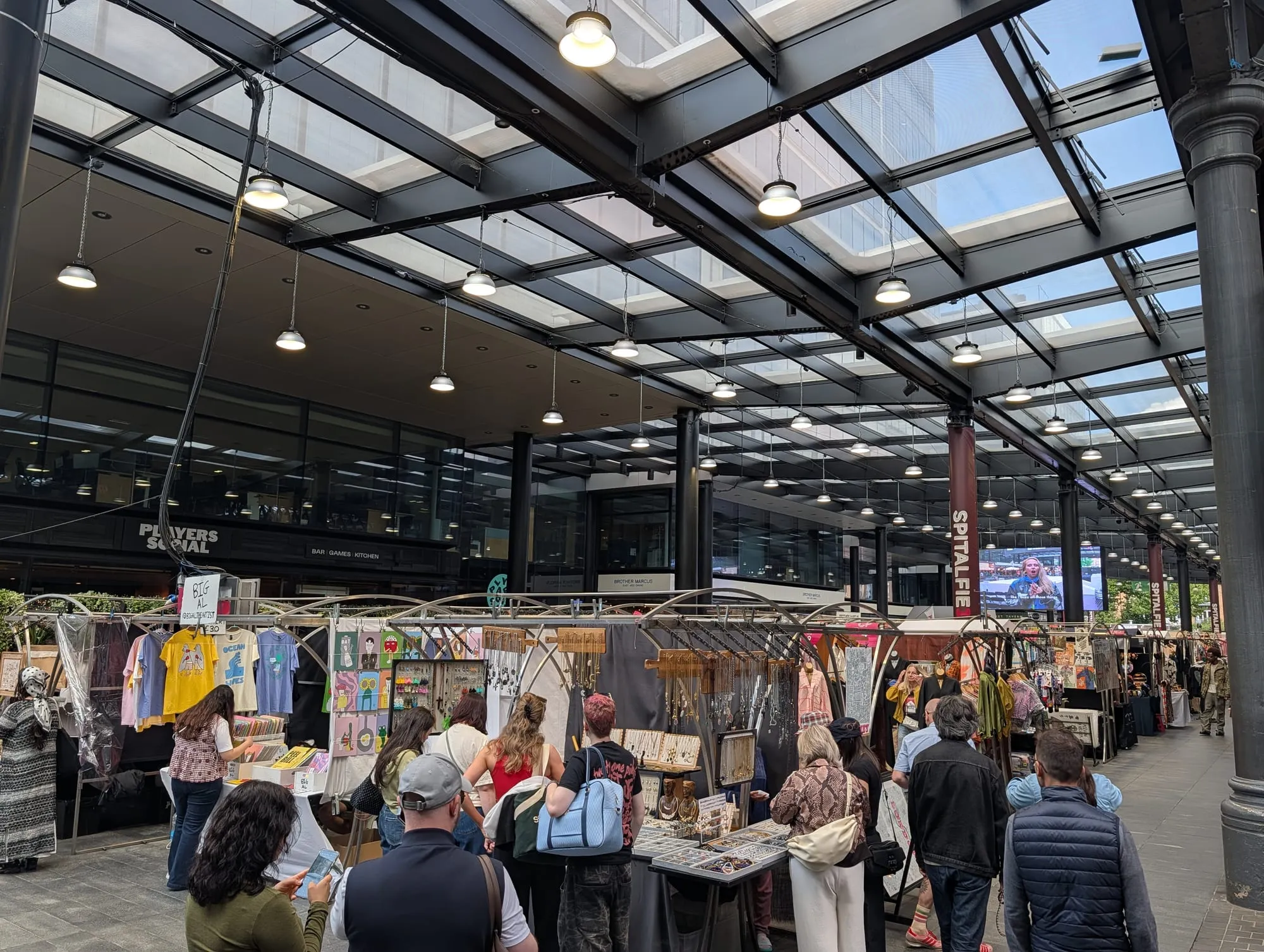
Old Spitalfields Market.
11. Petticoat Lane
Five minutes south, and the last surprise: Petticoat Lane is two different markets on two different streets, and which one you get depends entirely on the day.
It is also not on a street called Petticoat Lane, because there isn’t one. The Victorians thought the reference to underwear was too racy and renamed it Middlesex Street, which is where the Sunday market runs.
- Sunday, 9am to 3pm — the big one, on Middlesex Street and spilling into Cobb, Leyden, New Goulston, Old Castle, Strype, Toynbee, Goulston and Wentworth Streets. Fashion, textiles and leather goods, with Asian and African fabric shops behind the stalls.
- Monday to Friday, 8am to 4pm — a street food market on Wentworth Street, around the Goulston Street and Bell Lane junctions, with clothing stalls trading along Wentworth Street through the week.
So the weekday version is a lunch market and the Sunday version is a clothing market, and they occupy different ground. The textile trade here goes back to Huguenots arriving in the 1750s and was carried on by Eastern European Jewish traders through the nineteenth century — the same sequence of arrivals you have been walking through since Brick Lane.
Liverpool Street is five minutes north and Aldgate East five minutes east, which makes this the right place to stop.
The detour: Dennis Severs’ House
Worth its own section because it is nothing like anything else on this walk, and because it only runs three days a week.
18 Folgate Street, two minutes off the route between stops 9 and 10. A Georgian house arranged as though the eighteenth-century family living in it has just walked out of the room — fires lit, food on the table, chamber pots, the sound of the street outside. It is not a museum with labels; there is nothing to read and nothing roped off.
Day visits run Friday, Saturday and Sunday, in timed slots between 12pm and 3.15pm, and last about 45 minutes. £16 plus a £1.50 booking fee. Friday and Saturday are the Relaxed Day Visit, where talking is allowed; Sunday is the Silent Day Visit, which is done without speaking. A Silent Night Visit at £25 and evening performances — the Dennis Severs’ Tour at £75, for no more than seven people — appear on the same booking calendar.
Book online. Walk-ups depend on availability and latecomers are not admitted.
⚠️ Read the practicalities before you book. There are no toilets. There is no wheelchair access — uneven floors, steep stairs, and visitors must be able to leave the building unaided. No photography. Only handbags and small backpacks, carried in your hand. Open fires mean smoke levels can be high, and nuts are used and displayed throughout the house. Under-16s need one adult each.
Where to eat
Three answers, and the day decides between them rather than the food.
Upmarket, 83 Brick Lane (£), at stop five — the food hall inside the Truman Brewery, with over forty street food traders and open every day: 11am to 6pm Monday to Saturday, 10am to 6pm Sunday. Ely’s Yard behind it is outdoor food trucks, also seven days. This is the answer at the halfway point and the answer on a Monday.
The Kitchens at Old Spitalfields (£), at stop ten — around a dozen counters around long shared tables, 11am–6pm Monday to Saturday and 11am–5pm Sunday, entirely covered. The wet-weather answer, and the one that lands at the end of the walk, not the middle.
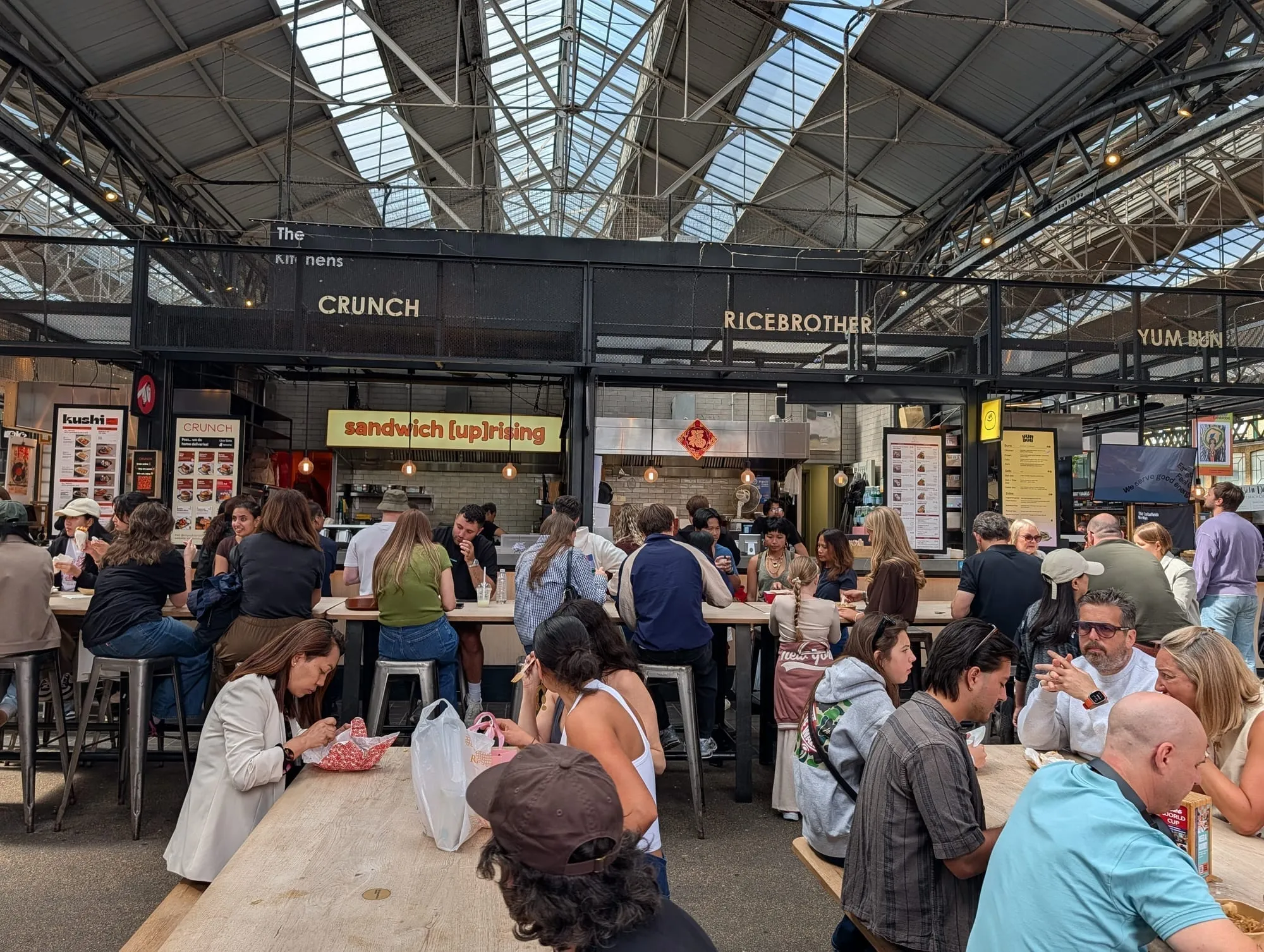
The Kitchens, Old Spitalfields Market.
A salt beef beigel at 159 Brick Lane (£), at stop four — the one that is open whatever time you get there, because it never closes.
For a pint rather than lunch, the Ten Bells at stop nine is open seven days — noon to midnight Monday to Wednesday, 11am to 1am Thursday to Saturday, 11am to midnight on Sunday. The kitchen is closed on Mondays and runs noon to 9pm the rest of the week, so on a Monday you can have a drink but not a meal.
Brick Lane’s curry houses are at stop eight and are a separate decision from this walk. Be selective, ignore the touts, and see the area guide for the full picture.
The best day to go
Sunday, and it is not close. This is one of the few walks in London where a single day gets you everything and the other six get you a fraction.
| Day | What you get |
|---|---|
| Sunday | Everything. Columbia Road, the Brick Lane street market, Petticoat Lane, all eight Truman markets, and Christ Church open 1–4pm |
| Saturday | Close second. Every Truman market runs, Old Spitalfields is at full stretch, Dennis Severs’ is open. No Columbia Road, no Christ Church |
| Thursday | The best weekday. Antiques at Old Spitalfields from 8am, Artisan opens, and the vintage market is browsable |
| Friday | Vintage market, Upmarket, Artisan, Dennis Severs’. Vinyl Market only on the 1st and 3rd Friday |
| Monday | Quiet. Vintage market, Upmarket, Artisan and Old Spitalfields open; Christ Church vestibule 10am–3pm. Ten Bells kitchen shut |
| Tuesday–Wednesday | Quietest. Vintage market and Upmarket open; Artisan closed. Wednesday adds Urban Makers at Spitalfields |
What closes if you do not come on a Sunday: Columbia Road entirely, the Brick Lane street market entirely, Petticoat Lane’s Middlesex Street footprint, Christ Church’s interior, and — Saturday aside — the Backyard Market, the Tea Rooms, Rinse Showrooms and Provisions.
What does not care what day it is: Arnold Circus, Redchurch Street, the street art, the Jamme Masjid from the pavement, Fournier Street, Beigel Bake, the Brick Lane Vintage Market, Upmarket, Ely’s Yard, Old Spitalfields and Rough Trade East. That is still seven of the eleven stops.
If you came to shop rather than to look, a Tuesday or a Thursday beats a Sunday outright. The basement vintage market is the biggest of its kind in the country and holds over a hundred traders; on a Sunday you cannot work a rail, and on a Tuesday you can go through it and get a conversation with the person selling. Thursday adds the antiques market from 8am and a floor of makers upstairs at Artisan. Old Spitalfields’ Kitchens run all week. Fournier Street is better empty. Nobody is shouting at you on Brick Lane.
The Sunday version is the better day out. The weekday version is the better shop, and it is the one almost no guide recommends.
On time of day: if it is Sunday, be at Columbia Road for 8am — that single decision does more for the day than anything else on this page. You will reach Brick Lane by ten as the street market opens, Old Spitalfields by early afternoon, and Petticoat Lane before it packs up at three.
Getting there and back
Start: Hoxton (London Overground) is the closest station to Columbia Road, about five minutes; Bethnal Green (Central) and Old Street (Northern) are around fifteen. Finish: Liverpool Street (Elizabeth line, Central, Circle, Metropolitan, Hammersmith & City and rail) five minutes from Petticoat Lane, or Aldgate East (District, Hammersmith & City).
Shoreditch High Street (Overground) sits beside stop 3 and is the way to join the route halfway if you are skipping Columbia Road.
The walk is flat and paved throughout and never more than about five minutes from a station, so it is easy to cut short. The one climb is the four steps up to the bandstand at Arnold Circus.
Walked south to north it also works, and finishes at Columbia Road — but only if it is a Sunday and only if you can be there before three, which is exactly the constraint that argues for doing it this way round.
Carry on walking
- City of London: Bank to Tower Bridge — starts at Bank, a short walk south of Spitalfields.
- The Banksy route — its stop 7, the Pink Car in Ely’s Yard, is beside stop 5 here and the ninth original Banksy on the way from Waterloo Place.
What to do with the rest of the day
- The Shoreditch area guide — Hoxton, the bars, Boxpark, the Museum of the Home, and where to stay.
- London’s best markets — where Columbia Road, Spitalfields and Brick Lane sit among the rest, and which days the others run.
- London street art and Banksy — the Rivington Street cluster north of here, and eight more areas.
- The City of London walk — starts at Bank, ten minutes south-west of where this one finishes.
- Where to stay in Shoreditch — the hotels compared, and which streets are loud at 2am.
- The best areas to visit in London — the neighbourhoods compared by what each is best for, how long it takes and the best day to go.
Common questions
What is the best walking route through Shoreditch and Spitalfields?
North to south: Columbia Road Flower Market, then Arnold Circus and Redchurch Street, down the length of Brick Lane through the Truman Brewery, and out at Christ Church, Old Spitalfields Market and Petticoat Lane. It is 2.6km measured, about 35 minutes of actual walking, and two to three hours with the markets. Going this way puts the Sunday-only flower market first, while it is still open.
Which day should I do the Shoreditch and Spitalfields walk?
Sunday, if you want every market at once — Columbia Road runs Sundays only from 8am to about 3pm, the Brick Lane street market 10am to 3pm, Petticoat Lane on Middlesex Street 9am to 3pm, and all eight of the Truman Brewery's markets are open. Christ Church Spitalfields also opens to visitors on Sunday afternoons and no other day. Thursday is the best alternative: Old Spitalfields runs its antiques market from 8am and the basement vintage market is browsable rather than jammed.
Is the Brick Lane vintage market still open?
Yes. The Brick Lane Vintage Market is in the basement of F Block at 85 Brick Lane, underneath the Old Truman Brewery, and its operator lists it as open seven days a week: Monday to Friday 11am to 6.30pm, Saturday 11am to 6pm and Sunday 10am to 6pm. It is the one market on this route that never has a closed day, which makes it the reason a midweek walk still works.
Can you go inside Christ Church Spitalfields?
Only on Sunday afternoons. The church's own guidance is that it opens to the public on Sundays from 1pm to 4pm. The vestibule opens 10am to 3pm on Monday and Tuesday, from which you can see into the nave but not walk into it, and group tours of up to twelve people are £60 and need booking two weeks ahead. On every other day you are looking at Hawksmoor's portico and spire from the outside.
Which is the real Brick Lane bagel shop?
There are two, a few doors apart at the north end, and that catches people out. Beigel Bake at 159 Brick Lane is the one whose own site states it trades 24 hours a day, seven days a week. The Beigel Shop at 155 is a separate business with a yellow shopfront — so 'look for the yellow one' sends you to the other shop. Both sell salt beef beigels and both have queues.
How long does the Shoreditch and Spitalfields walk take?
The walking itself is 2.6km and about 35 minutes. Realistically it is a half day, because most of the eleven stops are markets you go into, not buildings you look at — and if you do Columbia Road at 8am and finish at Petticoat Lane, it fills a Sunday morning and most of the afternoon.