In this guide
At a glance
- Vibe
- Roman street plan under glass towers, and empty at weekends
- Time needed
- A full day with the Tower and St Paul's
- Best day
- Weekdays for atmosphere and open pubs; weekends for empty streets
- Travel zone
- 1
- Walkability
- 5/5
- Typical spend
- ££
Best for
Nearest stations
- St Paul'sCentral
- BankCentralNorthernWaterloo & CityDLR
- Liverpool StreetElizabeth lineCentralCircleMetropolitanHammersmith & City
- Tower HillDistrictCircle
The City of London is the original city: a square mile on the Roman street plan, still a separate authority with its own Lord Mayor and police force, and now the densest cluster of tall buildings in Britain.
It is also the strangest place in London to visit, because roughly half a million people work here and only about eight thousand live here. On a weekday it is a crush. On a Sunday morning you can stand in the middle of a medieval street and hear nothing.
The City of London has its own share of the commemorative plaques marking where notable people lived or worked - see them on our interactive map.
Why visit — and who should skip it
Come here if you want history stacked on history — a Wren cathedral, a Norman keep, fragments of Roman wall, and glass towers built over all of it. It also has the two best free viewpoints in London.
Skip it if you want to eat or drink casually at the weekend. The City empties on Saturdays and Sundays, and much of it closes with the offices. Come on a weekday for atmosphere, or a weekend specifically for the emptiness — but bring a plan for lunch.
Top sights and activities
- St Paul’s Cathedral — Wren’s 1710 dome, and the 528-step climb to the Golden Gallery via the Whispering Gallery. Sightseeing is ticketed; Evensong is free and lets you sit in the quire.
- Tower of London — A Norman fortress begun in 1066, the Crown Jewels, the Yeoman Warders and the ravens. Book ahead and arrive at opening.
- Tower Bridge — The 1894 bascule bridge beside the Tower, and the one most people mistake for London Bridge. Walking across it is free. The ticketed Exhibition adds the high-level walkways, the glass floor over the road and the Victorian engine rooms. Lift times are published in advance, and watching it open costs nothing.
- Horizon 22 — Level 58 of 22 Bishopsgate and the highest public viewpoint in London, about ten metres above The Shard’s gallery. Book a slot online.
- Sky Garden — The planted terrace at the top of 20 Fenchurch Street, the “Walkie-Talkie”. Free with booking.
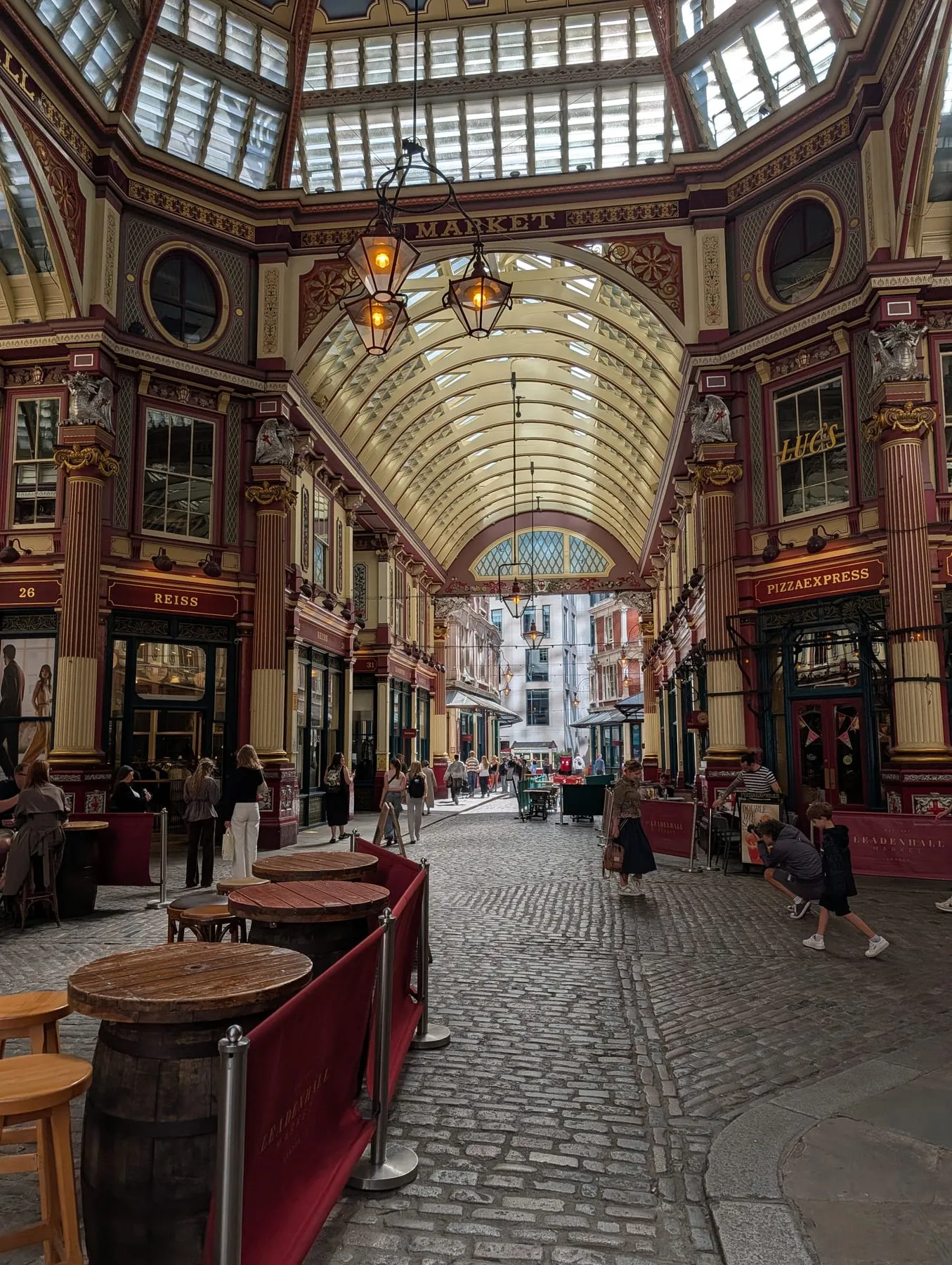
- Leadenhall Market — A painted Victorian arcade of 1881, where Hagrid walks Harry to the Leaky Cauldron in the first Harry Potter film. Best on a weekday when the traders are open.
- The Roman remains — The London Wall at Tower Hill and Noble Street, the Temple of Mithras rebuilt in situ beneath Bloomberg’s building (free, booked), and the amphitheatre under the Guildhall Art Gallery.
- The Wren churches — Around 50 were built after the Great Fire; roughly half survive. St Stephen Walbrook, St Mary-le-Bow and St Bartholomew the Great are the best, and all are free.
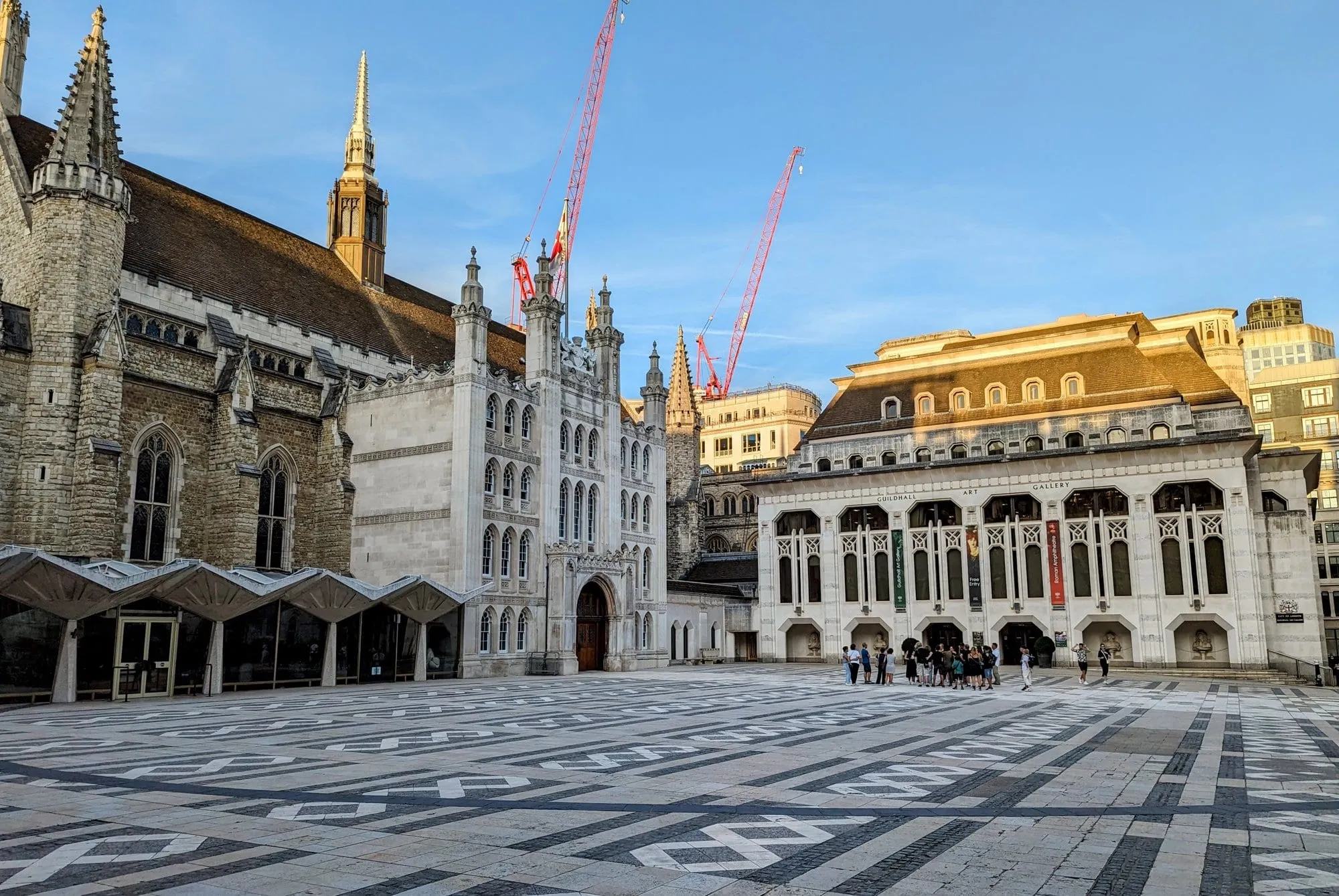
Guildhall Yard.
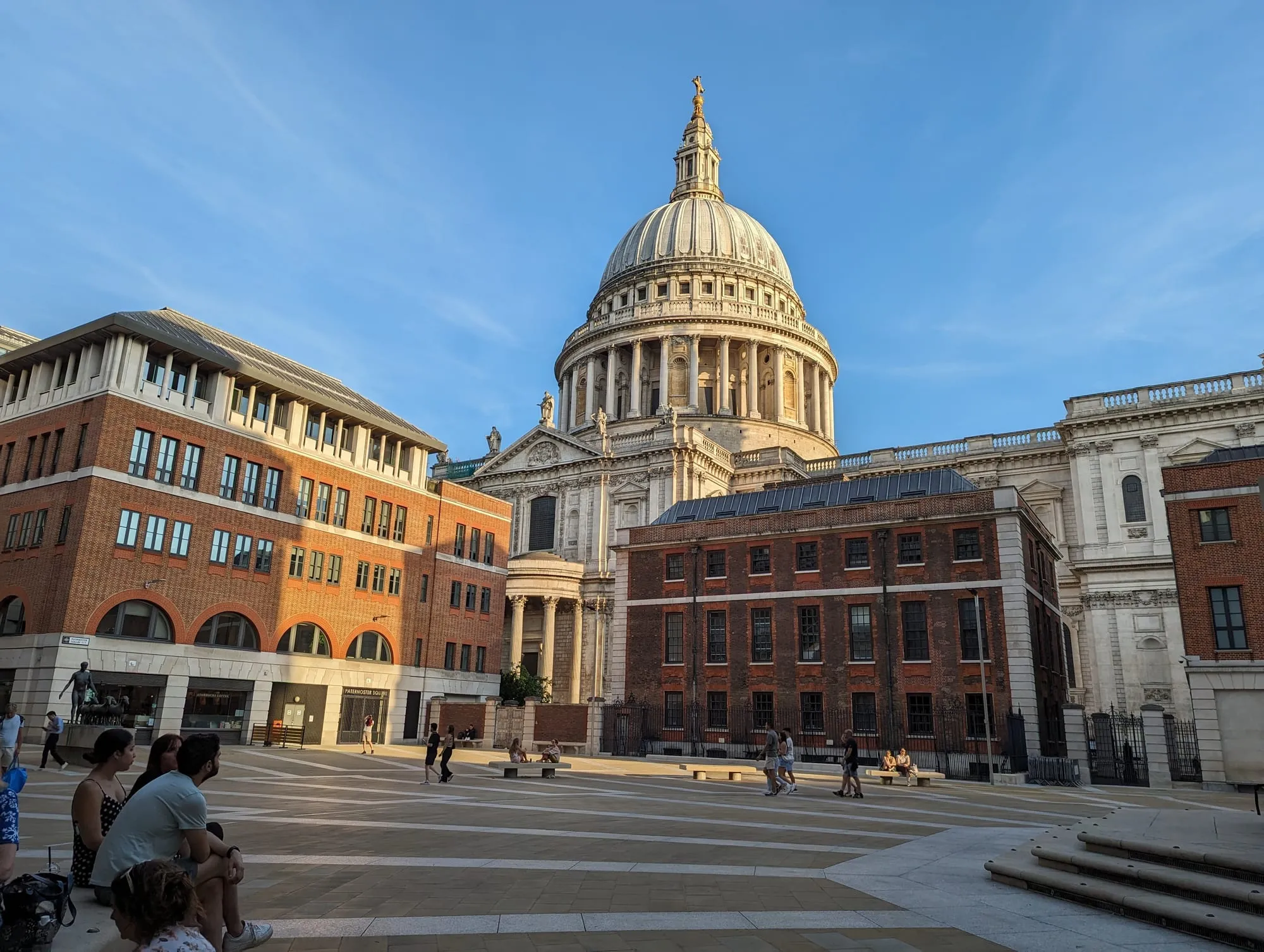
St Paul’s, over Paternoster Square.
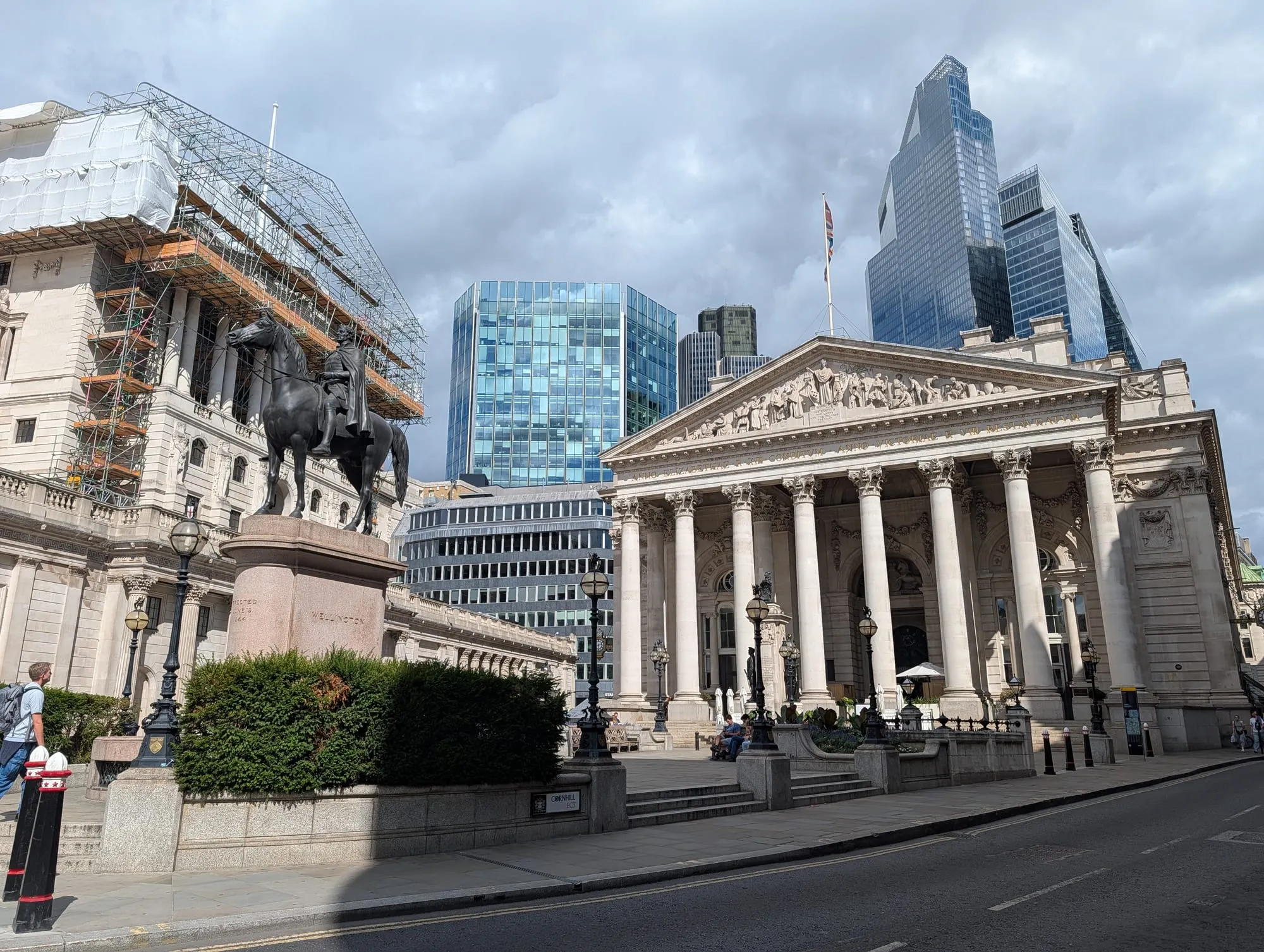
Bank junction.
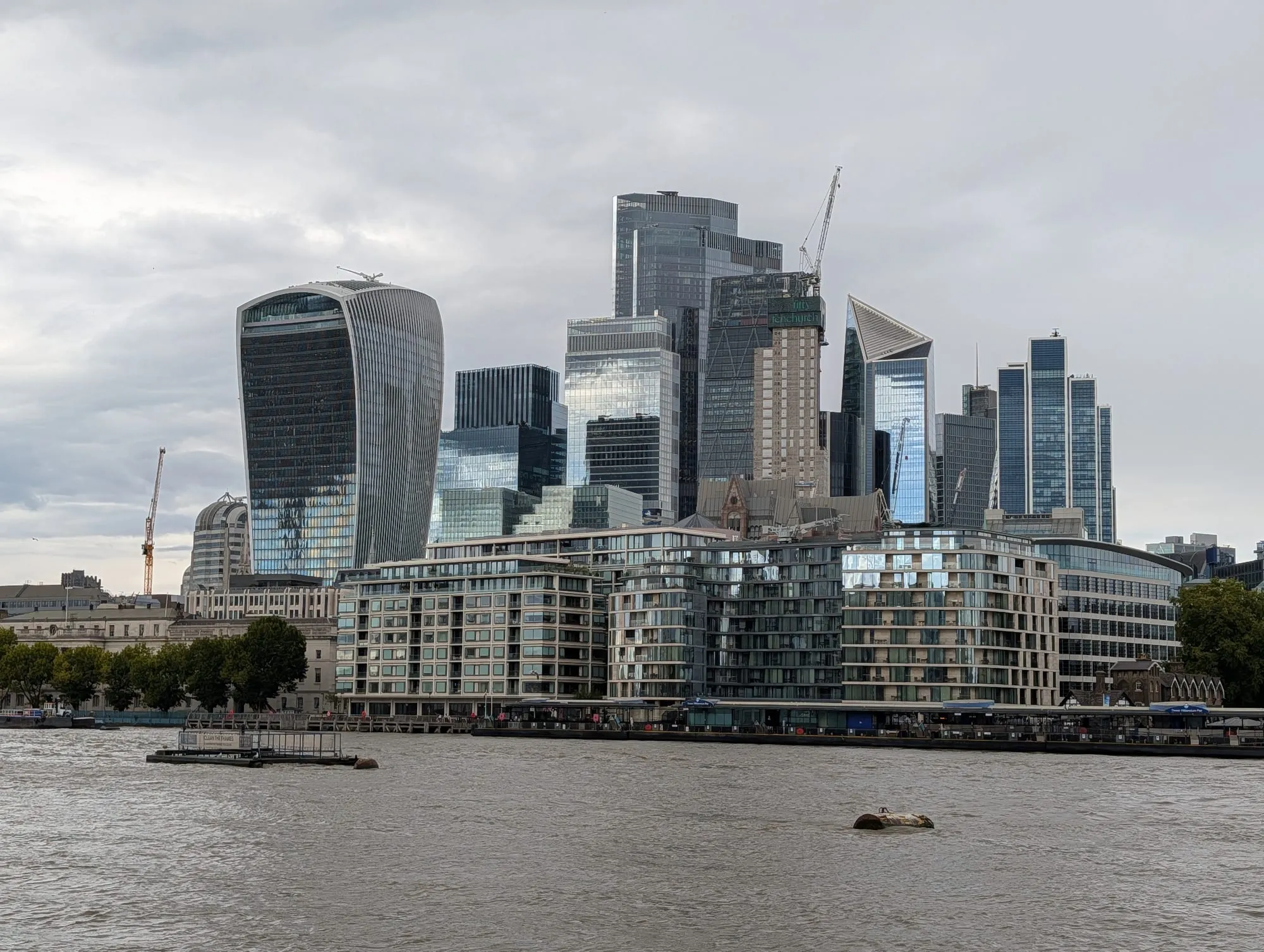
The City’s tower cluster, from the south bank.
Key streets and micro-districts
St Paul’s and Paternoster Square
The cathedral, the square behind it, and the shopping centre opposite that most visitors walk past without realising what is on its roof.
St Paul’s is £27 for an adult, which includes the floor, the crypt and all three dome galleries. The climb to the Golden Gallery is 528 steps with no lift at any point — 257 to the Whispering Gallery, 376 to the Stone, 528 to the top — and the cathedral itself advises against it for anyone with mobility difficulties. Monday to Saturday only for sightseeing; services are free to attend.
The roof terrace at One New Change is free, has no ticket and no queue, and gives you the dome at close range from a bar-height parapet. It is the best free thing in this part of the City, and it is directly opposite. Looking at St Paul’s costs nothing; climbing it costs £27.
Paternoster Square behind the cathedral is a modern pedestrian square with the Temple Bar gateway on one corner, Wren’s 1670s arch moved here from the Strand in 2004. Sweetings at 39 Queen Victoria Street is the Victorian fish restaurant nearby — lunch only, weekdays only, no bookings.
Bank and the Royal Exchange
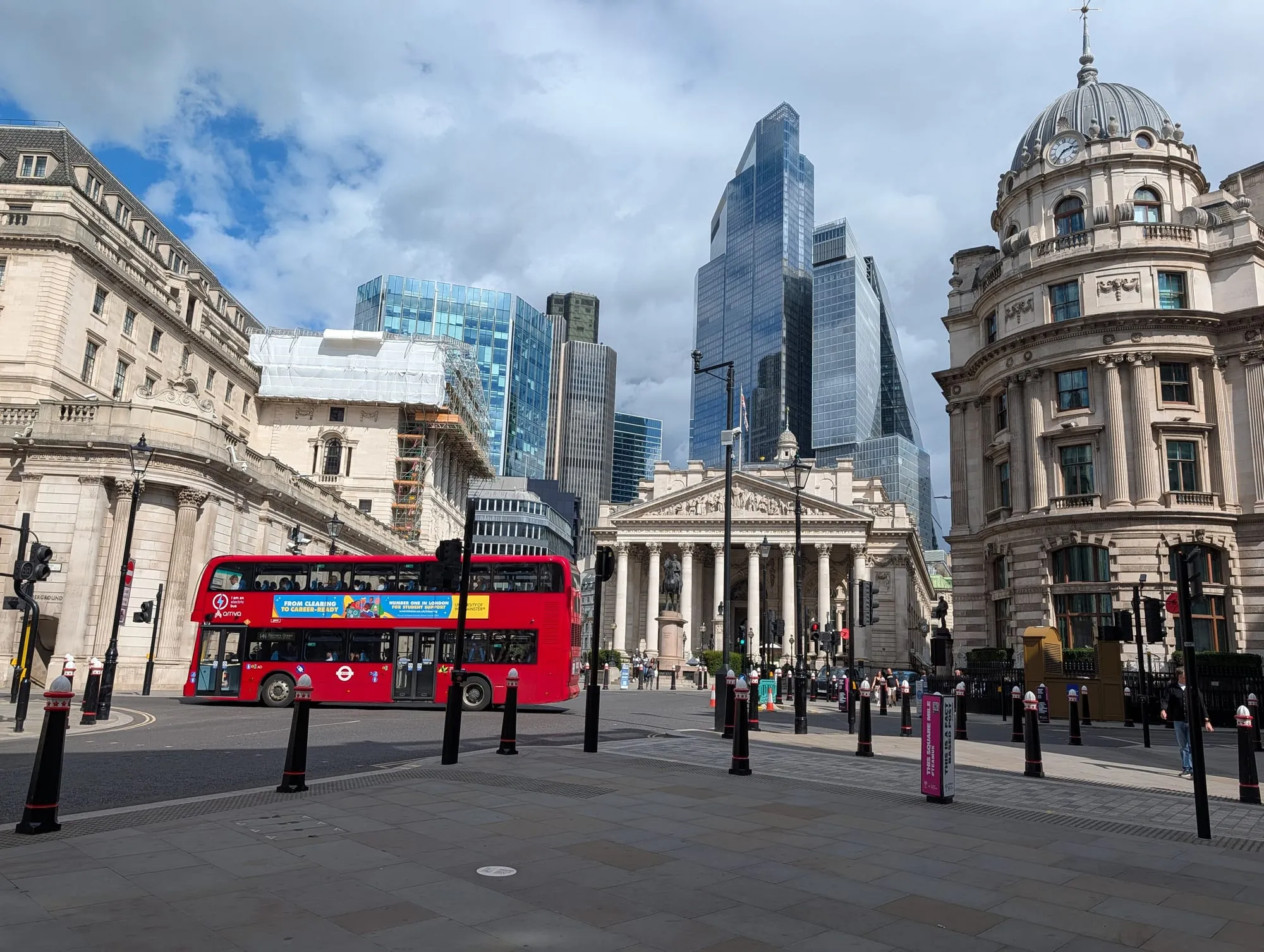
The Royal Exchange at Bank.
Seven roads meeting at once, with the Bank of England, the Royal Exchange and Mansion House on three corners of the junction. It is the most concentrated piece of imperial architecture in Britain and it is also a working traffic interchange, so give yourself a moment to look up.
The Royal Exchange is open and free to walk into — Victorian courtyard, mosaic floor, now luxury shops around a central bar. Nobody will stop you.
The Bank of England Museum is free, entered from Bartholomew Lane round the side, and it lets you lift a real gold bar. Weekdays only, closed at weekends and bank holidays, which is the trap here — this whole district shuts on a Saturday.
Royal Exchange Buildings, the alley behind, is where the snowy kiss at the end of Bridget Jones’s Diary was filmed. Bloomberg Arcade two minutes south has the modern eating, including Brigadiers for Indian barbecue, and the London Mithraeum beneath it — a reconstructed Roman temple, free, but pre-booked.
Bank station is directly underneath and has been substantially rebuilt, so exits are not where older maps put them.
Leadenhall and the tower cluster
Leadenhall Market sitting directly beneath 22 Bishopsgate, with the Gherkin, the Cheesegrater and the Scalpel within two streets. The most dramatic street-level contrast in London, and the reason to walk this bit rather than ride through it.
The market is free, roofed and open to walk through, which makes it the best wet-weather ten minutes in the City. In the first Harry Potter film it played the streets leading to the Leaky Cauldron, and the blue door used as the pub’s entrance is now Two Eyes Coffee House on Bull’s Head Passage. It is the first stop on our Harry Potter filming locations walk.
It keeps City hours. The shops and bars trade Monday to Friday and it is close to dead on a Sunday, so come on a weekday — around six in the evening is when it is fullest and best.
Three viewpoints are within five minutes, and two are free. Horizon 22 on level 58 is the highest public view in London and costs nothing, though it needs a timed ticket and is fully enclosed. The Lookout at 8 Bishopsgate is also free and runs to 9pm on Mondays and Fridays. Sky Garden is free with a ticket released three weeks ahead, with paid walk-in slots from £11.50 if you have missed them.
For eating up high, Duck & Waffle at 110 Bishopsgate is open 24 hours — the only London viewpoint you can use at four in the morning.
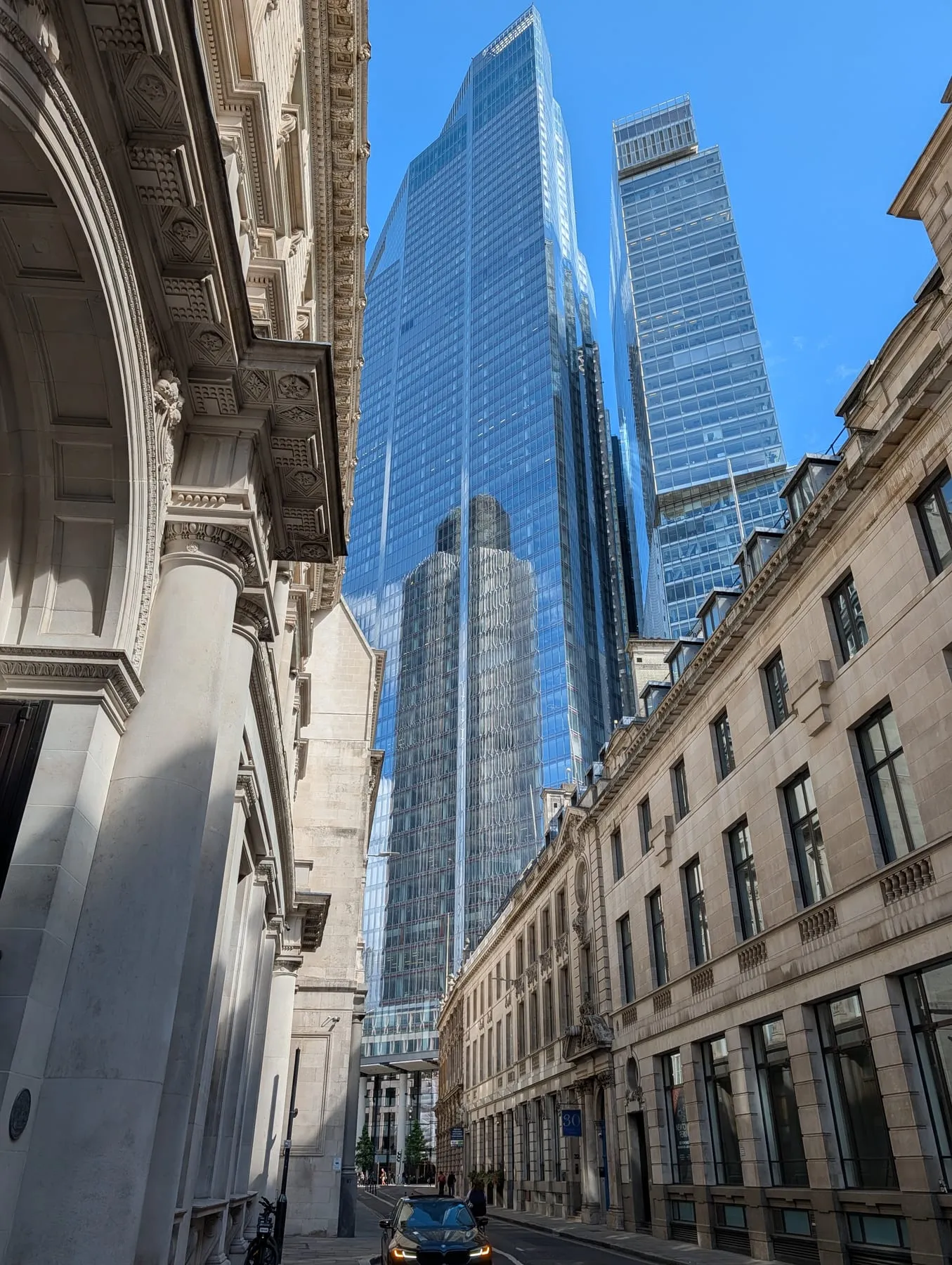
Old and new, on Leadenhall Street.
Tower Hill and the riverside
The Tower of London, the best surviving stretch of the Roman city wall — right beside Tower Hill station, free and unfenced — and the approach to Tower Bridge.
Almost all of the view is free. The Tower is expensive and busiest between 11am and 3pm, but the moat, the wharf and the riverside pavement cost nothing, and the upstream pavement on Tower Bridge is the officially designated viewpoint: the Tower, St Paul’s, The Monument and HMS Belfast in one sweep.
The Tower Bridge Exhibition is £18, one adult rate with no seasonal tier, open daily 9.30am to 6pm with last entry at 5pm. It buys you the glass floors 43.5 metres up and the Victorian engine rooms, and there is lift access to both — it is not a stairs-only climb. Residents of the City, Southwark or Tower Hamlets pay £1 with proof.
Bridge lift times are published at towerbridge.org.uk/bridge-lifts and updated daily, so you can watch it open for free.
This is the one part of the City that is busy at weekends, and the only part where the crowd is tourists, not workers.
Smithfield and Barbican
The north-west edge, and the most atmospheric corner of the City. Smithfield has been a livestock and meat market for over eight hundred years, and the Victorian market buildings are being converted into the new London Museum — a major change to this district, not yet open.
Come for St Bartholomew the Great. Founded in 1123, it is the oldest surviving parish church in London, and its Norman interior has stood in for St Paul’s in Sherlock Holmes and appeared in Four Weddings and Shakespeare in Love. There is a small admission charge for sightseers and none for worship, and it closes to visitors during services.
The Barbican is next door: a brutalist estate of concrete towers, raised walkways and a lake, with an arts centre at its heart. The Curve gallery is free, the main Art Gallery is ticketed, and finding the entrance is difficult — follow the yellow line painted on the pavement from Barbican station rather than trusting a map. For the programme, the booking fee and where to eat before a show, see what’s on at the Barbican.
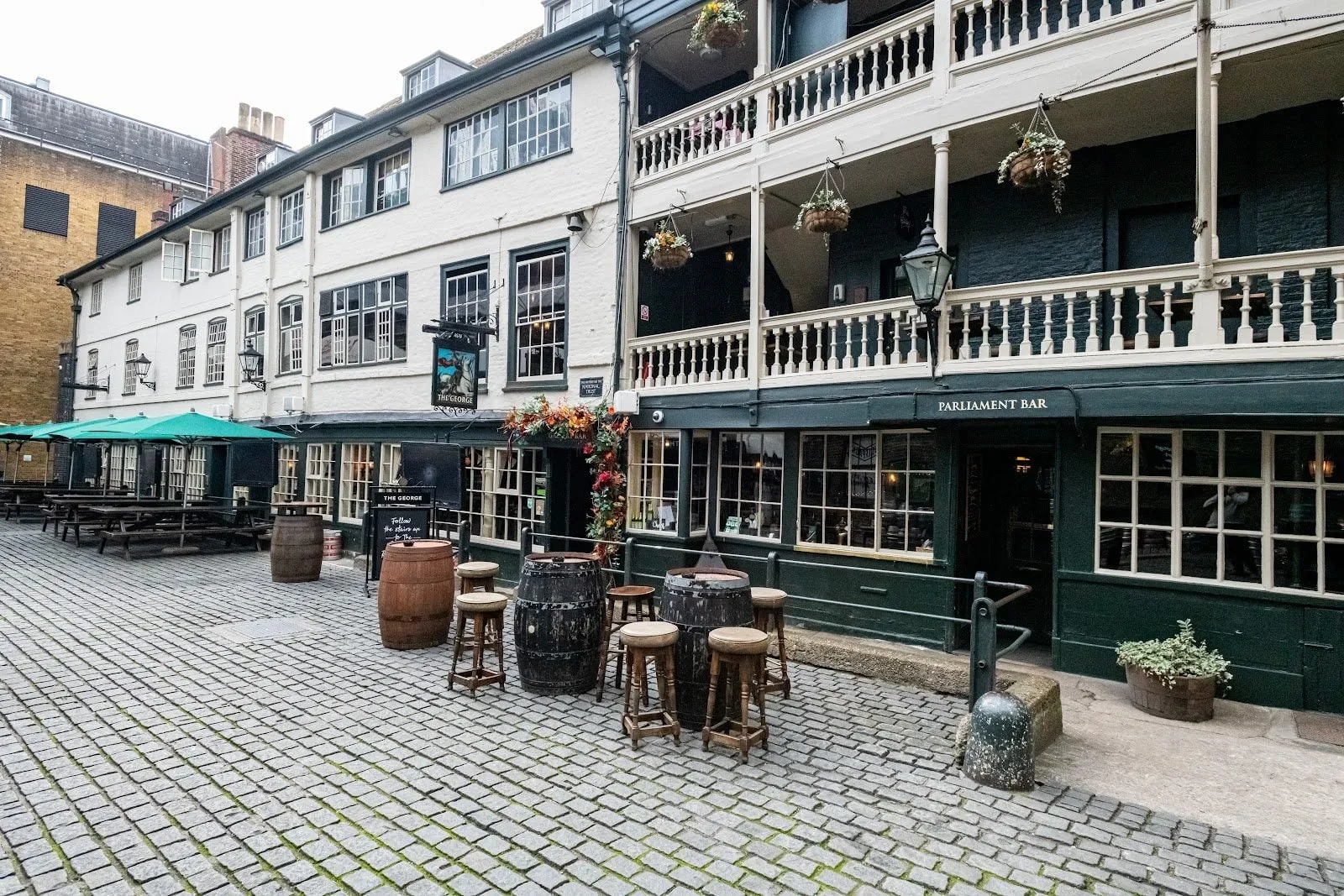
Ye Olde Cheshire Cheese on Fleet Street, rebuilt in 1667 after the Great Fire, is ten minutes west and worth the walk for the warren of dark rooms alone.
Leadenhall Market.
Go deeper
- The best views in London — Horizon 22, the Lookout and Sky Garden are all in the Square Mile, all free, and all need booking on different timetables.
- Sky Garden guide — the Monday ticket release, the restaurant and walk-in routes in, and the terrace hours.
Where to eat and drink
| Spot | Style | Price | Why go |
|---|---|---|---|
| Leadenhall Market | Pubs and cafes | ££ | Under the painted arcade; City hours, so best on a weekday |
| St. JOHN Smithfield | British nose-to-tail | £££ | Bone marrow and eccles cakes; a genuine institution |
| Ye Olde Cheshire Cheese | Historic pub | ££ | Rebuilt 1667, off Fleet Street, a warren of dark rooms |
| The Blackfriar | Art nouveau pub | ££ | Extraordinary 1905 interior by Blackfriars station |
| One New Change | Food court | ££ | Reliable at weekends when everything else is shut |
| Borough Market | Food market | £ | Ten minutes over London Bridge when the City closes |
Los Mochis cooks Mexican-Japanese food nine floors above Broadgate Circle, with a rooftop terrace, and SUSHISAMBA’s Japanese, Brazilian and Peruvian menu is on the 38th floor of Heron Tower. Both are in our fusion restaurants guide.
See all 23 places to eat and drink in the City of London
Getting there
By Tube. Four useful stations. St Paul’s (Central) for the cathedral, Bank (Central, Northern, Waterloo & City, DLR) for the middle, Liverpool Street (Elizabeth line and four others) for the north-east, Tower Hill (District, Circle) for the Tower.
Best exit. At Bank, use Exit 9 for the Royal Exchange and the Bank of England — the station is a warren with a dozen exits and it is easy to surface facing the wrong way.
On foot. Five minutes over the Millennium Bridge to Tate Modern, fifteen north to Shoreditch. The DLR from Bank or Tower Gateway reaches Canary Wharf in about fifteen minutes.
How long to spend, and when to go
| If you have | Do this |
|---|---|
| Two hours | St Paul’s exterior, Leadenhall Market and the tower cluster |
| Half a day | Add the Tower of London, or St Paul’s dome climb |
| A full day | Both, plus a free viewpoint and the Roman remains |
Best time: Weekday mornings for atmosphere and open pubs. Early Sunday morning for photography with empty streets.
Book ahead: Tower of London, Horizon 22, Sky Garden and the Temple of Mithras all need booking, and the free ones go fastest.
Map of the City of London
Open the map54 places: 17 places to eat · 19 things to do · 14 hidden spots · 4 places to stay
The map loads when you open this section.
Eat & drinkThings to doHidden LondonStay
What's on in the City of London
Limited runs and the annual fixtures. Anything already finished is removed automatically.Links marked ad are affiliate links. If you book through one we may earn a commission, at no extra cost to you. It never affects what goes on this list.
The Lord Mayor's Show
Not open yetA procession that has run every year since 1215 - state coach, livery companies, floats and a river of marching bands through the Square Mile, followed by fireworks on the Thames.
Free and one of the oldest civic events in the world. Get a spot on Cheapside or Fleet Street early; the fireworks are from the river at dusk.
Concrete and Clay: Archiving the Barbican
Not open yetThe Brutalist estate explaining itself - the best primer before wandering the highwalks, and it closes for good on New Year's Day 2027 despite feeling permanent.
Free, inside the Centre; combine with the conservatory's Sunday openings.
Yuko Mohri: In Concert
Not open yetBuilt specifically for the Curve's shape by an artist who represented Japan at Venice - site-responsive in the literal sense.
Price not on the listing - check when booking.
Robert Ryman: The Real Thing
Not open yetRyman's white monochromes divide people like little else in modern painting - a full retrospective is the honest way to decide for yourself.
Fills the whole main gallery; allow longer than a single-room show.
Open House Festival
Not open yetThe one week a year you can walk into the Lloyd's Building, private livery halls and architects' own homes for nothing. The 2026 programme marks the Lloyd's Building's 40th birthday.
Most buildings are walk-in but the famous ones are ticketed ballots that open weeks ahead and fill within hours - plan those first. 2026 booking opened 19 August.
The Knollys Rose Ceremony
Not open yetSir Robert Knolles built a footbridge without permission in 1381 and the fine - one red rose a year - is still being paid, in person, in procession. Revived in 1924 and performed to almost no audience at all.
A weekday in late June, unticketed and barely publicised. Check the Company of Watermen or City events listings for the exact date.
Pearly Kings and Queens Harvest Festival
Not open yetThousands of hand-sewn buttons, 150 years of costermonger tradition, morris dancing in Guildhall Yard and a working church service at St Mary-le-Bow. As visually distinctive as Carnival with a fraction of the attention.
A parade from Guildhall Yard to a harvest service at St Mary-le-Bow.
Things to do in the City of London
Beyond eating and drinking. Free things are listed first.Links marked ad are affiliate links. If you book through one we may earn a commission, at no extra cost to you. It never affects what goes on this list.
Bank of England Museum
FreeFree, inside the Bank itself, and it lets you lift a real gold bar out of a perspex case - which is the bit everyone remembers.
Free and no booking. Weekdays only - it is shut at weekends and on bank holidays, which catches out most weekend visitors.
Barbican Conservatory
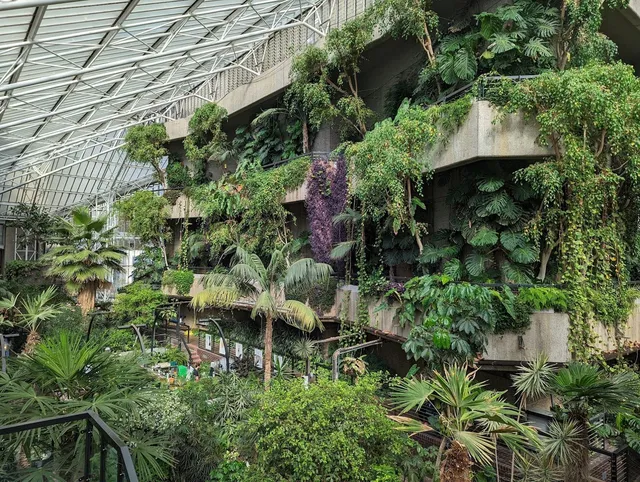
FreeOver 1,500 species of tropical plants and a pond of koi and terrapins, grown inside the concrete fly tower of a Brutalist theatre - the second largest conservatory in London and by far the strangest.
Free on selected days only and it is not open daily - check before travelling, which is the most common mistake here. Book the free slot online.
Guildhall Art Gallery
FreeVictorian and pre-Raphaelite paintings in the City's own gallery - the same building that sits directly above the Roman amphitheatre already on this site, so the two are one visit rather than two.
Free, and often overlooked in favour of the amphitheatre beneath it - the gallery upstairs is worth the same trip.
Leadenhall Market
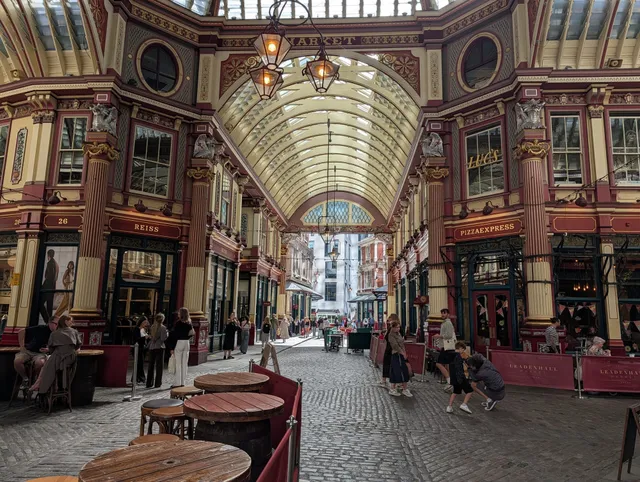
FreeAn 1881 covered market in cream, maroon and green wrought iron, standing where the Roman forum was, and standing in for Diagon Alley on film.
Free to walk through and covered. Dead at weekends - the shops and bars serve City workers, so Saturday gets you the architecture and nothing else.
London's Roman Amphitheatre
FreeThe remains of Londinium's amphitheatre in the basement of the Guildhall Art Gallery, with the missing seating drawn back in as green light on the walls.
Free, and included with the free Guildhall Art Gallery above it. The black ring in the paving of Guildhall Yard outside traces its full size.
Postman's Park
FreeA wall of hand-painted ceramic tablets, each recording an ordinary person who died saving someone else - the quietest and most affecting thing in the Square Mile.
Free, open in daylight, and takes twenty minutes. Read the tablets rather than photographing them; that is the whole point of the place.
Sky Garden
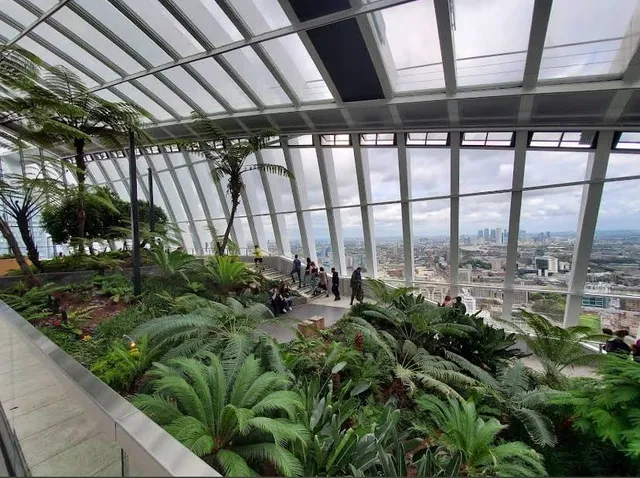
FreeThree storeys of planted terraces under a glass shell on top of the Walkie-Talkie, with a 360-degree view over the City - and it costs nothing.
FREE but the timed tickets are released in batches and go within minutes. Booking a table at one of the bars gets you in without the ticket lottery.
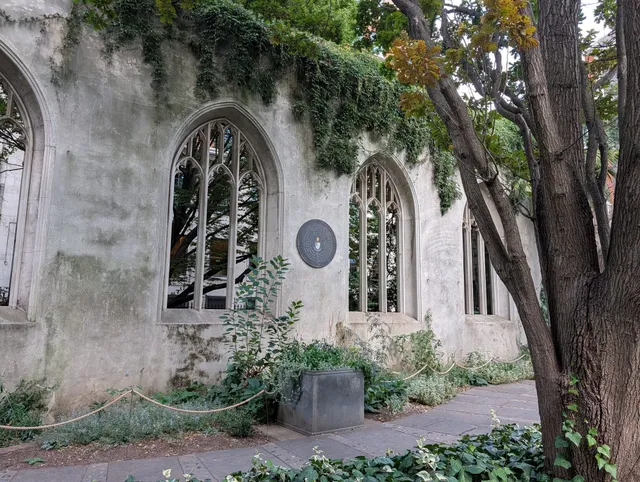
St Dunstan in the East
FreeA Wren church gutted in the Blitz and left as a shell, now filled with climbing plants and trees growing up through the empty windows.
Free and open in daylight hours. Very small and very popular for photographs - go early or at lunchtime on a weekend when the City empties.
The Garden at 120
FreeFifteen storeys up with a 360-degree view, a water rill and wisteria walkways - and unlike Sky Garden across the road, you can simply walk in.
Free and NO BOOKING needed for groups under twelve, which is the single best thing about it. Outdoor, so it closes in bad weather.
The Lookout at 8 Bishopsgate
FreeThe 50th floor, a 240-degree sweep across the City, and the newest of London's free high viewpoints - which means it is still the least crowded of them.
Free, but tickets are released fortnightly on a Monday and go quickly. Same-day walk-ins are let in only if there is capacity.
BAO KTV
Six KTV rooms across five BAO restaurants, each themed on a film, with no room hire: you spend at least £35 a head on food and drink in a two-hour slot.
Rooms at Borough, the City (two, in Bloomberg Arcade), Marylebone, Shoreditch and Battersea. The City's Taipei Room takes 13 to 23.
Barbican Hall
Home of the London Symphony Orchestra, in a 1,900-seat hall at the centre of the Barbican's brutalist estate - the programme runs well beyond classical into jazz, film scores and contemporary.
The Barbican is famously hard to navigate - follow the yellow line on the pavement from the station rather than trusting a map. The Conservatory upstairs is free on selected days and already on this site.
Clays The City
18+Clay pigeon shooting reworked as a simulator game in a cocktail bar - you shoot at screens, and it is far more absorbing than that sounds.
Ninety-minute slots for up to twenty, over-18 only, three minutes from Moorgate. Clarified cocktails are the bar's own thing.
F1 Arcade
18+ in the eveningSixty-odd full-motion racing simulators in seventeen thousand square feet at One New Change, with the dome of St Paul's through the windows.
Races are scored across the room, so you are competing with strangers as well as your group. Over-18 in the evening.
Moonshine Saloon
18+A Wild West saloon where you help run the still - the cocktails are made in front of you as part of the story rather than brought to a table.
Over-18. At the Aldgate edge of the City rather than the middle, so allow a walk from Bank or Liverpool Street.
Race Across The World: The Experience, City
The City route, which uses the alleys and churchyards most people walk past - a better way to see the Square Mile than a walking tour.
A different route from the West End version. Partly outdoors.
Roxy Ball Room St Mary Axe
18+ in the eveningDuckpin bowling, ice-free curling, tech darts, American pool, ping pong and karaoke rooms under one roof beside the Gherkin.
The point is the range - a group that cannot agree on one game can play six. Book the activity, not a table.
Swingers City
18+ in the eveningTwo nine-hole courses, four street food traders and five bars in a two-storey clubhouse a stone's throw from the Gherkin.
Books out with office parties from Thursday onwards - a weekday lunchtime or a weekend is far easier to get.
Book Tower of Londonad
Hidden the City of London
Free, self-guided and easy to walk past without knowing it's there.
30 St Mary Axe
Filming locationMatch Point (2005) - Chris lands his City job
The Gherkin, used for the office where Woody Allen's social climber gets his foothold. Foster's tower was five years old when the film came out and already the most recognisable silhouette in the City.
An office building with no general public access; the top-floor bar is private. Free to photograph from Bury Court or St Mary Axe. Aldgate or Liverpool Street.
All Hallows by the Tower
Point of interestThe oldest church in the City of London, founded in 675 AD
Founded in 675 AD, predating St Paul's - Samuel Pepys climbed the tower to watch the Great Fire spread in 1666, and the crypt holds a fragment of Roman pavement. Steps from the Tower of London but far quieter.
Free to enter; crypt museum included. Normal church hours, closed during services.
Banksy's Basquiat "Stop and Search"
Street artThe second 2017 Basquiat tribute piece in the same tunnel
The second of the pair of 2017 Basquiat-tribute pieces in the same tunnel - a police officer frisking a crowned Basquiat-style figure, a pointed comment on how the artist himself was treated by police in life.
Inside the same protected road tunnel as the Ferris Wheel piece - visit both together.
Banksy's Basquiat Ferris Wheel
Street artOne of two 2017 Basquiat tribute pieces in the Beech Street tunnel
Painted in 2017 to coincide with a Basquiat exhibition at the Barbican, reworking Basquiat's crown motif - among the best-preserved Banksy pieces in London precisely because it was protected not long after it appeared.
Inside a road tunnel, protected - one of the more reliably-still-there pieces on this list.
Banksy's Cannon Street Rat
Street artAn early-2000s rat stencil on a railway bridge
One of Banksy's earliest surviving London rats, on the railway bridge over Cannon Street - a reminder of how much of his early-2000s stencil work has simply vanished since, making survivors like this one worth seeking out.
On a railway bridge structure, viewable from the street.
Banksy's Piranhas (at the London Museum)
Street artDay seven of the August 2024 animal series - a school of fish swimming inside a glass-panelled police telephone box
Banksy painted a school of piranhas onto the glass panels of a real police telephone box near St Paul's, turning it into what looked like a fish tank. The City of London Corporation donated the box to the new London Museum, where it goes on permanent public display.
The London Museum's new Smithfield building opens 28 November 2026 - check the museum is open and the piece is on display before visiting; it's a museum object now, not a street piece.
Banksy/Robbo's "I Love London" Rat
Street artA 2004 Banksy rat, later altered by rival artist King Robbo - a physical record of their feud
Started life in 2004 as a Banksy rat holding a placard reading "London Doesn't Work". Rival graffiti artist King Robbo later reworked the placard with his own tag and a heart, as one move in a years-long "graffiti war" between the two - the surviving piece is a genuine joint artefact, not a misattribution, and Banksy repainted a memorial version after Robbo was hospitalised.
Street-level, out in the open - one of the older survivors, so check current condition before a special trip.
Blackfriars Bridge
Filming locationMission: Impossible - Fallout (2018) - the rooftop and bridge chase
Tom Cruise runs along the top of the bridge during the chase that ends at Tate Modern, having already run across the roof of Blackfriars station.
Free, open at all times. The best view of the run is from the Thames Path on the south bank.
Broadgate Tower
Filming locationSkyfall (2012) - the neon tower standing in for Shanghai
The glass lift shaft Bond rides up behind the assassin Patrice, dressed with blue neon to pass for a Shanghai skyscraper. London playing another city entirely, and doing it a hundred metres from Liverpool Street.
An office building - the lobby is not a visitor attraction and you are looking at the exterior and the Primrose Street entrance. Free, on a public street, two minutes from Liverpool Street.
Cloth Fair & St Bartholomew the Great
Point of interestLondon's oldest parish church (1123) on one of its oldest surviving streets
St Bartholomew the Great was founded in 1123 and is the City's oldest parish church, with a Norman interior used in dozens of films. Cloth Fair, right beside it, has some of the only houses in the City to survive the 1666 Great Fire.
The church charges a small entry fee for visitors (free for worship); Cloth Fair itself is a public street, walkable any time.
College of Arms
Filming locationSherlock Holmes (2009) - Sir Thomas's house
The 1670s brick building used as a grand private house, in reality the headquarters of English heraldry since the fifteenth century. The wrought-iron gates and the forecourt are the shot.
The Earl Marshal's Court is open free on weekdays during office hours; the rest of the building is not. Free to see the forecourt from Queen Victoria Street. Blackfriars or Mansion House.
Elizabeth I Statue, St Dunstan-in-the-West
Point of interestLikely London's oldest public statue, carved around 1586
Believed carved in 1586, the only surviving statue of Elizabeth I made in her lifetime - it originally stood on Ludgate and was moved here when the gate was demolished in 1760. Easy to walk past on busy Fleet Street.
Set in a niche on the church exterior, visible from the street at any time.
Leadenhall Market as Diagon Alley
Filming locationHarry Potter and the Philosopher's Stone (2001) - Diagon Alley and the Leaky Cauldron
The Victorian arcade played Diagon Alley in the first film, and the blue door that served as the entrance to the Leaky Cauldron belongs to what is now an opticians on Bull's Head Passage. The painted ironwork and glass roof needed no set dressing at all.
A working market, open to walk through in the daytime. The shops and bars keep City hours, so it is quiet at weekends.
Liverpool Street Station
Filming locationThe Elephant Man (1980) - Merrick returns to London
The terminus where John Merrick arrives back in London after escaping the continental freak show, and is chased into the gentlemen's lavatory by a crowd. Lynch shot it in black and white and the roof does most of the work.
Free, open around the clock as a working station. The 1875 train shed was rebuilt in the 1980s, so the ironwork you see is a reconstruction of what Lynch filmed.
London Stone
Point of interestAn ancient block of limestone, possibly Roman, that legend says protects the city
First recorded around 1100, of unknown but probably Roman origin, set behind glass in the wall of an office block on Cannon Street - most people walk past without noticing it. Legend holds that London's fortunes depend on the stone staying put.
On a public street frontage, viewable any time, free.
Royal Exchange Buildings
Filming locationBridget Jones's Diary (2001) - the kiss in the snow
The alley behind the Royal Exchange used for the film's final scene, with Bridget in her underwear in the snow and Mark Darcy going back for the coat. The snow was fake and the cold was not.
Free, a public passage, always open. Bank station is directly underneath it. The Royal Exchange itself is now shops and a bar.
Slow Horses' Slough House
Filming locationSlow Horses (2022-) - the exterior of Jackson Lamb's dumping ground for failed spies
The grubby door the slow horses trudge through in nearly every episode is a real one, on the corner of Aldersgate and Carthusian Street above an Italian restaurant - a genuinely unremarkable building doing a lot of work. The fire escape from the series is around the corner on St John's Street.
A working office building above a restaurant - the point is the doorway and the street, both public. Two minutes from Barbican station and Smithfield.
Snatch's Diamond Store
Filming locationSnatch (2000) - Doug the Head's diamond store
Doug the Head's diamond shop in Snatch is on Hatton Garden, London's real diamond district - and his "local" in the film is Ye Olde Mitre, already on this site, a couple of doors down.
A working commercial building on Hatton Garden - viewable from the street only.
St Alphage Ruins & Salters' Garden
Point of interestMedieval church ruins and a fragment of the Roman city wall, wedged between Barbican towers
A tiny public garden holds the ruins of St Alphage London Wall church alongside a real stretch of the Roman and medieval city wall, crenellated in 1477 - genuinely ancient London hiding in the concrete geometry of the Barbican.
Free, always open, easy to walk straight past - it's set back from London Wall itself, reached via Fore Street.
St Bartholomew's Hospital
Filming locationSherlock (2010-2017) - the fall from the roof in The Reichenbach Fall
Sherlock jumps from the roof of the pathology block and lands on the pavement below. Fans left so many notes on the phone box and the wall outside that the hospital had to manage it. Barts is also the oldest hospital in Britain still on its original site, founded in 1123.
A working hospital. The exterior and the square are public; the small museum keeps limited hours. Keep out of the way of patients.
Temple of Mithras (London Mithraeum)
Point of interestA Roman temple, discovered in 1954, now beneath Bloomberg's HQ
Roman Londoners worshipped Mithras here around 240 AD; the ruins were rediscovered during 1954 building work and drew such crowds that the Prime Minister had to weigh in. Now sunk seven metres below Bloomberg's building, with a free reconstruction of temple worship - dimmed lights, chanting, atmospheric smoke.
Free, but timed-entry tickets must be booked online in advance - it sells out, especially weekends. Closed Sundays and Mondays.
Ten Trinity Square
Filming locationSkyfall (2012) - M is summoned to meet the incoming Gareth Mallory
The Beaux-Arts former Port of London Authority headquarters, now a Four Seasons hotel, playing the establishment room where M gets told her time is up. The rotunda and the coffered ceiling are the shot, and they are still exactly as filmed.
A working hotel, so the lobby and bars are open to non-residents. Two minutes from Tower Hill. Free to walk in and look; you are expected to buy something if you sit down.
The Whispering Gallery, St Paul's
Filming locationPaddington 2 (2017) - the search for the pop-up book clue
The circular gallery inside the dome where a whisper against the wall carries round to the far side, used as Buchanan hunts for the next clue. It is 257 steps up, the first of the three galleries.
Included in the £27 adult sightseeing ticket, which also covers the Stone and Golden Galleries at 376 and 528 steps. Stairs only, no lift. Monday to Saturday, last entry around 4pm. St Paul's station.
Throgmorton Avenue
Filming locationMission: Impossible - Rogue Nation (2015) - Solomon Lane goes through a window
The gated City lane where the villain confronts Hunt and exits through plate glass. It is a private road with iron gates at both ends, which is why it looks so unlike a normal street.
Free to walk through on weekdays; the gates are closed at night and at weekends, which catches people out. Two minutes from Bank or Moorgate.
Tower Bridge, West Upper Walkway
Filming locationSpider-Man: Far From Home (2019) - the battle for the bridge
The high-level walkway where the film's climax plays out, glass floor and all. It is the same walkway you can stand on with an £18 ticket, which makes this one of the few blockbuster finales you can literally visit.
The Exhibition is £18 adult, daily 9.30am to 6pm with last entry at 5pm, and there is lift access to the walkways. The bridge itself and its pavements are free at all hours. Tower Hill, two minutes.
Tower of London
Filming locationSpider-Man: Far From Home (2019) - the school trip arrives
The visitors' entrance where Happy Hogan delivers the school party, on the London leg of the film's European tour. The Tower gets destroyed later, which the guidebooks tend to leave out.
Ticketed and expensive, and busiest between 11am and 3pm. The moat, the wharf and the view of the White Tower from the free pavement cost nothing. Tower Hill, two minutes.
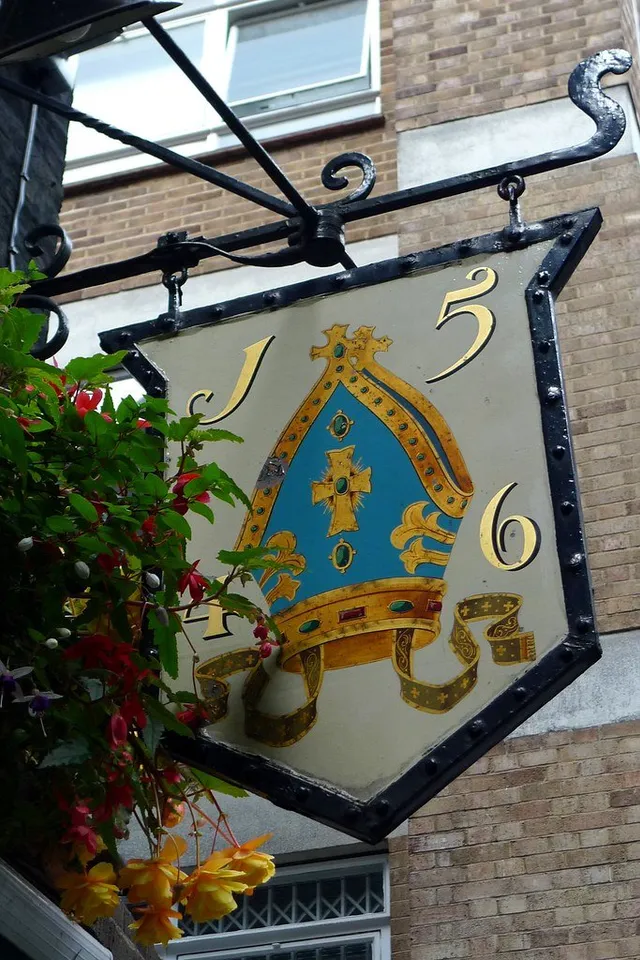
Ye Olde Mitre
Point of interestA pub built in 1546 down an alley with no street sign
Founded in 1546 for the Bishop of Ely's household staff, tucked down a narrow passage off Hatton Garden with nothing marking the entrance - most people who work nearby never find it. A preserved cherry tree trunk inside is said to mark where Elizabeth I danced with Sir Christopher Hatton.
No sign on the street - look for the narrow gap between the buildings on Hatton Garden opposite number 8. Two tiny wood-panelled rooms, low ceilings, gets busy after work.
Where to stay
Excellent transport and good weekend rates, with the caveat that the area is dead at night.
- Liverpool Street and Aldgate — The main hotel cluster, walkable to Shoreditch for the evening.
- Barbican and Smithfield — Quieter, near the arts centre, good for Farringdon and the Elizabeth line.
- Tower Hill — Convenient for the Tower and the river, and connected to the South Bank on foot.
Our City of London hotel guide compares the hotels and the weekend rates.
Cheapest first. Prices are a typical starting rate per night, not a quote.Links marked ad are affiliate links. If you book through one we may earn a commission, at no extra cost to you. It never affects what goes on this list.
citizenM Tower of London
££Hotel370 rooms on Trinity Square facing the Tower of London, with cloudM on the ninth floor - a rooftop bar looking across the Gherkin, the Sky Garden and Tower Bridge, at chain-hotel money rather than five-star money.
Far bigger than the other London citizenMs at 370 rooms, so it reads less as a boutique and more as a very well-designed large hotel with a view. Bought by Marriott, so Bonvoy applies and citizenm.com now redirects. The postcode falls in Tower Hamlets by about a block, not the City.
Cove by Locke Cannon Street
££AparthotelAccessible roomsFive minutes from St Paul's and the Millennium Bridge, with Cannon Street and Mansion House stations either side and the free City viewpoints all walkable.
Like the rest of the Square Mile it is quiet at weekends and short of everyday shops, which the kitchens make more of a problem than it sounds. Check Saturday rates - they are often the cheapest of the week.
Cove by Locke Moorgate
££AparthotelAccessible roomsApartments on Moorgate itself, a minute from the station's Elizabeth line platforms and ten minutes' walk from both Liverpool Street and the Barbican.
Weekday-business territory, so weekend rates are usually the softer ones - the opposite of most of London. Full kitchens.
DoubleTree by Hilton London - Tower of London
£££HotelSavage Garden, the rooftop bar on top of it, looks straight at the Tower of London and Tower Bridge and is the reason both our sources named the hotel at all. Tower Hill and Fenchurch Street are both a short walk and the operator puts central London fifteen minutes away.
Savage Garden is open to the public and 18+ after 6pm, so the lifts and lobby get busy in the evening. Dogs are allowed in bedrooms for a non-refundable £40, but not in the cafe, the rooftop or the executive lounge, on Hilton's own page.
Locke at Broken Wharf
£££AparthotelAccessible roomsFull kitchens and a washing machine, directly opposite Tate Modern across the Millennium Bridge - the format that makes a week in London affordable with children.
Priced per apartment rather than per person, so the value improves sharply with a family. Weekly rates are materially cheaper than seven nights.
Native King's Wardrobe
£££AparthotelAccessible roomsA courtyard building on Carter Lane, about ninety seconds from St Paul's, on the site of the medieval wardrobe that stored the king's robes until the Great Fire took it.
Square Mile rhythm: quiet at weekends, short of everyday shops, and often cheapest on a Saturday.
South Place Hotel
£££BoutiqueFive minutes from Liverpool Street and the same again from Moorgate, with Angler - a Michelin-starred restaurant, in the operator's own words - and the all-day Bluebird City both in the building, so it is worth booking for the dinner as much as the bed.
Now run by the Evolv Collection, not D&D London. Time Out files it under Shoreditch, but the address is EC2M between Moorgate and Liverpool Street - a City hotel walkable to Shoreditch rather than a Shoreditch one.
Cheval Three Quays
££££AparthotelAccessible roomsDirectly on the river between the Tower of London and Tower Bridge, with apartments that look straight at both - the view is what you are paying for and it is the best of any aparthotel in London.
Full kitchens, a concierge and one- to three-bedroom layouts, so it works for a family in a way a hotel room at this price does not.
Four Seasons Hotel London at Tower Bridge
££££HotelThe former Port of London Authority headquarters at Ten Trinity Square, a listed 1920s pile beside Tower Hill, converted into a Four Seasons - the Grand Heritage Suites run to ceilings of five metres and the third-floor Royal Garden Suite opens onto its own planted terrace.
Renamed in October 2024: this was Four Seasons Hotel London at Ten Trinity Square. The same building holds the Ten Trinity Square private members' club - a Reignwood, Chateau Latour and Four Seasons venture - which is separate from the hotel and members-only, so a guest is not automatically inside it.
The Ned
££££HotelAccessible roomsThe former Midland Bank headquarters, built in 1924 by the architect the hotel is named for - marble banking hall, twelve restaurants, and a rooftop pool with St Paul's over the parapet.
The rooftop pool is for members and their guests rather than every hotel booking; the basement spa's 20-metre pool is the one hotel guests can generally use.
Make a day of it
Combine the City of London with
Walking times are from the centre of the City of London. Each of these works as an afternoon once you have finished here.
Shoreditch
15 min walkNorth past Liverpool Street for markets, street art and somewhere open in the evening.
South Bank
5 min walkStraight over the Millennium Bridge from St Paul's to Tate Modern.
Bloomsbury
20 min walkWest along Theobald's Road for the British Museum and the garden squares.
Canary Wharf
15 min walkEast by DLR from Bank or Tower Gateway — walking is not practical.
Walking routes
A Walk Around the City of London: Bank to Tower Bridge →
Our full route for this area: eleven numbered stops over about 3km and two to three hours, with a map, a Google Maps walking link for your phone, and a day-by-day breakdown of what is actually open. It starts at the Bank junction rather than St Paul’s, goes inside the Royal Exchange, and takes in St Dunstan-in-the-East — the church bombed in 1941 and left as a ruin with a garden planted inside it, which is the best free thing in the Square Mile.
The short version, if you only have three hours
- Start: St Paul’s station. St Paul’s Cathedral and Paternoster Square.
- One New Change: The free roof terrace for the close view of the dome.
- Bank: East along Cheapside past St Mary-le-Bow to the Royal Exchange.
- Leadenhall Market: South-east under the painted arcade.
- Tower Hill: Down to the Roman wall and the Tower of London.
- Finish: Tower Bridge, or north to Shoreditch for the evening.
Common mistakes to avoid
- Coming at the weekend without a food plan. Much of the City shuts. One New Change and Borough Market are the reliable fallbacks.
- Not booking the free viewpoints. Horizon 22 and the Sky Garden cost nothing but both require a slot booked weeks ahead.
- Arriving at the Tower mid-morning. Go at opening and see the Crown Jewels first.
- Paying to enter St Paul’s just to see inside. Evensong is free daily and you sit in the quire.
- Getting lost at Bank station. A dozen exits across a large junction. Check which one you want before you surface.
- Trying to walk to Canary Wharf. It is much further than it looks. Take the DLR from Bank.
Common questions
Is the City of London the same as London?
No. The City of London is a separate square-mile authority at the historic centre, with its own police force, its own Lord Mayor and around 8,000 residents. It is the original Roman and medieval city. Greater London — the 32 boroughs around it — grew up later and is what people usually mean by London.
Why is the City empty at weekends?
Around half a million people work here and only about 8,000 live here. On Saturdays and Sundays most offices, sandwich shops and many pubs close. It is eerie and excellent for photography, but plan food in advance — you may walk ten minutes to find somewhere open.
What are the free views of London from the City?
Two, both free but both requiring booking. **Horizon 22** at 22 Bishopsgate is the highest public viewpoint in London, on level 58. The **Sky Garden** at 20 Fenchurch Street has an indoor planted terrace. Both release slots online some weeks ahead and both go quickly.
Do I need to book the Tower of London?
Yes, book online — it is cheaper than the gate price and the queue is long, particularly in summer. Allow three hours. Go at opening and head straight for the Crown Jewels before the coach parties arrive, then work back through the White Tower.
Can you climb the dome at St Paul's?
Yes, 528 steps to the Golden Gallery outside the dome, via the Whispering Gallery and the Stone Gallery. It is included in the admission ticket. The last section is steep and narrow. Entry to the cathedral is ticketed for sightseeing, but attending a service — including free daily Evensong — costs nothing.