In this guide
London gets less rain than Rome — somewhere around 600 to 630mm a year, against Rome’s roughly 750mm. What London gets instead is drizzle: many grey, damp days rather than a handful of proper downpours. That changes the question. It is rarely “what do I do indoors” — London has hundreds of indoor things — and much more usefully “where do I go”, because the places that actually work on a wet day are the ones where several of them sit close enough together that an umbrella barely helps.
This is a guide to those places: which parts of London are good to be in when it’s raining, and why — a connected building, a covered walkway, a cluster of things within a few minutes of each other — with the theatre, cinema and immersive shows that are actually there woven in, not described from scratch.
💡 The Short Version: Canary Wharf has underground shopping malls that connect the Elizabeth line, the Jubilee line and the DLR without a drop of rain. Battersea Power Station is over 150 shops and both restored turbine halls under one roof. The Barbican links two galleries, three cinema screens, a concert hall, a theatre and a library by raised walkway. King’s Cross clusters the British Library, a covered Victorian coal yard and a 360-degree projection venue within five minutes of the station. The West End has the highest concentration of covered market halls, theatres and immersive shows anywhere in Britain. The City strings a Victorian covered market, a free indoor garden at the top of the “Walkie-Talkie” and a Roman amphitheatre together on foot. And the Westfield centres at White City and Stratford are simply enormous roofed malls, both about to get large new immersive attractions.
Free, indoors, wherever you are
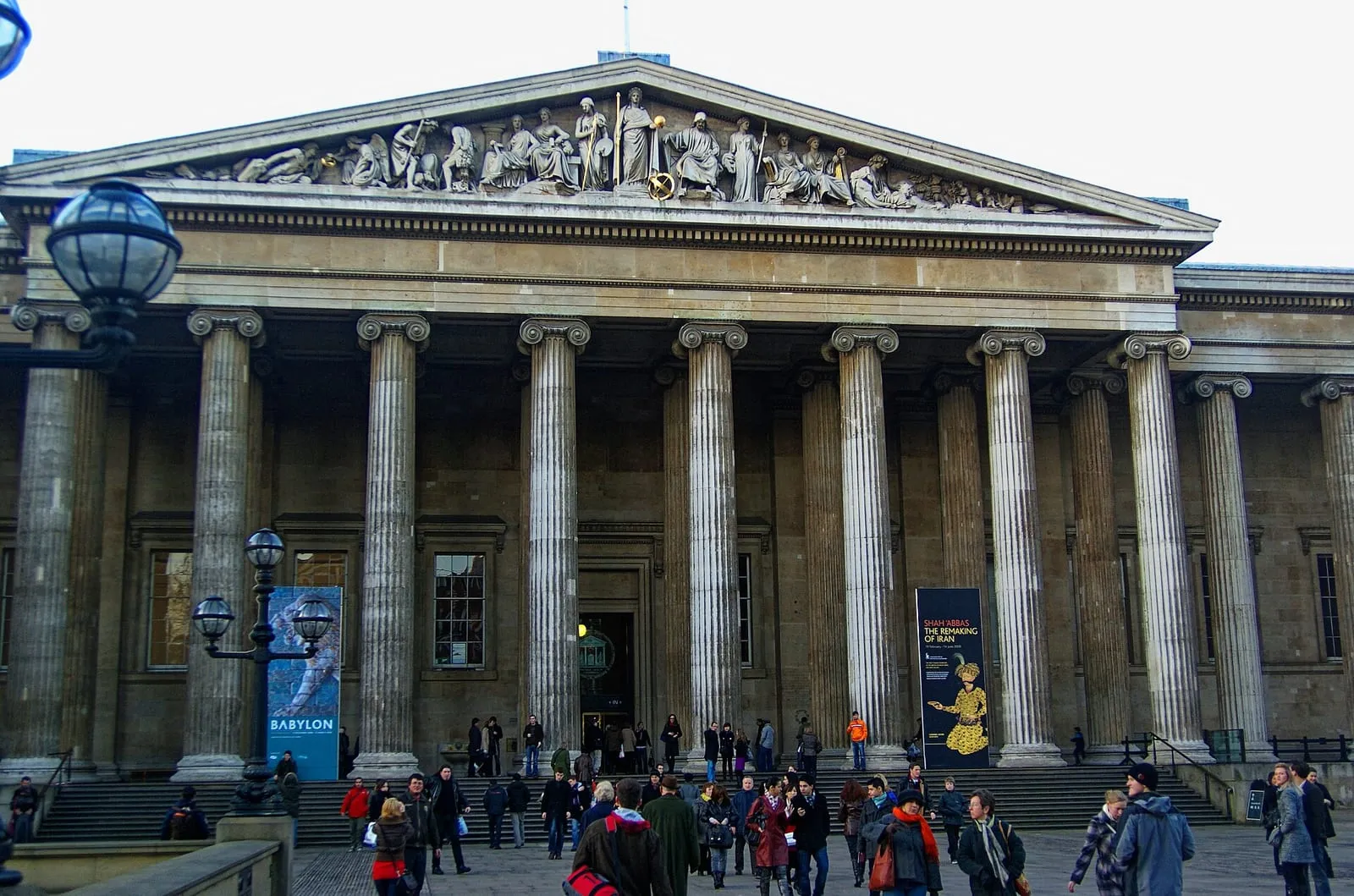
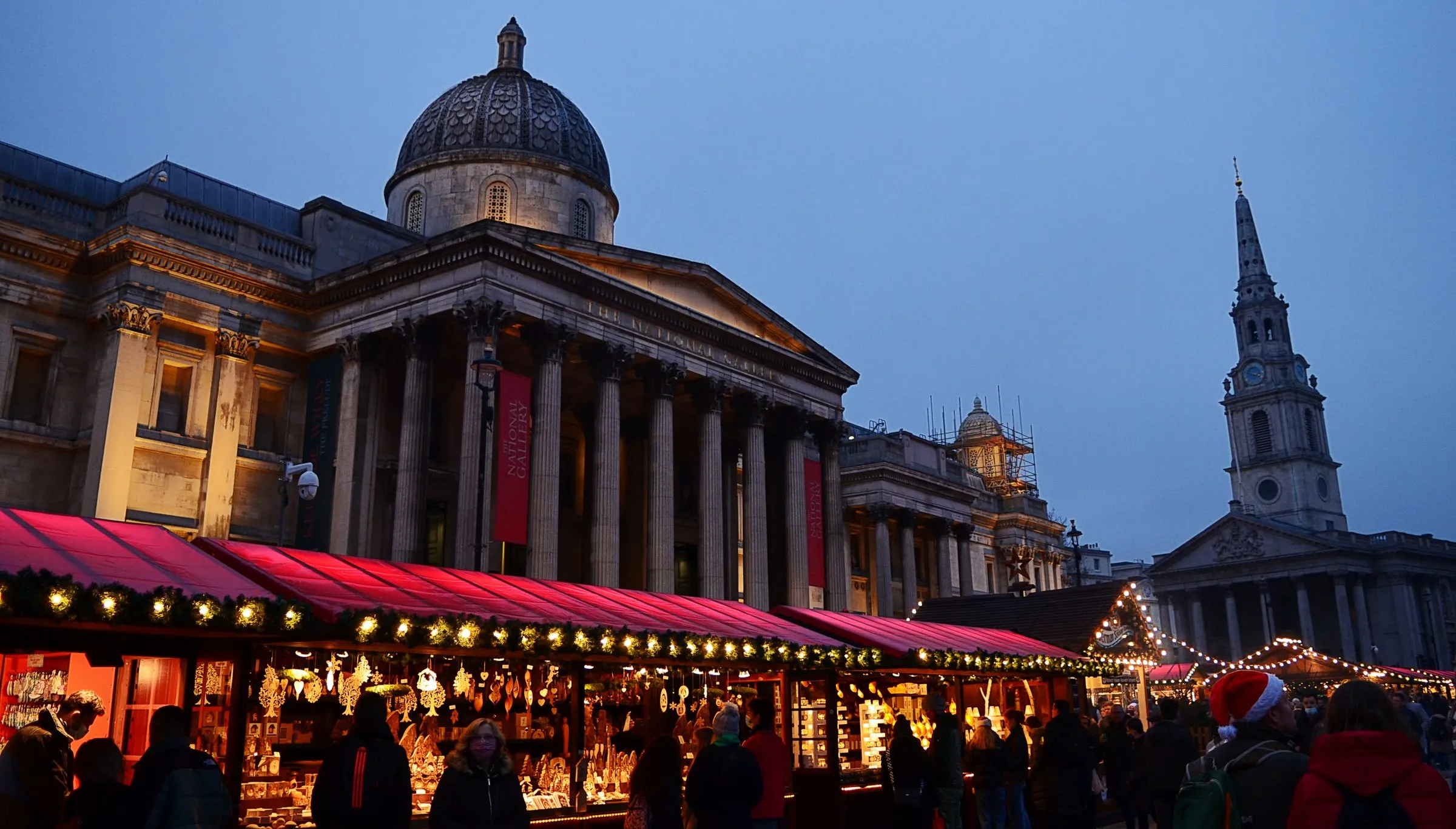
Whichever area you end up in, one fact does a lot of the work: every national museum in London is free, including on a Tuesday afternoon in a downpour. The British Museum’s Great Court, the Natural History Museum, the Science Museum, the V&A, Tate Modern, the National Gallery and National Portrait Gallery on Trafalgar Square, and smaller free ones — the Wellcome Collection, Sir John Soane’s Museum, Young V&A — are all indoors and cost nothing at the door. Our guide to London’s best museums has all of them compared.
South Kensington is the one genuine tunnel-to-door case, and it’s worth being precise about it. A Victorian pedestrian subway runs from inside the Tube station towards the museum quarter, and the Natural History Museum has a gate straight off it — you can walk in without going outside at all. The Science Museum and the V&A are a short stretch above ground from the same subway, not a second dry corridor, so budget for a damp minute.
The areas worth heading for
Each of these earns its place for a specific, checkable reason — a market hall with a real roof, a mall that connects underground to three sets of platforms, a walkway that never drops to street level — not because there is generically “lots to do” nearby.
Battersea Power Station
Battersea Power Station is the most literal answer on this list: an entire derelict power station rebuilt as one continuous indoor building. Walking in is free, and both of Giles Gilbert Scott’s turbine halls — the restored 1930s Art Deco Turbine Hall A and the plainer 1950s Turbine Hall B — sit under the original steel roof, with more than 150 shops, bars and restaurants spread across several indoor levels between them. Our Battersea area guide has both halls in full.
The covered part is the power station building itself. Circus West Village, the restaurant quarter in the railway arches beside it, and Electric Boulevard, the newer pedestrian street south of the station, are both open to the sky — so the promise here is the building, not the wider 42-acre estate, and you will get wet crossing between them.
Inside, that still buys plenty. NEON, a purpose-built exhibition space in Circus West Village, runs large-scale ticketed shows — Ramses and the Pharaoh’s Gold until 1 January 2027 — and there are two separate cinemas on the estate: the Cinema in the Arches at Circus West Village, and a second screen inside the power station itself. Our immersive experiences guide covers the rest of London’s scene, including venues a short Tube ride away.
Battersea Power Station station is on the Northern line’s Charing Cross branch, a few minutes from Nine Elms and about fifteen from Tottenham Court Road.
Canary Wharf
Canary Wharf makes the strongest case of anywhere in this guide, because the shelter here is a network, not a single building. Canada Place, Cabot Place and Jubilee Place are underground shopping malls that connect most of the estate to the Elizabeth line, the Jubilee line and the DLR without going outside at all — the single best piece of wet-weather infrastructure in London. Our Canary Wharf area guide has the layout.
Above ground but still under cover, Crossrail Place is the best of it: a timber lattice roof built directly over the old North Dock, with a free roof garden planted by hemisphere along the old trade routes, reached straight from the Elizabeth line station without stepping outside. It’s open daily, free, and quiet even at lunchtime.
Two more points: the London Museum Docklands, free, in a Georgian sugar warehouse on West India Quay, and the fact that the malls themselves — being the older, more corporate part of the estate — keep shorter hours at weekends. A Sunday visit is better spent at Crossrail Place and the museum than counting on the shops.
The Elizabeth line reaches Canary Wharf from Liverpool Street in six minutes.
King’s Cross
King’s Cross doesn’t offer one continuous covered route so much as a dense cluster of indoor anchors within a few minutes of the station — crossing the open pavement of Granary Square between them is the one damp part.
The British Library’s Treasures Gallery is free, indoor, and holds Magna Carta, the Lindisfarne Gospels and Beatles lyrics scribbled on the backs of envelopes — a solid hour, no ticket needed. Coal Drops Yard, the Victorian coal warehouses Thomas Heatherwick joined with a swooping “kissing roof”, shelters the double-height space where the two roof pitches meet and rise together, though the wider cobbled yard itself stays open to the sky. Our King’s Cross area guide has the detail.
For something to actually sit and watch, Lightroom, a purpose-built 360-degree projection room, shows David Bowie: You’re Not Alone until 10 January 2027, with an Aardman anniversary show opening in October 2026 — covered in full in our immersive experiences guide. And moored right at Granary Square, Word on the Water, the canal-boat bookshop, has a wood stove and a roof, which on a wet afternoon is exactly what’s wanted.
The West End: Covent Garden, Soho and the theatre district
No part of London packs in more indoor things per square metre than the West End, and it earns the claim on density, not any one connected building. Around 200 shows run every night within about half a mile of Leicester Square, in theatres that are, definitionally, indoors; our London theatre guide covers choosing one and paying less for it.
The market halls are the covered heart of it. Covent Garden’s Apple Market sits under a glass roof added in the 1870s, Seven Dials Market fills a former banana warehouse three minutes north, and Kingly Court off Carnaby Street is three galleried floors around a courtyard covered enough to work in the rain. Our Covent Garden and Soho guides have both in full.
It’s also the densest patch of immersive experiences in London. Twist Museum at Oxford Circus is eighty-plus hands-on illusions about perception, one minute from the station; The Crystal Maze LIVE Experience runs at Piccadilly Circus; The Traitors: Live Experience puts you at the Round Table in Covent Garden; and the nine Can-Can tables at the Piccadilly Theatre’s Moulin Rouge! are the closest the West End gets to sitting inside the set rather than watching it. Right on Soho’s eastern edge, Outernet, the wraparound 4K screens beside Tottenham Court Road station, is free, needs no ticket, and is worth twenty minutes if you’re passing. All of these, and more, are in our immersive experiences guide.
For cinema, the Prince Charles off Leicester Square and The Garden Cinema in Covent Garden are both covered in our independent cinemas guide, and our cinema deals guide has the memberships and 2-for-1 codes that make either cheaper. If the market halls have you thinking about shopping instead of watching something, Foyles on Charing Cross Road runs to five floors with a café at the top, and Chinatown’s dim sum kitchens on Gerrard Street are indoors and serving until mid-afternoon.
The Barbican
The Barbican is less a single venue than an area in its own right. A short flight of stairs from Barbican station leads over a bridge and straight onto the estate’s raised highwalks, without ever dropping to street level, and from there the Centre itself connects two art galleries (the main gallery and the free Curve), three cinema screens, the 1,943-seat Barbican Hall (home to the London Symphony Orchestra), the Barbican Theatre and The Pit, and the public Barbican Library — by internal walkway, without going back outside. Our City of London area guide has the wider estate, and our independent cinemas guide covers the Barbican’s own repertory programme, including a second pair of screens a few minutes away on Beech Street.
The Conservatory, around 1,500 species inside the old theatre’s fly tower, is free but needs planning around: it opens on selected dates only, published up to a month ahead on the Barbican’s own booking page, with a small batch of day tickets released online at 9.30am on the day itself for anyone who didn’t book ahead.
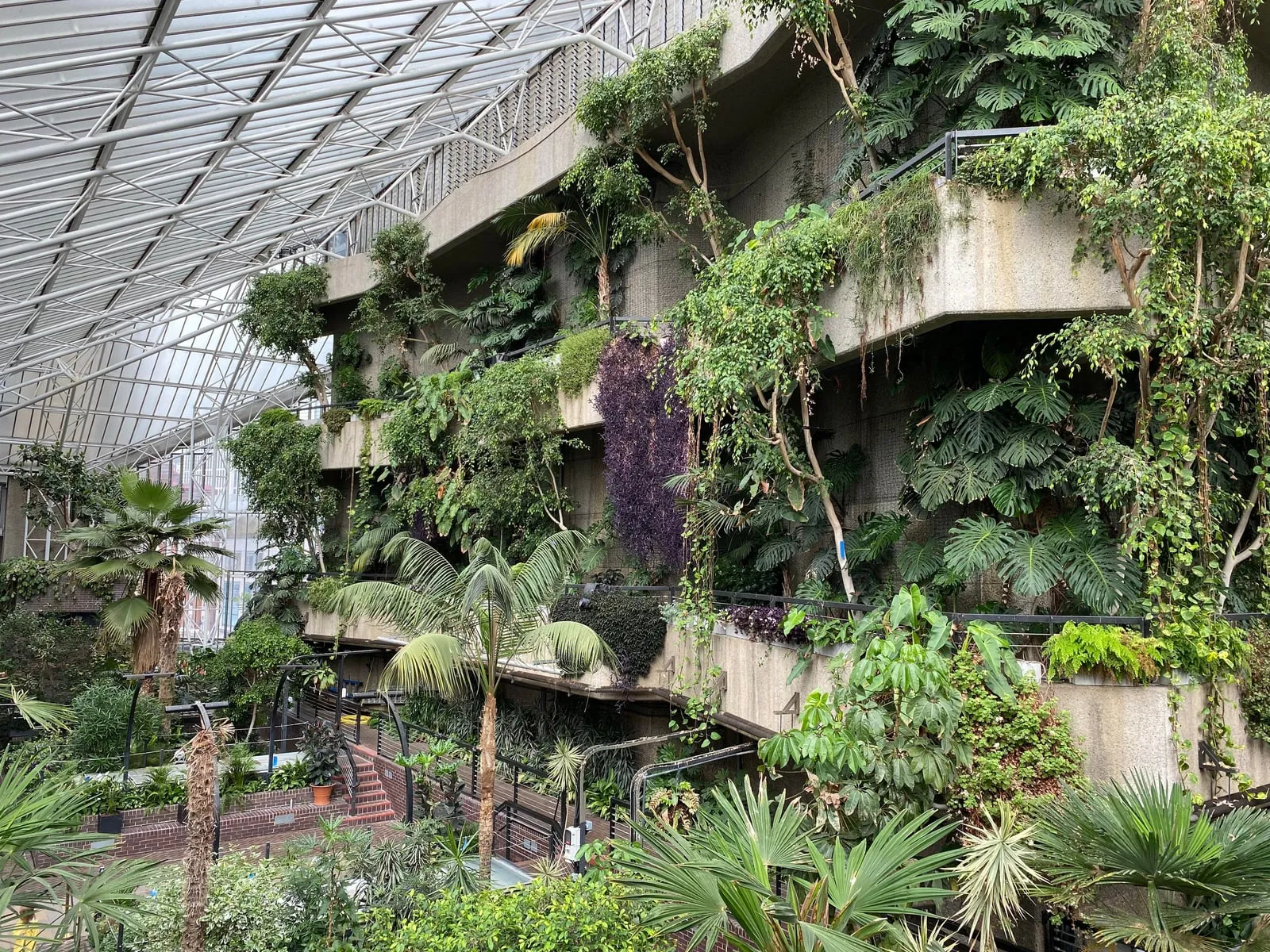
The Barbican Conservatory.
Barbican station is on the Circle, Hammersmith & City and Metropolitan lines; Moorgate, a few minutes further round the highwalks, adds the Northern line.
The City
The City’s case for a wet day is a walking one — short outdoor stretches between a genuine run of indoor and covered stops, best done on a weekday, since much of it keeps office hours and empties at weekends.
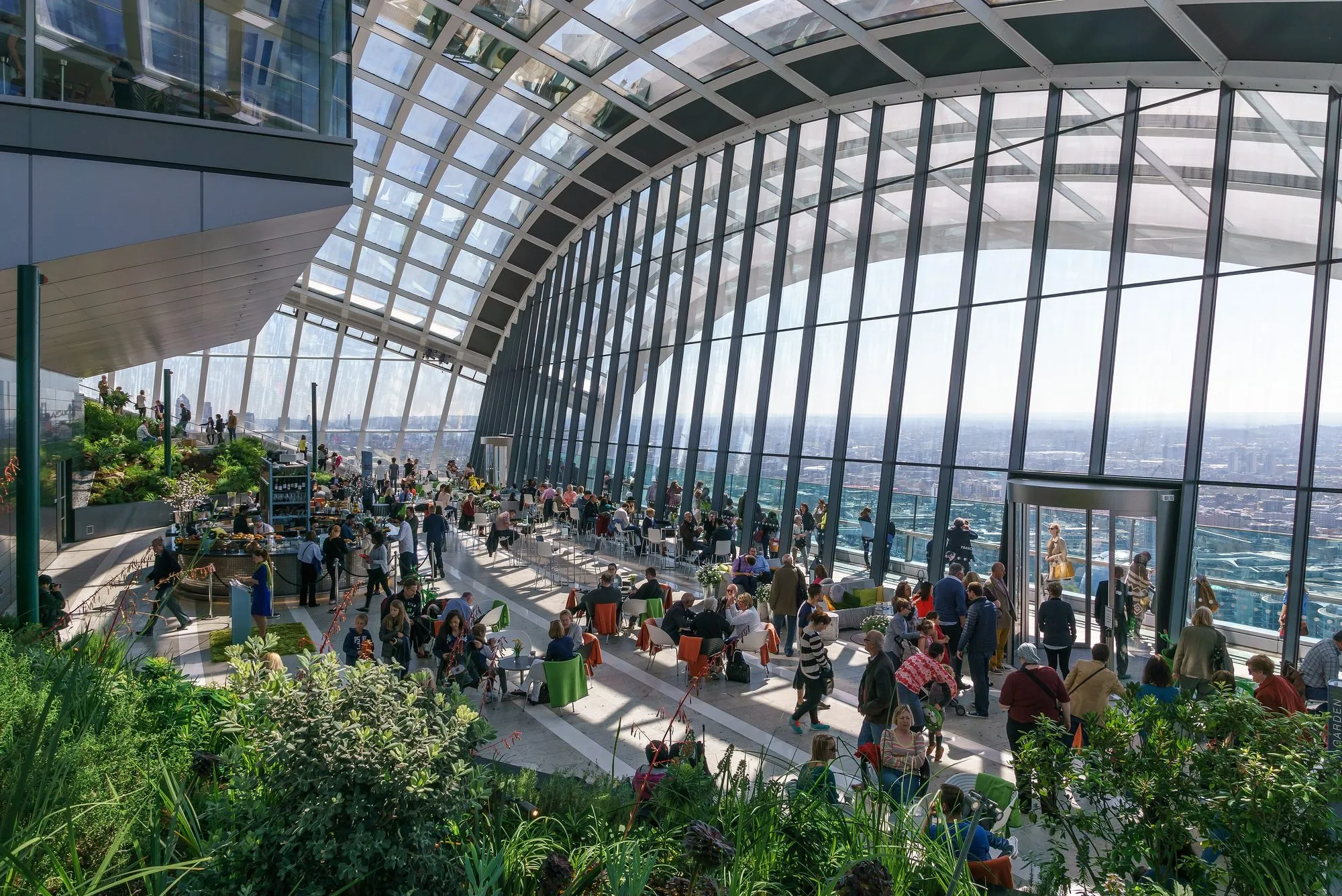
Leadenhall Market, an 1881 wrought-iron arcade painted maroon and green, is roofed and free to walk through — it played the streets outside the Leaky Cauldron in the first Harry Potter film, and it sits within five minutes of two free indoor viewpoints: Horizon 22, the highest public viewpoint in London, and the Sky Garden, a planted terrace at the top of the “Walkie-Talkie”, both booked online ahead. The Roman amphitheatre under the Guildhall Art Gallery is free and indoors too, a ten-minute walk away. Our City of London area guide has the full cluster.
One more, if you’d rather sit down: The Crosse Keys, a Wetherspoons inside a 1913 banking hall on Gracechurch Street, is indoors, cheap, and considerably grander than the name suggests.
The Westfield centres
London’s two Westfield centres don’t need a clever argument — they are simply vast, fully roofed malls, and both are about to get a serious new reason to visit.
Westfield London, at White City and Shepherd’s Bush, is Europe’s largest shopping centre, with around 476 shops and a 17-screen Vue cinema under one roof. Absurd City, an 80,000 sq ft immersive art experience from the makers of Bristol’s “amazement park”, opened inside the centre — in the old KidZania unit — on 15 October 2026. Westfield Stratford City connects directly to Stratford station — you walk through it to reach the Olympic Park, whatever the weather — with around 250 shops, a cinema, a casino and a bowling alley; Phantom Peak, the immersive free-roam show that closed at Canada Water, reopens here on 4 December 2026, bigger and fully accessible this time. Both malls are covered in our shopping guide and immersive experiences guide; Stratford also has its own area guide.
If serious shopping is part of the plan while you’re sheltering: the UK abolished VAT refunds for visitors in 2021, and the only way to claim it back now is to have the shop ship your purchase abroad. Our tax-free shopping guide has what still works.
A few more places
Not everything good on a wet day belongs to one of the areas above. These stand on their own.
The London Silver Vaults, Holborn — a vault complex under Chancery Lane with more than forty dealers and, by its own claim, the largest single collection of silver for sale in the world. Free to browse, Monday to Friday and Saturday mornings.
Mail Rail, at the Postal Museum in Bloomsbury — a miniature train on a circular route through the Post Office’s own tunnels beneath Mount Pleasant, about fifteen minutes end to end.
Babylon Park, Camden — an underground, three-storey theme park at Hawley Wharf with London’s only indoor rollercoaster, a drop tower and arcade games throughout. Free to enter, pay per ride.
The Porchester Spa, Bayswater — an Art Deco Turkish bath from 1929, Grade II* listed, reopened in February 2025 after an £800,000 restoration. Two steam rooms, a tepidarium, caldarium and laconium, a sauna and a plunge pool, run jointly by Westminster City Council and Everyone Active. Single-sex days: men Monday, Wednesday and Saturday; women Tuesday, Thursday and Friday; mixed on Sunday.
London Fields Lido, Hackney — heated and kept open through the winter, which is unusual for an outdoor pool in London and means it’s emptiest exactly when the weather is worst.
Bookshops you can lose an hour in: Daunt Books on Marylebone High Street, with its Edwardian galleried room and books arranged by country rather than genre, and Persephone Books in Bloomsbury, reprinting forgotten women writers with endpapers taken from period fabrics.
And if none of the above is covered enough: BFI Southbank’s Mediatheque lets you watch archive film free with no ticket at all, part of the deeper repertory scene our independent cinemas guide covers in full.
What to know
- Museums are quietest in the last two hours before closing — everyone else has the same rainy-day idea at 11am.
- The South Kensington subway gets you to the Natural History Museum’s door dry; the Science Museum and V&A need a short stretch in the open.
- Leadenhall Market and the Silver Vaults both keep office-district hours — Leadenhall is weekdays only, and the Silver Vaults adds Saturday mornings, but neither is worth a special trip on a Sunday.
- The Barbican Conservatory needs a timed ticket — book up to a month ahead, or try for one of the limited day tickets released online at 9.30am.
- Canary Wharf’s older malls wind down on Sundays, though Crossrail Place, the museum and the newer Wood Wharf restaurants run all week.
- The Tube is warm, dry, and covers more of central London underground than most people plan for — several of the areas above are one line apart.
Continue planning your London trip
- 🏛️ The Best Museums in London
- 🎭 London Theatre: How to Choose a Show and Pay Less
- 🎢 The Best Immersive Experiences in London
- 🎬 London’s Best Independent Cinemas
- 💷 The Best Cinema Deals in London
- 🛍️ Shopping in London
- 💳 Tax-Free Shopping in London
- 🎪 Free Things to Do in London
- 🫖 The Best Afternoon Tea in London
- 👨👩👧 London With Children
- 🛒 London Markets by Day
Common questions
Which parts of London are best to be in when it's raining?
The ones where several indoor things sit close together rather than one damp walk between them. Canary Wharf has underground malls connecting three sets of platforms without going outside. Battersea Power Station is over 150 shops and two turbine halls under one roof. The Barbican links two galleries, three cinema screens, a concert hall and a library by raised walkway. King's Cross, the West End and the City each cluster a free museum, a covered market and an immersive show or two within a few minutes' walk.
Does it rain a lot in London?
Less than the reputation suggests. London gets somewhere around 600 to 630mm of rain a year depending on the weather station, against roughly 750mm in Rome. What London actually gets is many days of light drizzle rather than a few heavy downpours, which is why a plan helps more than an umbrella does.
Can you get around Canary Wharf without going outside?
Largely, yes. Canada Place, Cabot Place and Jubilee Place are underground shopping malls connecting most of the estate to the Elizabeth line, Jubilee line and DLR platforms without stepping outside, and Crossrail Place's roof garden is reached directly from the Elizabeth line station the same way.
Is Battersea Power Station actually covered, or just the shops inside it?
The power station building itself is indoors — both turbine halls and the shopping levels between them sit under the original steel roof. Circus West Village and Electric Boulevard, the newer streets beside it, are open to the sky, so the covered promise is the building rather than the whole 42-acre estate.
Where can you see theatre, cinema or an immersive show indoors when it's raining?
The West End has the largest concentration of all three anywhere in Britain, including immersive venues like Twist Museum at Oxford Circus and The Crystal Maze LIVE at Piccadilly Circus. Our immersive experiences guide and London theatre guide cover the rest, including venues at King's Cross and the Westfield centres.
What is the best indoor activity in London for families when it rains?
The Science Museum and Natural History Museum are both free and next door to each other in South Kensington — the Natural History Museum has a gate straight off the pedestrian subway from the Tube station, though the Science Museum and V&A need a short stretch above ground first. Young V&A in Bethnal Green is free and built entirely around children, and Babylon Park in Camden is an underground three-storey theme park with London's only indoor rollercoaster.