
In this guide
Falling ill or getting hurt on a visit to London raises questions that don’t come up at home: which number to call, whether A&E will actually treat you for free, and what a pharmacist is now allowed to hand over without a GP. The answers are set by NHS and GOV.UK rules, not by guesswork, and they change depending on the service, your nationality, and how long you’re staying. This is information from those rules, not medical advice — for the medical question itself, call NHS 111 or see a clinician.
💡 The Short Version: For a life-threatening emergency, call 999 or 112 — both reach the same UK call handlers. For anything urgent that isn’t life-threatening, call 111 or use 111 online, free, 24 hours a day. For minor illness, a pharmacist can help directly, and under England’s Pharmacy First service can also assess and prescribe for 7 common conditions without a GP appointment. A&E, NHS 111 and a GP appointment are free to every visitor, whatever your nationality. Planned hospital treatment isn’t: without an exemption, a GHIC/EHIC or a reciprocal agreement, it’s charged upfront at 150% of the NHS’s own rate. EU, EEA and Swiss visitors should carry their own country’s EHIC; Australian and New Zealand visitors have narrower reciprocal cover. None of this replaces travel insurance. Prescriptions cost £9.90 per item in England, the same for visitors as residents.
If you’re ill or hurt: where to start
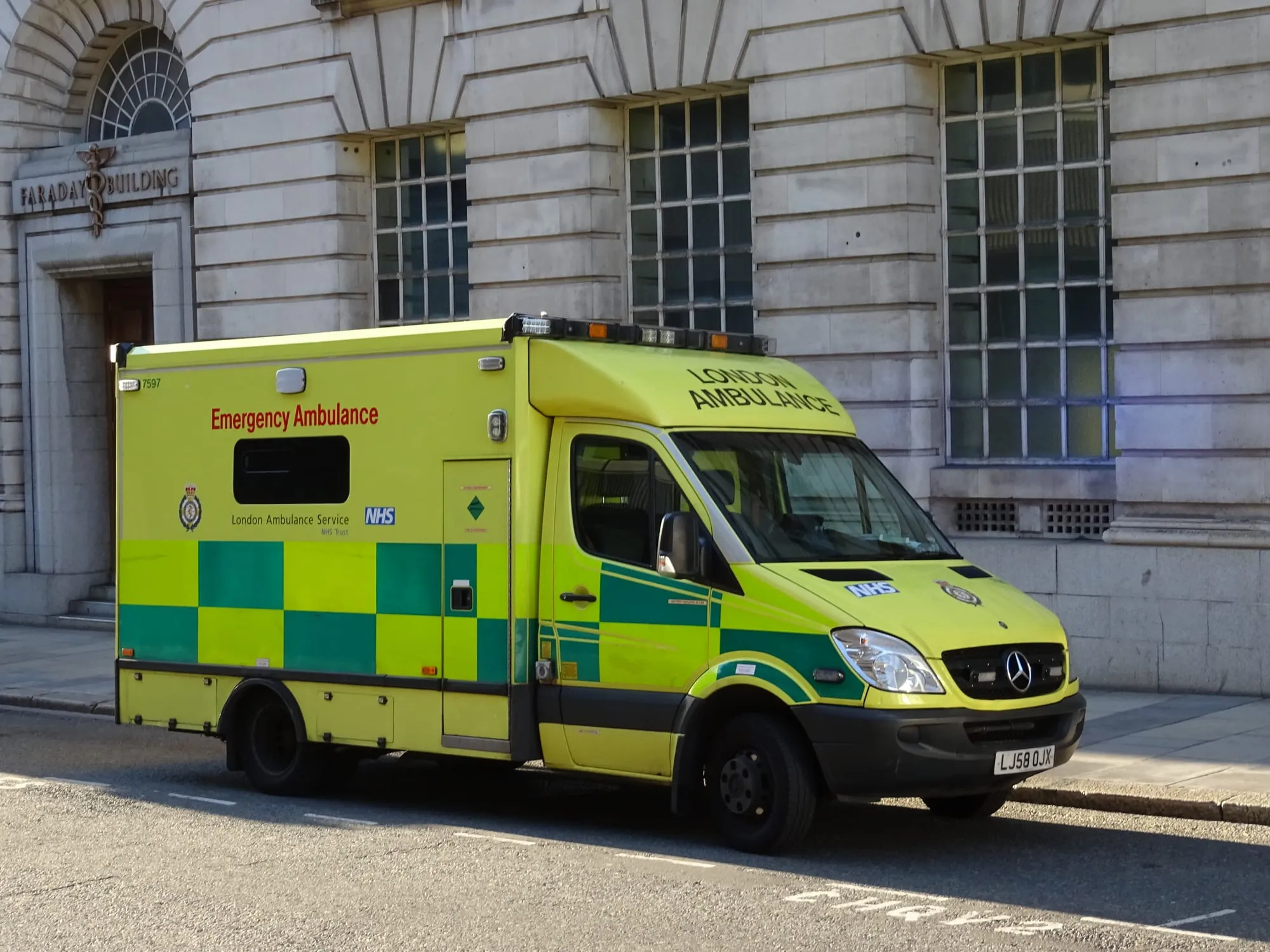
Call 999, or 112, for a life-threatening emergency — a serious accident, chest pain, difficulty breathing, a stroke, heavy bleeding. GOV.UK confirms 112 is the pan-European equivalent to 999 and can be used in the UK: both are answered by the same call handlers, who ask for your location, what’s happened, and a contact number. Calling 999 doesn’t automatically mean an ambulance is sent — you might be told it’s safe to make your own way to A&E instead — but a life-threatening emergency gets paramedics dispatched by ambulance, rapid response car or motorbike, or cycle responder. Don’t drive yourself to A&E; ask someone else to drive, or call 999 for an ambulance.
Call 111, or use 111 online, for anything urgent that isn’t life-threatening. NHS 111 is free, runs 24 hours a day, and can tell you whether you need 999, a same-day GP, an urgent treatment centre, or can safely look after yourself at home. It can also arrange an emergency supply of regular medicine and help with urgent dental problems. 111 online is for anyone aged 5 and over; call 111 by phone for a child under 5, for a complex existing condition, or if you need an interpreter or British Sign Language support (via SignVideo).
For minor illness, start with a pharmacist rather than a GP. Every pharmacy sells general sale medicines — paracetamol, ibuprofen, antihistamines and the like — without an appointment, the same as at home. Since 31 January 2024, England’s Pharmacy First service has let pharmacists go further: for 7 common conditions, they can assess you in a private consultation room and supply prescription-only medicine directly, with no GP visit needed first.
| Condition | Who it covers |
|---|---|
| Acute otitis media (earache) | Ages 1 to 17 |
| Impetigo | 1 and over |
| Infected insect bites | 1 and over |
| Shingles | 18 and over |
| Sinusitis | 12 and over |
| Sore throat | 5 and over |
| Uncomplicated urinary tract infection | Women aged 16 to 64 |
You can walk into a participating pharmacy directly for any of these, or be referred in by a GP, NHS 111 or an urgent care setting. The pharmacy notifies your GP (if you have one) by the next working day.
A&E, urgent treatment centres and walk-in centres
These aren’t interchangeable, and NHS guidance is specific about which fits which situation.
A&E (accident and emergency, also called the emergency department) is for serious injury and life-threatening emergencies, open 24 hours every day. Everyone is triaged by a doctor or nurse on arrival, so the most seriously unwell are seen first regardless of who arrived earlier — arriving by ambulance doesn’t itself mean being seen sooner. NHS guidance is blunt that departments are often very busy and a wait is likely.
Urgent treatment centres (UTCs) and walk-in centres handle the everyday injuries and illnesses that don’t need A&E: sprains and suspected broken bones, cuts and bruises, stomach pain, vomiting and diarrhoea, skin infections and rashes, a high temperature, mental health concerns, and emergency contraception. Many can do an ECG, blood tests or an X-ray, and arrange a prescription on the spot. You don’t need to be registered with a GP, have a fixed address, or know your NHS number.
To find your nearest of any of these, use the NHS’s own service finder — search by postcode or “near me” for A&E, a UTC, a walk-in centre, a GP or a dentist. If you’re not sure which you need, 111 online will ask about your symptoms and point you to a specific service, and in some cases let you book an arrival time so the service knows you’re coming.
What overseas visitors pay on the NHS
The NHS in England is what the NHS itself calls a residence-based system, not an insurance-based one — so unlike many other countries, being a visitor rather than a resident can mean paying, depending on the service and your circumstances.
| NHS service | What it costs an overseas visitor |
|---|---|
| 999 ambulance and A&E, until you’re admitted to a ward | Free to everyone, whatever your nationality or visa status |
| NHS 111, by phone or online | Free to everyone |
| A GP appointment, including registering as a temporary patient | Free to everyone |
| Walk-in centres, minor injuries units and urgent treatment centres | Free to everyone |
| STI testing and treatment, contraception and other sexual health services | Free to everyone |
| Treatment for most infectious diseases, including HIV, TB and COVID-19 | Free to everyone |
| Planned (“secondary”) hospital care, admission, and follow-up outpatient appointments | Free if you’re ordinarily resident, exempt, or covered by a GHIC, EHIC or reciprocal healthcare agreement; otherwise charged upfront at 150% of the NHS’s own rate for the treatment |
| Prescriptions, dental treatment and eye tests | Charged at the same rate as a resident — for example £9.90 per prescription item — even when the underlying care is free |
A&E, NHS 111, walk-in and urgent treatment centres, sexual health services and treatment for infectious disease are exempt from charge for every overseas visitor by name, under the National Health Service (Charges to Overseas Visitors) Regulations 2015, set out in GOV.UK’s guidance for NHS trusts. GP consultations are free for a simpler reason: primary care sits outside those charging rules altogether, for residents and visitors alike. Nothing on either list depends on your passport.
Where a charge does apply — non-emergency hospital treatment for a visitor with no exemption or cover — it’s 150% of what the NHS Payment Scheme would charge for the same treatment, payable in full and in advance. The one override: a clinician can never withhold or delay treatment they judge urgent or immediately necessary over payment, even from a visitor who can’t pay — the charge is still pursued afterwards, but care isn’t held back to enforce it. Visitors on a visa of more than 6 months normally pay the immigration health surcharge as part of their application instead, which then covers NHS care on close to the same basis as a resident.
GHIC, EHIC and reciprocal healthcare agreements
If you’re visiting from an EU, EEA or Swiss country, bring your own country’s EHIC. (The UK’s own card for its residents travelling abroad is called the GHIC — a different card, for the opposite direction of travel. What a visitor to London needs is the card issued by their own country, which for EU, EEA and Swiss residents is the EHIC.) NHS guidance confirms a valid EHIC covers treatment that becomes medically necessary during your stay, plus pre-existing conditions and routine maternity care, provided you didn’t travel specifically to give birth or seek treatment. If your EHIC is lost or stolen while you’re in England, your home country can issue a Provisional Replacement Certificate (PRC) with the same cover. Visitors from Norway can use a passport alone for medically necessary care; NHS guidance notes that since 1 January 2021, visitors from Iceland and Liechtenstein may be charged at the standard 150% rate instead.
Australia and New Zealand have their own, narrower arrangement. GOV.UK’s guidance for NHS providers lists both countries under reciprocal healthcare agreements covering “necessary healthcare” — treatment a clinician judges medically necessary before you can reasonably be expected to return home — for their residents, shown with a passport and proof of residency. It doesn’t extend to routine or planned care.
⚠️ None of this is travel insurance. NHS guidance says it directly: a GHIC, EHIC or reciprocal agreement is “not a replacement for travel insurance.” None of them cover being flown home, treatment at a private hospital, or lost property, and reciprocal agreements typically exclude repatriation and ongoing monitoring entirely. GOV.UK’s advice for every visitor, covered or not, is to also carry a valid travel insurance policy for the whole trip.
Prescriptions and medicines
A prescription costs £9.90 per item in England, confirmed on both nhs.uk and the NHS Business Services Authority’s own site — the same rate whether you live in England or are visiting. It’s charged per item rather than per prescription: three medicines on one prescription is three charges. Some items carry no prescription charge, including contraception and medicines for hospital inpatients. Most prescriptions are valid for 6 months from the date they’re signed; prescriptions for controlled drugs such as morphine are valid for 28 days.
For anything that doesn’t need a prescription, a pharmacy is the first stop. Standard over-the-counter medicines — pain relief, antihistamines, travel sickness tablets, rehydration sachets — are sold without an appointment, and under Pharmacy First a pharmacist can go further for the 7 conditions listed above.
Bringing your own medication into the UK is generally straightforward, but a medicine containing a controlled drug comes with GOV.UK conditions. You can bring up to 3 months’ supply, and you must be able to prove it’s yours with a letter from the prescriber giving your name, your travel dates, and the medicine with its dose and quantity. Your doctor or pharmacist can tell you whether a medicine contains a controlled drug. Anything on the more tightly restricted schedule 1 list needs a Home Office licence from the Drug and Firearms Licensing Unit arranged before you travel.
⚠️ A controlled drug with no proof it’s prescribed for you, or more than 3 months’ supply of one, will be taken away at the UK border. For a longer stay, GOV.UK’s route is to have it prescribed by a UK doctor or pharmacist once you’re here, which you may need to pay for.
Dental emergencies
Call 111, or use 111 online, first — it can point you to an emergency or urgent NHS dentist. NHS guidance sets rough response times by symptom: a knocked-out adult tooth should be seen within an hour, or as soon as possible; severe pain that painkillers don’t touch, a swelling or patch in the mouth that’s getting worse, or bleeding after an extraction, within 24 hours to 7 days. While you wait, a pharmacist can advise on painkillers and on managing toothache, mouth ulcers under 2 weeks old, or a lost filling.
⚠️ Go straight to A&E or call 999 instead for a serious injury to the face or jaw, mouth bleeding that won’t stop, swelling of the mouth, lips, throat or neck that’s affecting breathing or opening your eyes, or any head injury that’s caused loss of consciousness, vomiting or double vision.
Most adults pay for NHS dental treatment, visitor or resident alike, on the same charge bands as everyone else.
Mental health crisis support
If life is at risk — a serious suicide attempt, an overdose, or you can’t keep yourself or someone else safe — call 999 or go to A&E now. NHS guidance is direct that a mental health emergency should be treated exactly as seriously as a physical one, and A&E staff will refer you on to a liaison psychiatry or home treatment team after your immediate needs are met.
For urgent help that isn’t an emergency, call 111 and select the mental health option, or use 111 online — you may be able to speak to a trained mental health professional by phone. Samaritans offer free, confidential support from trained volunteers on 116 123, 24 hours a day, for anyone struggling, not only in crisis. Under-19s can also call Childline on 0800 1111.
Sexual health clinics
Sexual health clinics — sometimes called GUM (genitourinary medicine) clinics — are free and available to everyone, in the NHS’s own words, no matter your age, gender, ethnicity or sexuality. That holds for visitors too: STI testing and treatment sit on GOV.UK’s list of services exempt from overseas visitor charging, regardless of residency or immigration status. Clinics offer STI testing and treatment including HIV, contraception including emergency contraception, pregnancy testing, HPV and hepatitis vaccination, PrEP and PEP, and confidential support after rape or sexual assault. Some GP surgeries and pharmacies also offer sexual health advice and free condoms. Use the NHS’s sexual health clinic finder for your nearest; visits are confidential, and staff won’t share what’s discussed, including with your GP, without your permission unless they believe you or someone else is at risk.
Private GPs and urgent care, if you’d rather pay
For a same-day appointment without going through 111, or care outside NHS hours, London has private GP clinics with published prices. DocTap runs 11 London clinics, with GP appointments from £55 online or £75 in a clinic on weekdays (£85 at weekends) for a standard 15-minute consultation. London Doctors Clinic runs 16 London locations, with 15-minute face-to-face GP appointments from £89 on weekdays and weekday evenings, rising to £105 on weekends and bank holidays; longer appointments and same-day blood tests cost more. Both operate as walk-in-style private GP services rather than A&E replacements — for anything urgent or serious, use NHS 111 or A&E as above.
Continue planning your London trip
- 🛂 The UK ETA Guide — the entry permit to sort before you fly, not after you land
- 📱 Travel SIM and eSIM Guide — so 111 online and the NHS service finder actually work the moment you land
- 💰 Money in London — cash, cards and what things cost once you’re here
- 🚻 Public Toilets in London — another practical guide for the same kind of trip
Rules, charges and figures in this guide are from NHS and GOV.UK’s own pages — including nhs.uk, england.nhs.uk, the NHS Business Services Authority, and GOV.UK’s guidance for NHS providers on overseas visitor charging — checked 17 September 2026. Private clinic prices are from each operator’s own published price list, checked the same day. Charges, cover and clinical guidance change; this is information, not medical advice, so check the current NHS or GOV.UK page, or call 111, before you rely on it.
Common questions
What number do I call in a medical emergency in London?
999, or the pan-European 112 — GOV.UK confirms 112 is the pan-European equivalent to 999 and can be used in the UK, reaching the same call handlers. Both are for life-threatening situations: serious accidents, chest pain, stroke, severe bleeding. If you're not sure it's that serious, call NHS 111 instead and they'll tell you what to do.
Is A&E free for tourists in London?
Yes, for the treatment itself. NHS and GOV.UK guidance both list accident and emergency services among the handful of services free to every overseas visitor regardless of nationality or immigration status. The exception is if you're admitted to a hospital ward afterwards — at that point standard overseas visitor charging applies, unless you're exempt or covered by a GHIC, EHIC or reciprocal healthcare agreement.
Do I still need travel insurance if I have a GHIC, EHIC or come from a country with a reciprocal healthcare agreement?
Yes. NHS guidance is explicit that these schemes are not a replacement for travel insurance: they don't cover being flown home, treatment at a private facility, or lost property, and GOV.UK's reciprocal agreements with countries such as Australia typically cover only immediate, medically necessary treatment, not repatriation or ongoing care.
What can a London pharmacist treat without a GP appointment?
Under England's Pharmacy First service, which NHS England launched on 31 January 2024, a pharmacist can assess and, where appropriate, prescribe for seven common conditions without a referral: earache (ages 1 to 17), impetigo (1+), infected insect bites (1+), shingles (18+), sinusitis (12+), a sore throat (5+), and uncomplicated urinary tract infections in women aged 16 to 64. You can walk in directly for any of these.
How much does an NHS prescription cost in England?
£9.90 per item, confirmed on both nhs.uk and the NHS Business Services Authority's own site — the same rate for visitors as for residents. It's charged per item, not per prescription, so three medicines on one prescription cost three charges. Contraception carries no prescription charge.
Can I bring my own medication into the UK?
Generally yes. If a medicine contains a controlled drug, GOV.UK limits you to three months' supply and requires proof it's yours: a letter with your name, travel dates, the medicine, dose and quantity, and the prescriber's signature. Without one, or with more than three months' supply, it will be taken from you at the border. Anything on the more restricted schedule 1 list needs a Home Office licence arranged before you travel.
What's the difference between A&E, an urgent treatment centre and a walk-in centre?
A&E is for life-threatening emergencies and serious injury. Urgent treatment centres and walk-in centres handle everyday injuries and illness — sprains, cuts, infected bites, a child's high temperature — often with an X-ray or blood test on site, without A&E's queue for genuine emergencies. NHS 111 will direct you to whichever fits, or search directly on the NHS service finder for your nearest of each.
Are Australian and New Zealand visitors covered by the NHS?
Partially. GOV.UK's charging guidance for NHS providers lists Australia and New Zealand among the countries with a reciprocal healthcare arrangement, covering medically necessary treatment for their residents while visiting England. It doesn't extend to routine care, monitoring of existing conditions, or repatriation, which is why GOV.UK still recommends travel insurance for the trip.
Where can I get emergency dental treatment in London?
Start with NHS 111, by phone or online, which can point you to an emergency dentist. NHS guidance says a knocked-out adult tooth should be seen within an hour; most other urgent problems, such as an abscess or a lost filling with pain, within 24 hours to 7 days. Go straight to A&E or call 999 instead for facial injuries, mouth bleeding that won't stop, or swelling affecting your breathing or swallowing.
What should I do in a mental health crisis in London?
Call 999 or go to A&E if life is at risk. For urgent support that isn't life-threatening, call NHS 111 and choose the mental health option, or use 111 online. Samaritans (116 123) offer free, confidential listening support 24 hours a day, and the NHS says a mental health emergency should be taken exactly as seriously as a physical one.

.jpg)