In this guide
September is the month London stops performing for visitors and goes back to being a working city — and it is, for that reason, one of the two or three best months to be here.
💡 The Short Version: Whistler at Tate Britain closes on Sunday 27 September, and Totally Thames runs along the river to the 30th. Blue Note London, the New York jazz club’s first UK room, opened on St Martin’s Lane on 23 September. On Saturday 26 September England play Spain at Wembley and the Red Roses play New Zealand at Twickenham. Bayeux Tapestry tickets at the British Museum are sold out to 31 December; the next general release is 21 October.
The schools go back in the first week. From around the 5th, the museums thin out, restaurant tables reappear and the South Bank stops being an obstacle course, while the weather usually holds well into the month. Sunset is still after seven for the first three weeks. It is August’s weather with October’s crowds.
Then the middle of the month collided.
Open House and the London Design Festival ran the same nine days. In 2026 that was 12 to 20 September, exactly. Heritage Open Days overlapped them, 11 to 20, and London Fashion Week started the day before they finished. For anyone interested in buildings, design or how London is put together, that was the best week of the year to be in the city — and simultaneously the worst week for a cheap hotel room or a quiet gallery.
The one that will define the year
The Bayeux Tapestry — British Museum, from 10 September
Room 30, the Sainsbury Exhibitions Gallery · 10 September 2026 to 11 July 2027
For the first time in nearly a thousand years, the Bayeux Tapestry is in England. Not a reproduction and not a section of it: the seventy-metre embroidery itself, on loan from France under a government-level agreement, telling the story of the events leading to the Battle of Hastings and the Norman Conquest.
The thing worth understanding about it is the collaboration buried in its making. It was likely commissioned by a Norman patron but embroidered by English hands, working from manuscript drawings out of Canterbury — so the account of England’s conquest was stitched by the conquered, and it is as much a record of eleventh-century life as of a battle. Castles, ships, warfare, but also clothing, food and furniture.
Opening hours are unusually long, and that is the tactical detail. Sunday to Wednesday it runs 10am to 6pm; Thursday to Saturday it stays open until 9pm. Late Thursday and Friday slots are the civilised way to see it.
Tickets: this is the part to plan. Every ticket for 10 September to 31 December 2026 has sold out. Members’ priority booking reopens on 6 October 2026, and the next general ticket release is 21 October 2026, covering visits from 1 January to 31 March 2027. If you want to go and have not booked, mark those two dates — the British Museum’s newsletter is the only reliable way to be told when releases open. Our British Museum guide keeps the ticket position, prices and rooms in one place.
If you cannot get in, Bayeux Around Britain runs related programmes at more than sixty museums and heritage sites across the country. There is also a curator’s talk, The real world of the Bayeux Tapestry, online on 25 September, £50.
The annual fixtures
These come round every year. If you are reading this in a later September, the dates will have moved but the events will be here.
Totally Thames — the whole month, the whole river
1 to 30 September, every year, along the length of the tidal Thames.
A month-long river festival run by the Thames Festival Trust, and easy to miss because it does not present as a single event you can turn up to. It is dispersed by design: art installations, boat trips, river races, environmental projects and — the ones worth planning around — foreshore archaeology walks, where you go down onto the exposed riverbed at low tide with someone who can tell you what you are looking at.
A large share of it is free. The foreshore walks are the exception in demand rather than price, and they book out early, because the number of people who can safely stand on a tidal foreshore is small and the tide, not the organisers, decides the timings.
London is here because of the Thames, and September is the one month the city organises itself around saying so.
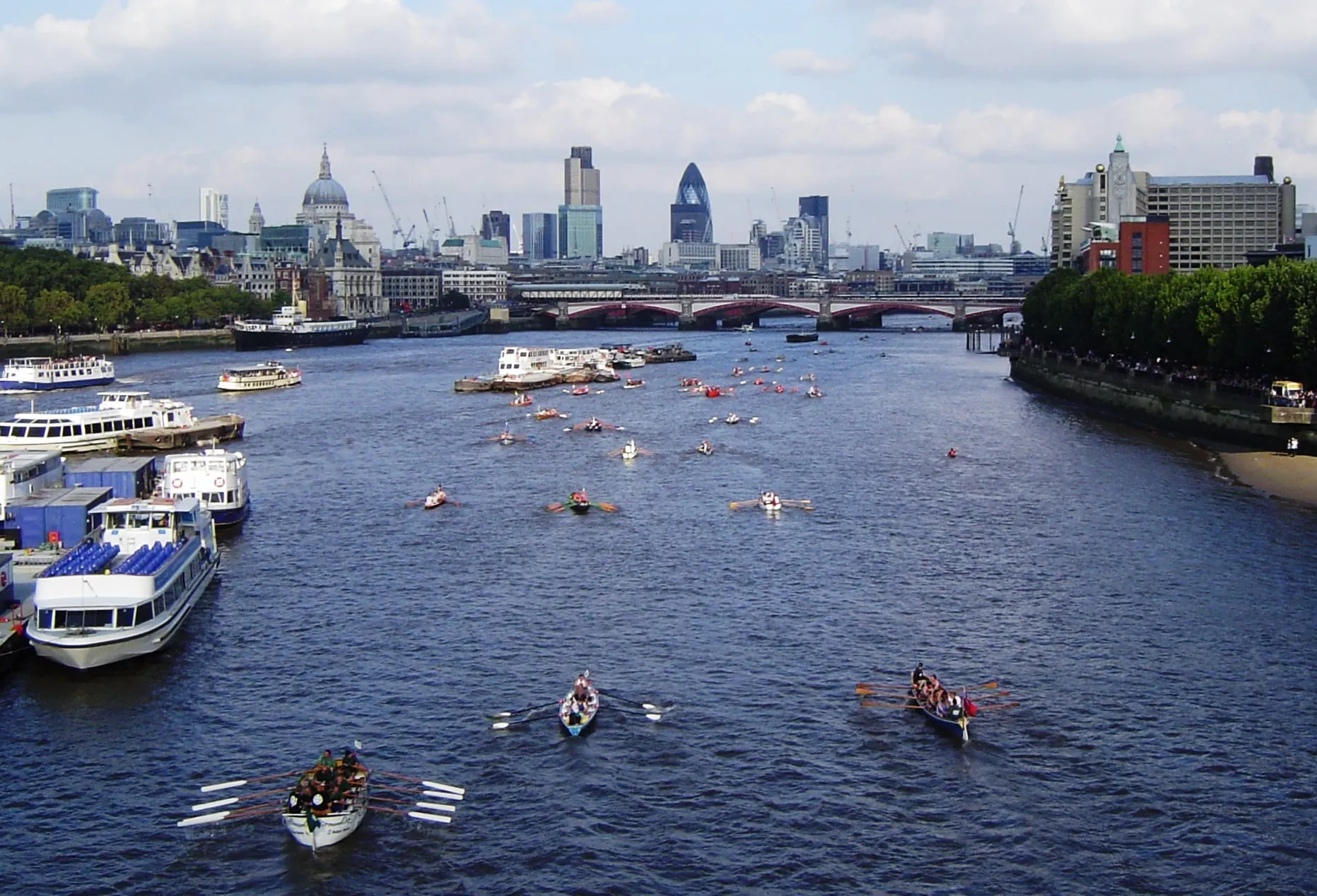
The Great River Race — 21.6 miles, 300 boats, mostly in fancy dress
The race was on Saturday 12 September 2026, first boats crossing the start line at 12.45pm.
London’s river marathon, and a strange and wonderful thing to stumble on. Around 300 fixed-seat crews row 21.6 miles from Millwall in the east to Ham in the west, under every bridge in between. It started in 1988 with 61 boats and is now international, with crews from America, Australia and across Europe — and a large part of the field is raising money in fancy dress, so the serious athletes are threaded through a flotilla of nonsense.
It is free to watch and you do not need a plan. Stand on any bridge or bank and it will come past; the organiser publishes an observation points page giving rough times along the course. The finish at Ham has food, a bar and a disco. There is also a supporters’ boat from Millwall to Ham, which is bookable.
One warning worth carrying: the start time moves with the tide and is confirmed late, so never assume the previous year’s. The organiser’s site is greatriverrace.org.uk.
Open House Festival — the free one everybody misses by a week
12 to 20 September 2026. Free.
Open City opens buildings across every London borough that are normally shut, private or expensive: livery halls, private houses, government buildings, infrastructure, and architects’ own homes, which are consistently the most interesting category and the least contested.
The constraint is timing, not money, and this is where most people go wrong. The programme goes live in August. The buildings everyone wants — the ones that appear in the newspaper write-ups — either run a ballot or release timed slots that are gone within hours. By September the marquee list has been taken.
That is not a reason to skip it. Hundreds of buildings are walk-up, no booking, just a queue and a volunteer at the door, and they are frequently better than the famous ones because you can take your time. The move is to ignore the towers, pick a neighbourhood, and walk it. Then set a reminder for the programme launch each August.
Heritage Open Days — the one people confuse with Open House
11 to 20 September 2026. Free.
A different organisation, running at the same time, and readers conflate the two constantly. Heritage Open Days is England’s largest festival of history and culture, volunteer-organised and national rather than London-only, and it skews to heritage where Open House skews to architecture — so churches, halls, historic trades and local history, alongside the buildings.
If you are in London that week you can treat them as one programme with two websites. Check both; the overlap is smaller than you would expect.
London Design Festival — nine days, and mostly free
12 to 20 September 2026.
Built on design districts — Brompton, Shoreditch, Mayfair, Bankside and others — each with its own trail, plus large commissioned installations in public spaces and at the V&A, which has been the festival’s traditional hub for years.
Most of it is free and unticketed, which is the part people do not realise: the installations are simply in the city, and you can walk into them. The Global Design Forum and the talks programme are ticketed and do sell out.
Because it runs the same nine days as Open House, the sensible approach is to treat them as a single week instead of choosing. One gets you inside buildings; the other tells you what people are doing with the insides of buildings.
Last Night of the Proms — and how to actually get in
The concert was on Saturday 12 September 2026, 7.15pm, doors 5.45pm, Royal Albert Hall.
The close of a summer of more than eighty concerts. In 2026 it is Yuja Wang on piano, returning after her 2023 appearance, with Scottish tenor Nicky Spence and the massed BBC forces under Sakari Oramo.
Seats are long gone. Day Promming tickets go on sale at 9.30am on the day of the concert, two per booker — standing, in the arena or the gallery, and the cheapest way into the most oversubscribed classical concert in the country. Season ticket holders redeem theirs from 11am the day before. The ballots, the leftover sale and the £8 day tickets, with their 2026 dates, are in our Last Night of the Proms tickets guide.
If you want the experience without the queue, the Proms in the Park tradition has changed in recent years; check the BBC’s own listing for what is running before making plans around it.
National Television Awards — and how to get in
The 2026 ceremony was on Tuesday 8 September at The O2, broadcast live on ITV. It is a televised awards night where the winners are chosen by public vote and the public can also buy a seat.
Tickets for the 8 September 2027 ceremony are sold through AXS and Ticketmaster, from £25, with red-carpet viewing packages at £150 and £270. The National Television Awards tickets guide has the full price list and the booking links.
London Fashion Week — and what it actually means for you
Thursday 17 to Monday 21 September 2026.
Worth including mainly to correct a misunderstanding. This is not a public event. The September edition shows the following spring and summer, it is run by the British Fashion Council, and the shows themselves are trade and press only.
What it means for a visitor is threefold: a schedule of open events and shopping activations around the main programme; a noticeably busier central London; and hotel rates through that weekend that are the highest of the month. If you are choosing dates and do not care about fashion, book either side of it.
Exhibitions that closed in September
James McNeill Whistler — Tate Britain, closed 27 September 2026
The month’s biggest closing show, which ended on Sunday 27 September 2026, and the first major European Whistler exhibition in thirty years.
A full retrospective of the American who spent his career in London: the famous paintings alongside works rarely or never shown, running from his teens in St Petersburg through to the enigmatic late self-portraits, and taking in portraits, drawings, prints and designs. The Nocturnes are the reason most people come — Old Battersea Bridge among them — and they are the paintings that got him into a libel court arguing that a picture need not be a picture of anything.
Ticketed, and free for Tate Members, which pays for itself quickly if you are going to two or more shows in a season.
Exhibitions worth the trip
Running through September and beyond, so no rush — but these are the good ones.
BBC TV 90 at Alexandra Palace, 18 September to 30 November, is the pick. BBC television began at Ally Pally in 1936, so a ninetieth-anniversary exhibition there is on the actual site rather than merely about it — the transmitter mast is still on the roof.
John Constable: views of nature at the British Museum runs to 4 October and is free. Frida: The Making of an Icon at Tate Modern runs to 3 January, so it will keep. The Serpentine Pavilion is in Kensington Gardens until 25 October, also free, and September is the final month it is reliably pleasant to sit in one. Richard Dadd at the Royal Academy runs to 25 October. Open Roots opened at the Photographers’ Gallery on 18 September.
Theatre: the autumn openings
September is when the West End restarts. The summer run ends, Kids Week is over, and the autumn press nights come in a cluster — which means an unusual concentration of opening nights and, for a few weeks, previews at preview prices.
The first week brings Bloodsport: After Helen of Troy at Theatre Royal Stratford East on the 3rd — Ava Pickett’s follow-up to 1536, with Michelle Dockery and Laura Aikman, and Lisa Spirling directing. The same night, Thelma & Louise opens at the Young Vic as a new musical, with Amy Lennox and Rachel Tucker. Million Dollar Quartet follows on the 4th at the Arts at Marble Arch.
The one to book is on the 5th: Tilda Swinton in Man to Man at the Royal Court, returning after more than thirty years to the role that made her name — Manfred Karge’s play about a woman who takes on her dead husband’s identity to survive in 1930s Germany.
The second half of the month is heavier still. Jesse Tyler Ferguson plays Truman Capote in Tru at the Menier Chocolate Factory from the 19th. Gillian Anderson and Billy Crudup open in Who’s Afraid of Virginia Woolf? at @sohoplace on the 21st, directed by Marianne Elliott. The same evening, James Graham’s The Standard of Living opens at the Theatre Royal Haymarket, with Rory Kinnear as John Maynard Keynes. Then on the 22nd: Christine Baranski and Richard E. Grant in Hay Fever at Wyndham’s, Into the Woods at the Noel Coward, and RENT returning to Drury Lane for its thirtieth anniversary.
The Duke of York’s Theatre is now the Tom Stoppard Theatre.
Gigs worth planning around
Not a listings page — Songkick and DICE do that better. These are the shows worth building an evening around, and in September one of them was a building.
Blue Note London — St Martin’s Lane, open since 23 September
Covent Garden · WC2N 4EJ
The New York jazz club opened its first UK venue on St Martin’s Lane on 23 September, joining a group that already runs rooms in New York, Los Angeles, Tokyo and Milan.
There are two rooms: a 300-seat main room, and B-Side, a 130-seat space for late sets, emerging artists and one-offs. That means two shows a night, every night — so a sold-out headliner does not close the building, and the B-Side programme is where the interesting risks will be taken. There is a full kitchen and a bar, with a cocktail list built on reimagined jazz-era classics.
Robert Glasper played the sold-out opening night. The rest of the opening run follows: Sinead Harnett on the 25th, corto.alto on the 26th, Yussef Dayes on the 27th, and Jamie Cullum across the 28th and 29th, with Nik West carrying it into October.
Look further ahead before you book anything, because the October diary is extraordinary for a room that will be three weeks old: Erykah Badu on the 10th and 11th, Baaba Maal, Nubya Garcia across the 15th to 17th, and Shabaka on the 19th and 20th. If you are choosing a night, choose on the programme, not the novelty.
Good Kid with Last Dinosaurs play the Roundhouse on the 26th — still to come, and the one to take seriously if you have any history with that room. Earlier in the month it hosted Saint Etienne on the 18th and Bellaire, Dublon and Jeremy Underground on the 12th.
Alexandra Palace has the busiest month of any venue in London: I Prevail on the 25th and Public Service Broadcasting on the 26th are still to come — the latter, in a hall that is also the birthplace of television, is a better fit than the band could have designed. Earlier in the month it hosted Annie Mac, ANOTR and Boris Brejcha.
The Monteverdi Choir performed Rossini’s Petite Messe Solennelle at Ally Pally on 18 September.
Sport: the last Saturday is the big one
Saturday 26 September puts two England teams on in London on the same day. The men play Spain at Wembley in the UEFA Nations League, and the Red Roses play New Zealand at Allianz Stadium, Twickenham, kicking off at 3pm, with tickets from £20.
American college football came to Wembley a week earlier. The Union Jack Classic on Saturday 19 September was Arizona State Sun Devils against Kansas Jayhawks. The NFL follows in October, with three games on consecutive Sundays.
The Wimbledon 2027 public ballot closed at 23:59 BST on Monday 14 September. The All England Club opened it on 1 September; entry was free, and overseas applicants used the same window. How it works, and the other routes in if you are not drawn, are in our Wimbledon tickets guide.
Match-day transport, the bag rules and the hotels that treble in price on event nights are in our Wembley guide.
New restaurants and bars
September is the opening rush — the trade holds its launches back through August and then releases them all at once. This is the most perishable section on the page; everything below opened in the first ten days of the month.
Nakimushi in Notting Hill (7 Kensington Mall, W8 4DY) is the one generating most noise. From the Dorian team, in a townhouse, bringing together Yuji Shimokawa Kelly of Urchin and Robin Kosuge of Robin’s Ramen — a ramen bar downstairs and a broader Japanese menu above, with dishes like red prawn and courgette gyoza with umeboshi.
In the City, The Albatross (8–10 Old Jewry, EC2R 8DN) is the Goodman and Wild group’s first proper pub, with Chris Dunlop, previously of New York’s The Spotted Pig, brought in as landlord to get the pub part right. The food is seafood-led — lobster thermidor, bisque, oyster platters.
Cordelia’s in Mayfair (6 Clarges Street, W1J 8AE) is a steakhouse in the old Joël Robuchon space, built round a charcoal bar, with British cuts alongside Galician and Parmesan-fed Italian beef. Beefbar has taken over Dear Jackie inside Broadwick Soho, keeping the name and the downstairs decor. Le Cafe LPM has opened inside the Lanesborough at Hyde Park Corner as a twelve-month residency, terrace included.
Further out, Marrion’s on Morning Lane in Hackney is a neighbourhood bar from the man behind Norman’s — classic cocktails, Spanish beer, devilled crab rarebit. Pardeh in Bethnal Green is Persian; Pino in Stoke Newington is Puglian, with riso, patate e cozze on the menu.
Three more worth watching: Romy Gill has taken over The Pem in St James’s and turned it to regional Indian cooking; Endo Kazutoshi has opened his ENDO omakase room in Chelsea with a Moga listening bar above it; and the Savoy’s Beaufort Bar has become a wine bar, complete with a bespoke charcuterie trolley. The Mr Fogg’s team are opening The Admiral’s Mess inside Admiralty Arch, where Clare Smyth and Daniel Boulud are also arriving.
Practical: September in London
Weather. Typically 19–21°C by day, 12–13°C at night, cooling through the month, and historically one of the drier ones. The thing to plan for is the gap between afternoon and evening: take a jacket even when the day is warm.
Daylight. Sunset moves from roughly 7.30pm on the 1st to about 6.45pm on the 30th, with the equinox around the 22nd. The last good evenings for river walks, roof terraces and outdoor tables are in the first three weeks.
Crowds. The best argument for September. Schools return in the first week and the difference is immediate — from about the 5th, the big museums, the major attractions and the restaurants that never have tables all become manageable.
Prices. Hotel rates fall from the August peak in the first week, then climb sharply for the middle stretch when Open House, the Design Festival and Fashion Week land on top of each other. If you are flexible, the first week and the last week of September are the value in September.
Looking ahead. October brings five art fairs in a single week alongside the closing weekend of the BFI London Film Festival, a free Bayeux Tapestry festival at the British Museum, and the clocks going back. It is all in our Things to Do in London in October guide.
Comparing September against the rest of the year? Best Time to Visit London sets every month’s weather, crowds and cost against each other.
Common questions
What is the best time to visit London in September?
The first week if you want the city quiet and cheap, the middle if you want the most to do. Schools go back in the first few days, so from around the 5th the museums and restaurants ease off sharply while the weather still holds. The middle of the month is the opposite trade: Open House, the London Design Festival and Heritage Open Days all overlap, and London Fashion Week follows immediately, so there is more on than at any other point in the year and hotel rates rise to match.
When can I get tickets for the Bayeux Tapestry at the British Museum?
The next general ticket release is 21 October 2026, covering visits between 1 January and 31 March 2027. Members' priority booking reopens earlier, on 6 October 2026. The exhibition itself opened on 10 September 2026 and runs until 11 July 2027 in Room 30, and earlier releases have gone quickly — the museum's newsletter is the only dependable way to hear when the next one opens. It stays open until 9pm from Thursday to Saturday, so late slots are the calmest.
What events are on in London in September 2026?
Totally Thames runs the whole month along the river. Open House and the London Design Festival both ran 12 to 20 September, Heritage Open Days 11 to 20, and London Fashion Week 17 to 21. Saturday 12 September was the busiest single day of the month: the Great River Race rowed 21.6 miles from Millwall to Ham from 12.45pm, and the Last Night of the Proms closed the season at the Royal Albert Hall at 7.15pm.
Is Open House London free?
Yes, entirely. The constraint is timing, not money — the programme goes live in August, and the buildings people most want to see either ballot or release timed slots that go within hours of opening. If you are deciding in September, the marquee buildings have gone. Plan around the walk-up sites instead, of which there are hundreds, and set a reminder for the programme launch each August.
Can you still get tickets for the Last Night of the Proms?
The 2026 concert was on 12 September and is over, but seats sell out far in advance every year, and the hall is never closed to you. Day Promming tickets — standing, in the arena or the gallery — go on sale at 9.30am on the day of the concert, two per person. Season ticket holders can redeem from 11am the day before. It is the cheapest way into the most oversubscribed classical concert in Britain and almost no guide mentions it.
Which exhibition was the biggest to close in London in September 2026?
James McNeill Whistler at Tate Britain, which closed on Sunday 27 September 2026. It was ticketed and free for Tate Members.
What is the weather like in London in September?
Usually 19 to 21°C by day and around 12 to 13°C at night, cooling noticeably through the month, and historically one of the drier months. The practical point is that afternoons stay warm while evenings stop being reliable — take a jacket even on a hot day. Sunset moves from about 7.30pm at the start of the month to about 6.45pm by the end, so the last good evenings for river walks and outdoor drinking are the first three weeks.