In this guide
St Pancras to Brussels-Midi is as little as 1 hour 51 minutes on Eurostar’s fastest trains, and the fare that seat sells for starts around £51 in Eurostar Standard booked ahead — cheaper and faster than the same railway’s trip to Paris. Both figures come from Eurostar’s own booking engine and two independent timetable checks, all run the same day.
Brussels gets less attention than Paris as a Eurostar day trip, which is exactly what makes the maths work in your favour: a shorter train, the same border process to learn once, and — if you take one of the earlier departures — close to a full working day in the city before you need to think about the platform home.
💡 The Short Version: St Pancras to Brussels-Midi, from 1h51 direct (1h57–2h06 on the trains we checked). Eurostar Standard from £51 one-way booked ahead (£39 on some promotional dates); Eurostar Plus from £98; Eurostar Premier a flat £325 one-way / £490 return. Arrive 75 minutes before departure for Standard or Plus (45 for Premier) — UK exit, Belgian entry and EU Entry/Exit System registration all happen at St Pancras before you board, and the same process runs in reverse at Brussels-Midi for the way home. You need a passport, not an ID card, issued within 10 years and valid 3 months after you leave the Schengen area — ETIAS isn’t live yet, so there’s nothing else to apply for. Take the early train and the last realistic one back leaves Brussels around 19:56–20:56, giving eight to eleven hours in the city. Or skip the route-planning — a 2.5-hour guided walking tour (4.6★, 4,262 reviews) covers the Grand-Place, the guildhalls and Manneken Pis in one loop, which matters when you’re working with a fixed number of hours. If you’d rather stay the night, see where to stay below.
Getting there: the Eurostar
| London St Pancras → Brussels-Midi | |
|---|---|
| Operator | Eurostar, direct |
| Journey time | From 1h51 (1h57–2h06 on the trains we checked) |
| Eurostar Standard, from | £51 one-way, £78 return (from £39 on some promotional dates) |
| Eurostar Plus, from | £98 one-way, £140 return |
| Eurostar Premier | £325 one-way, £490 return — barely moves with the date |
| Recommended arrival, St Pancras | 75 min before (Standard/Plus), 45 min (Premier) |
| Trains per day | Around 10, roughly hourly to two-hourly |
Eurostar’s own site quotes fares to Brussels from £39 for a promotional-fare seat; the steadier advance fare, checked the same day on Seat61’s published fare table and Trainline’s live timetable, was £51 one-way in Standard. Both are real, checked prices rather than a single quote, so treat the range as what to expect rather than a guarantee for your date.
Eurostar Standard, Plus or Premier
Eurostar renamed its travel classes in 2024: Eurostar Standard, Eurostar Plus and Eurostar Premier replace the old Standard, Standard Premier and Business Premier on every London route, Brussels included.
| Eurostar Standard | Eurostar Plus | Eurostar Premier | |
|---|---|---|---|
| Exchange | Free up to 1hr before | Free up to 1hr before | Free up to 48hrs after departure |
| Refund | Up to 7 days before, £25 fee | Up to 7 days before, £25 fee | Free, up to 48hrs after departure |
| Luggage | 2 bags + 1 daypack | 2 bags + 1 daypack | 3 bags + 1 daypack |
| Seat | Standard | Extra spacious, meal included | Extra spacious, hot meal, lounge |
| Lounge | — | — | St Pancras, Paris, Brussels |
For one day in Brussels, Standard does the job — it’s refundable up to a week out for a £25 fee and free to change up to an hour before your train. Plus is worth the difference mainly for the meal service; Premier is priced for the lounges and the flexible ticket, not for a day trip.
Eurostar bookings open 10 to 11 months ahead, and — like every fare on this route — the price climbs as the train fills, so book as early as your dates allow.
See Brussels with a guide
If you’d rather not plan the route yourself with a fixed number of hours on the clock, a local guide covers the ground faster than working it out from a map on the day.
- 2.5 hours, 4.6★ (4,262 reviews) — Guided walking tour of the Lower and Upper City, taking in the Grand-Place, the guildhalls and the city’s major landmarks
- 4.9★ (449 reviews) — City-centre food tour with tastings, if the point of the day is as much what you eat as what you see
- 4.7★ (967 reviews) — Belgian beer tasting in Brussels, a seated introduction rather than a bar crawl
Check-in and the border
As with every London-departing Eurostar, the whole border process happens at St Pancras before you leave — UK exit, Belgian entry and EU biometric registration — rather than on arrival in Brussels.
| Station | Class | Recommended arrival |
|---|---|---|
| St Pancras (outbound) | Standard / Plus | 75 min before |
| St Pancras (outbound) | Premier | 45 min before |
| Brussels-Midi (return) | Standard / Plus | 75 min before |
| Brussels-Midi (return) | Premier | 45 min before |
⚠️ This is longer than the 20 minutes Eurostar recommends for journeys between Paris, Brussels, Amsterdam and Cologne. Those don’t cross the UK border. Any route that starts or ends at St Pancras carries the longer recommendation, so don’t apply the shorter figure to this trip.
You need a passport, not an ID card. UK nationals are non-EU travellers on this route. Your passport must have been issued less than 10 years before the date you enter Belgium and stay valid for at least 3 months after the day you leave the Schengen area — a passport that fails either rule is turned away at the gate.
The EU’s Entry/Exit System (EES) has applied to this route since 12 October 2025, and by 10 April 2026 it had fully replaced the old manual passport stamp. It means a passport scan, a photo and, on your first crossing, fingerprints, done at self-service kiosks in three zones of St Pancras before the ticket gates. It’s free, needs no advance booking, and your digital record then lasts three years.
ETIAS is a separate, later step, and it isn’t live yet. The UK government’s own guidance says the EU expects to start ETIAS operations from autumn 2026, with the exact date still to be announced — so there is nothing for a UK traveller to apply for today, and any site charging you for one now is not official.
Luggage: one handbag or daypack plus two further items, none over 85cm at their widest point, for Standard and Plus — three bags plus the daypack for Premier.
Is Brussels actually doable as a day trip?
Yes, and it’s a kinder trip than Paris on the same pattern, simply because the train is shorter.
The first Brussels train each day leaves St Pancras at 06:16, reaching Brussels-Midi at 08:13 — but that means checking in by around 5am. The more realistic early option is the 08:16, arriving 10:13. Checked the same day, the last Brussels–London service still showing on the timetable left Brussels around 19:56–20:56, arriving St Pancras roughly two hours later.
Boarding the 08:16 and returning on the last train gives you from 10:13 to around 18:40–19:40 in Brussels before you need to be through Brussels-Midi’s 75-minute check-in — call it eight and a half to nine and a half hours. Take the 06:16 instead and the day stretches past eleven hours. Either way, that’s more room than the roughly seven hours Paris gives you on the equivalent pattern, because the train itself takes less of the day.
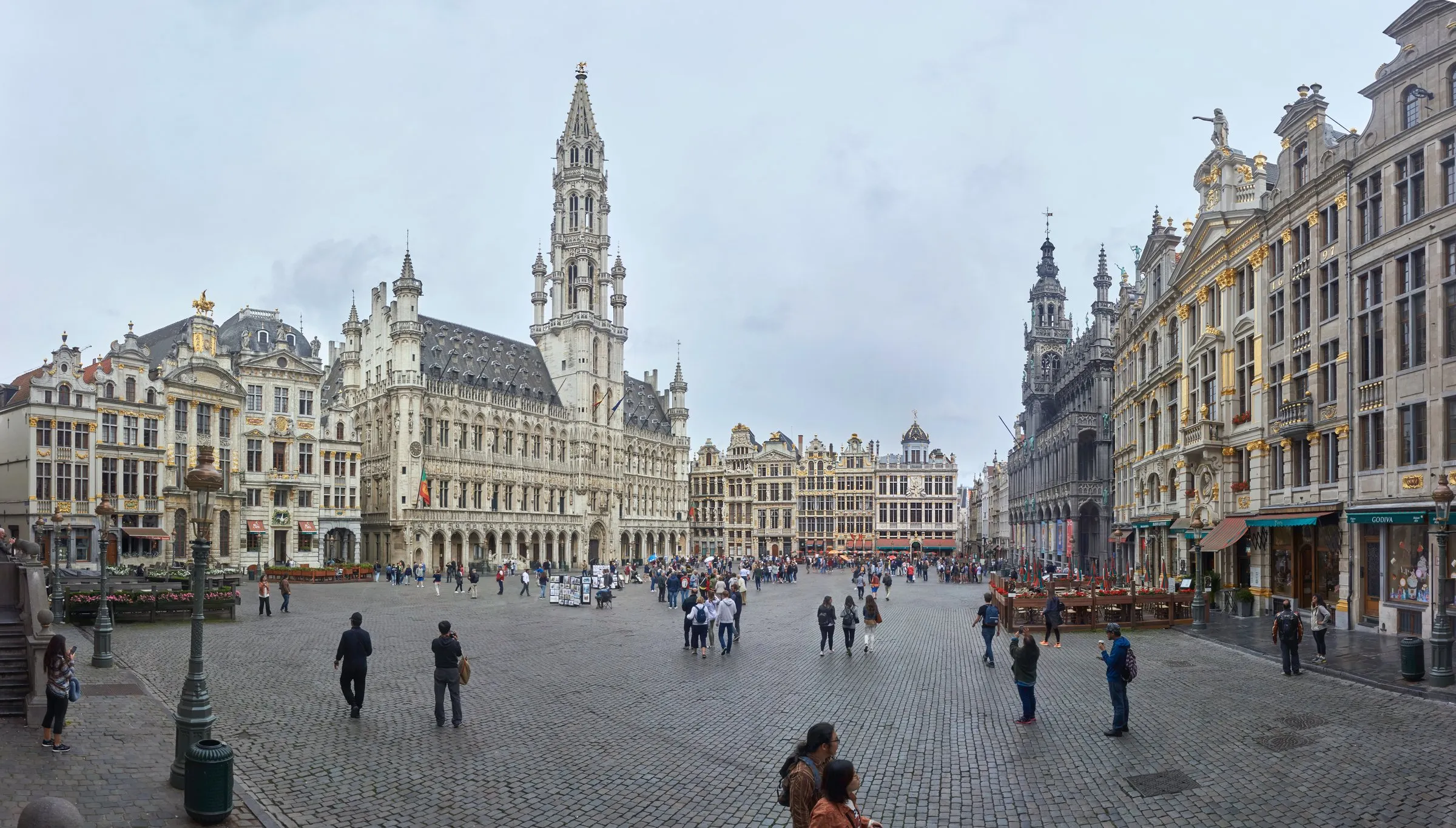
The Grand-Place, Brussels’ central square and the natural start of the day — rebuilt within four years of a 1695 bombardment, and a UNESCO World Heritage Site since 1998.
Getting into Brussels: from Midi to the centre
Brussels-Midi’s own Metro and premetro (underground tram) station sits directly beneath the platforms, on lines 2, 4, 6 and 10. From there it’s a premetro ride of about 10 minutes to De Brouckère, right by the Bourse and a short walk from the Grand-Place — or you can walk the whole way in about 20 minutes if the weather’s on your side. A single STIB/MIVB ticket covers either option.
What to do with the day
The Grand-Place and Manneken Pis
The Grand-Place is where nearly every route starts, and it earns the position: a market square ringed by guildhalls, with the Town Hall’s 96-metre spire — topped with a gilded statue of St Michael, the city’s patron saint, placed there in 1454 or 1455 — rising over the whole thing. Most of what you see was rebuilt within four years after a French army under Marshal de Villeroy bombarded the square in 1695; UNESCO listed it as a World Heritage Site in 1998.
Manneken Pis is a five-minute walk south-west of the square — a bronze fountain figure of a small boy, 55.5cm tall, first commissioned in 1619. The statue on the street today is actually a 1965 replica; the original is kept in the Brussels City Museum, on the Grand-Place itself. The figure is dressed several times a week from a wardrobe of roughly a thousand costumes, on a published schedule posted at the railings — since 2017, retired costumes have their own small museum, the GardeRobe MannekenPis, close by.
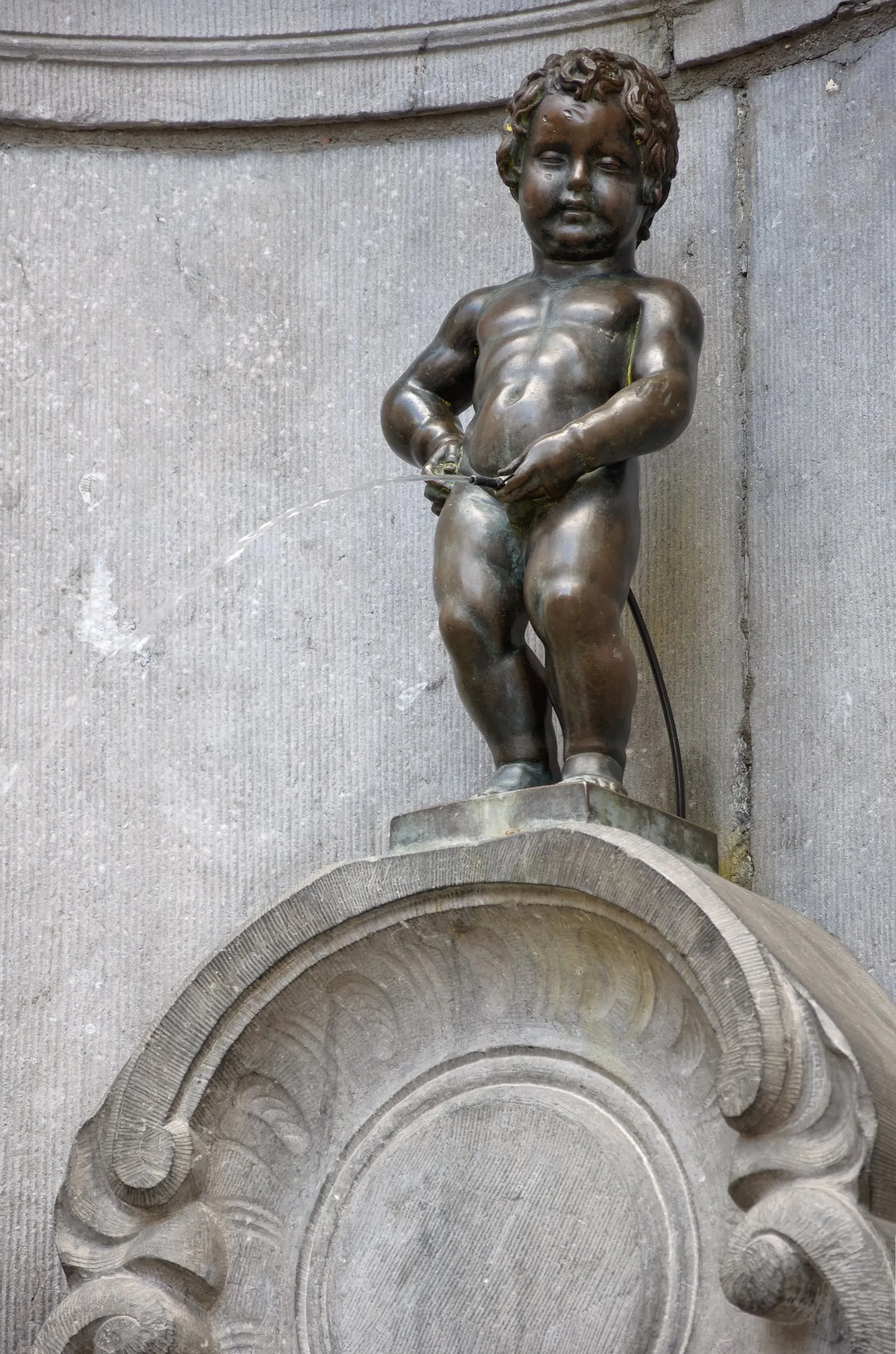
Manneken Pis, a short walk from the Grand-Place. This bronze figure dates from 1965; the 1619 original is in the Brussels City Museum.
The comic-strip walls
Brussels has been painting comic-book murals onto blank gable walls since 1991, a joint project between the city and the Belgian Comic Strip Center; there are now more than 50, most of them inside the Pentagon (the ring road that marks the old city walls), so a walk between two or three sights will usually cross one without planning for it. Look out for Tintin’s rocket, Gaston Lagaffe on the Rue de l’Écuyer, and the Smurfs.
The Belgian Comic Strip Center itself — the indoor museum, not the outdoor walls — is worth the admission if you want the history behind the murals: it’s housed in a former textile warehouse designed by Victor Horta in Art Nouveau style in 1906, and the museum opened inside it in 1989. Adult admission is €14.
⚠️ The Belgian Comic Strip Center is closed on Mondays. The murals themselves are outdoors and always viewable — it’s only the indoor museum that has a closing day, so check which one you actually want before you plan around it.
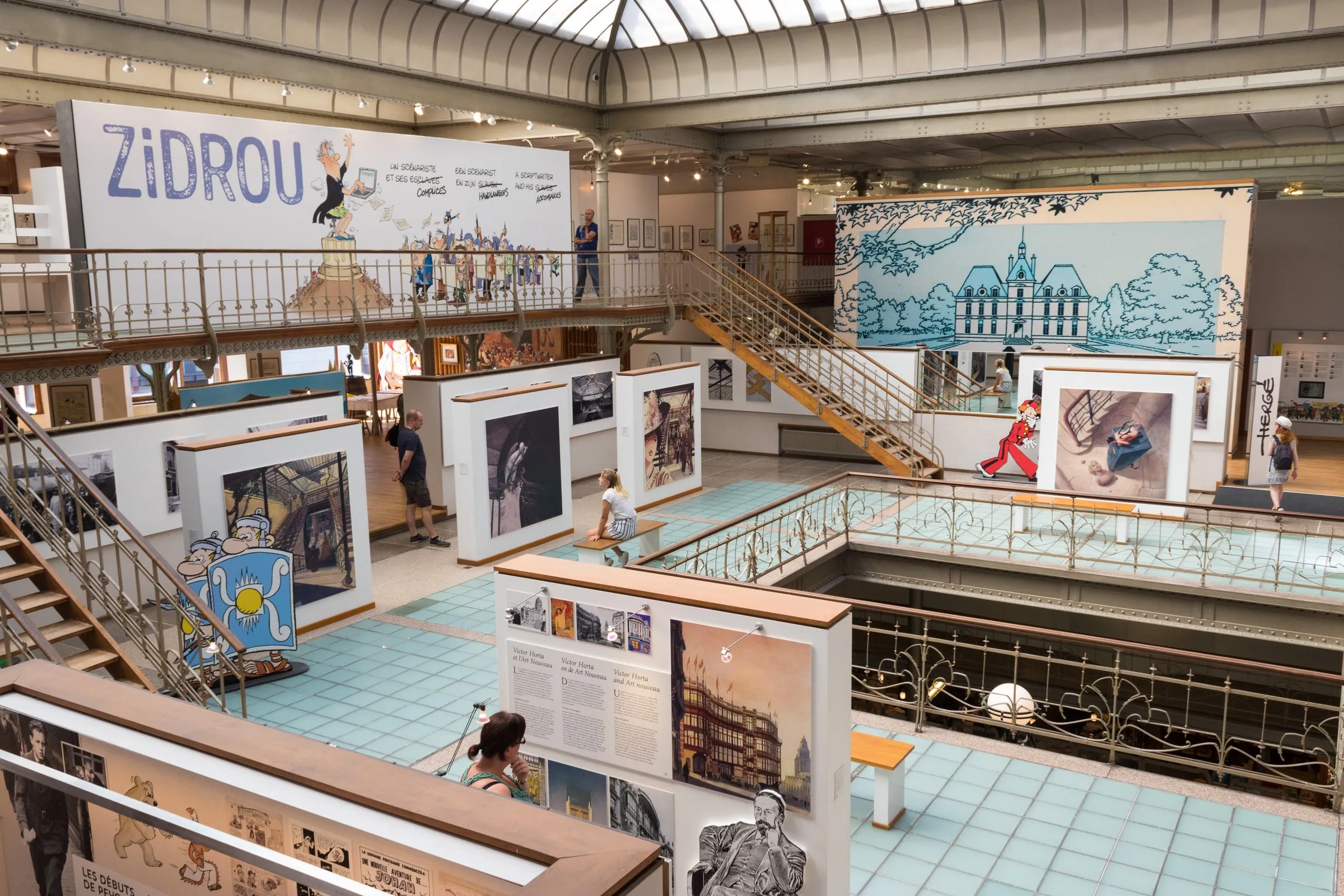
Inside the Belgian Comic Strip Center, in the Art Nouveau building Victor Horta designed as a textile warehouse in 1906.
The Atomium question
The Atomium — nine steel spheres, 102 metres tall, built as the symbol of the 1958 World’s Fair and never meant to outlast it — is the most photographed thing in Brussels that isn’t the Grand-Place, and it’s a genuine detour rather than a stop on the way to anything. It sits at Heysel, north of the centre, and the fastest route is a direct 15-minute Metro line 6 ride from Brussels-Midi itself, no change needed — useful, because it means you don’t have to backtrack through the centre to reach it. Six of the nine spheres are open to visitors, including a panorama restaurant in the top one; adult admission is €17, which also covers the neighbouring Design Museum Brussels. It’s open every day, 10am to 6pm, so unlike the Comic Strip Center it isn’t a Monday problem.
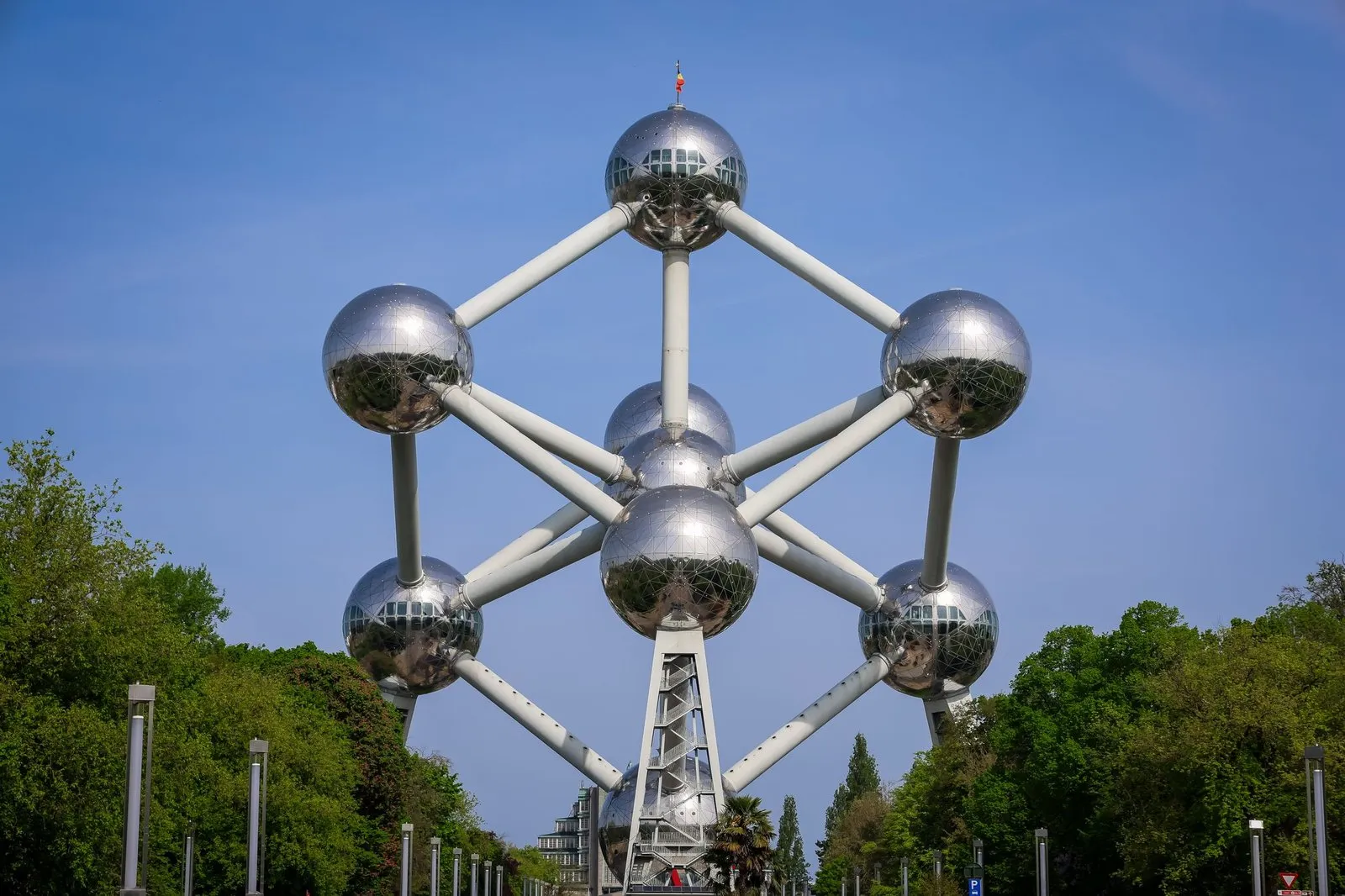
The Atomium, at Heysel.
The honest answer on whether it’s worth the trip: if you’re on one of the early trains and can give it 90 minutes to two hours there and back, it’s a straightforward add-on. If you took the later 08:16 and want a proper look at the centre as well, it’s the first thing to cut — the Grand-Place, Manneken Pis and the comic walls sit close together, and the Atomium doesn’t.
Waffles, frites and beer
Waffles come in two shapes here, and they’re not interchangeable: a Brussels waffle is light, crisp and rectangular, made from a yeasted batter and usually dusted with icing sugar or piled with toppings; a Liège waffle is smaller, denser and irregularly oval, made from a brioche-like dough studded with pearl sugar that caramelises as it cooks. Both are sold from stands across the centre.
Frites come from a paper cone with a dollop of mayonnaise rather than ketchup as the default, fried twice — once to cook the potato through, once to crisp it — at a frietkot (a fries stand, sometimes just a hatch in a wall) rather than a restaurant. Whether the fry itself is Belgian or French in origin is a live dispute between food historians on both sides of the border; nobody disputes that Belgians eat more of them.
Beer is the other constant. The Delirium Café, in the Impasse de la Fidélité alley just off the Bourse, held the Guinness World Record for the longest beer list — 2,004 different beers — when it opened in December 2003, and the list has only grown since.
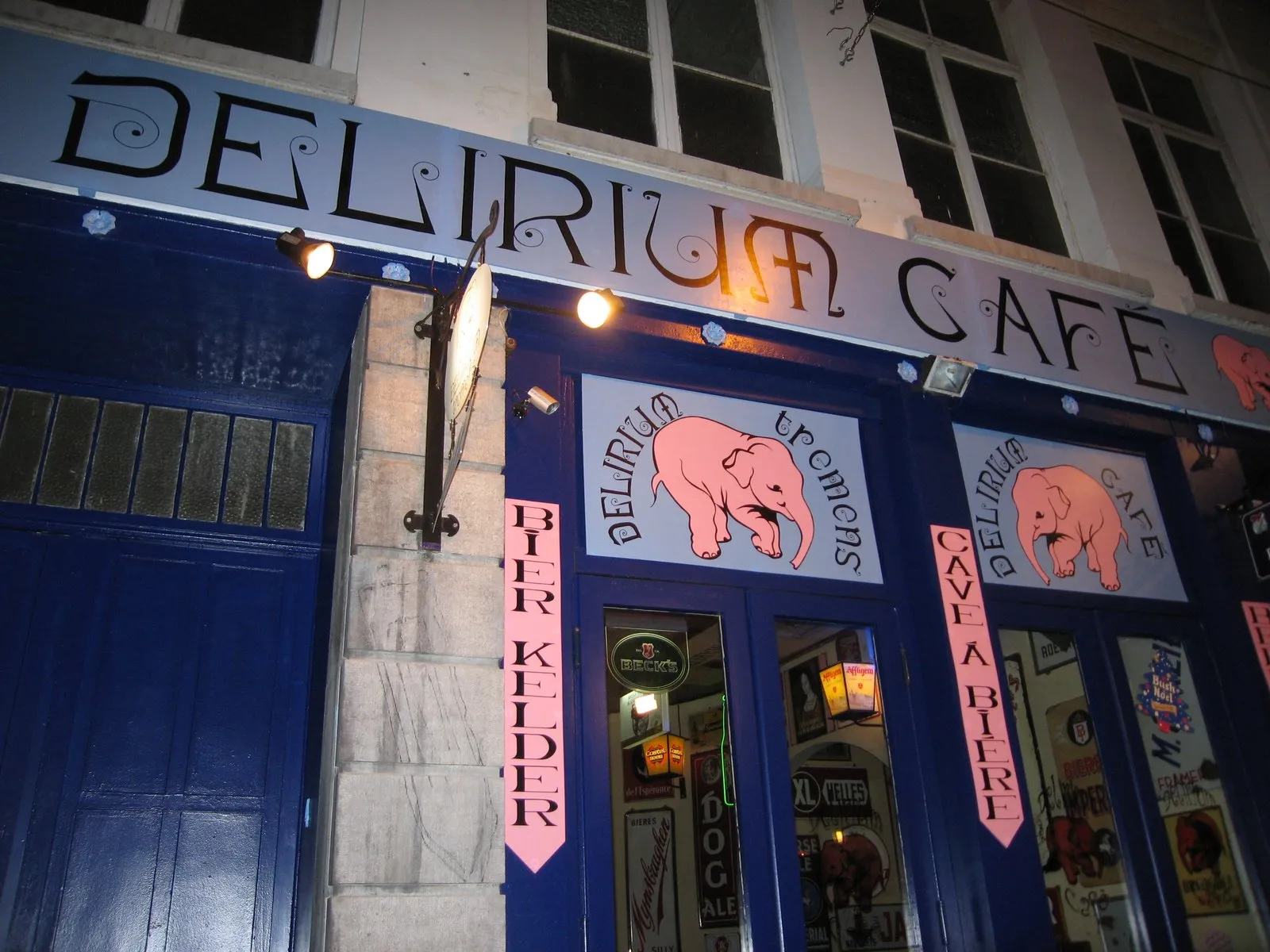
The Delirium Café, just off the Bourse.
Chocolate shops
Neuhaus, still trading from the Galeries Royales Saint-Hubert a few minutes from the Grand-Place, is where the modern filled chocolate began: Jean Neuhaus opened an apothecary on the site in 1857, and it was his grandson, Jean Neuhaus II, who created the first chocolate-filled praline in 1912. Neuhaus’s wife, Louise Agostini, invented the ballotin — the small box that stops pralines crushing each other — shortly after, and both are still standard across the trade. Other names worth the walk: Mary, official supplier to the Belgian royal court since the 1930s, and Pierre Marcolini, the newer, more experimental end of the same tradition.
Onward to Bruges and Ghent
Both are a short Belgian train on from Brussels — Bruges about an hour from Brussels-Midi, Ghent around 35 minutes — but that’s the reason to treat them as their own trip rather than bolt them onto this one: added to the London leg, the maths stops working for a single day. If you want to see both, a guided day trip run from Brussels itself covers the transport and a local guide in one booking; the independent, cheaper option is buying a Belgian Rail ticket on the day, which needs no advance booking on domestic routes. Either way, it’s a better fit as its own day trip from London on the same Eurostar route — see the Bruges day trip guide for the fares and the hours that leaves you.
Where to stay
Stay near Brussels-Midi only if you need the five-minute walk to a morning train — the streets immediately around the station are one of the city’s biggest pickpocketing spots and get a reputation for rough edges after dark. Everyone else is better off in the old centre, one premetro stop away, with a short ride back to Midi for the return journey.
- Jill Hotel Brusselsad — Avenue Fonsny, a two-minute walk from Gare du Midi’s platforms and premetro; a 4-star boutique fit-out behind a plain façade, with a hidden garden terrace. ££, and only worth booking for the early train, not an evening in the area.
- Hotel Amigoad — Rue de l’Amigo, between the Grand-Place and Manneken Pis; a five-star with its own Italian restaurant and Bar Magritte’s live jazz. £££, for the location as much as anything.
- Hotel Le Plaza Brusselsad — Boulevard Adolphe Max, a ten-minute walk from the Grand-Place past the Rue Neuve shops; a traditional, formal hotel rather than a boutique one. ££, and quieter than staying right on the square.
- ibis Brussels off Grand Placead — Rue du Marché aux Herbes, two minutes from the Grand-Place; a modern budget-chain room with a breakfast buffet that includes Belgian waffles. £, the cheapest of the four for the same walk to the square.
What people get wrong
- Treating check-in like a UK domestic train. Eurostar wants 75 minutes at St Pancras for Standard and Plus, not the 10 or 15 minutes a British train gets away with.
- Bringing an ID card instead of a passport. UK nationals need a passport for this route, checked against both the 10-year issue rule and the 3-month validity rule.
- Paying for an ETIAS application. It isn’t live yet; any site selling one now isn’t the official EU service.
- Trying to fit in the Atomium on a short afternoon. It’s a real 30-minute round trip on the Metro before you’ve looked at anything, worth it only if you have the hours.
- Turning up at the Belgian Comic Strip Center on a Monday. The murals outdoors are always there; the indoor museum isn’t.
- Bolting Bruges or Ghent onto the same day. Both need their own hour of travel from Brussels-Midi, on top of the Eurostar you’ve already spent getting there.
- Asking for ketchup with your frites and getting a funny look. Mayonnaise is the default; ask if you want anything else.
All prices and times checked 27 September 2026.
Continue planning your trip
- 🗺️ Day trips from London — what the others cost, how long they take, and which days they are shut.
- 🇫🇷 Paris day trip — the other Eurostar day trip here, and how the fares and the hours compare.
- 🎢 Disneyland Paris from London — a Eurostar day trip with a theme park at the end, and the two routes there.
- 🇧🇪 Bruges day trip — the onward Belgian train from Brussels-Midi, as its own day out from London.
- 🇳🇱 Amsterdam from London — the same train carries on to Rotterdam and Amsterdam, better as a night away than a day.
- 🛏️ Where to stay near King’s Cross — for a hotel within walking distance of St Pancras before an early train.
- 🚇 King’s Cross area guide — what’s around the station if you arrive back with time to spare.
Common questions
How long does the Eurostar take from London to Brussels?
Eurostar's fastest advertised time is 1 hour 51 minutes, St Pancras to Brussels-Midi. Live timetable checks the same day showed direct trains ranging from 1h57 to 2h06 depending on the departure, with around ten trains a day on the route — so check the time on the train you actually book.
How much does the Eurostar to Brussels cost?
Eurostar's own site lists fares to Brussels from £39 for a promotional-fare seat. The more typical advance fare, checked the same day on two independent timetables, was from £51 one-way in Eurostar Standard (or £78 return), from £98 one-way in Eurostar Plus, and a flatter £325 one-way / £490 return in Eurostar Premier, which barely moves with the date.
Can you do Brussels as a genuine day trip from London?
Yes, and more comfortably than Paris. The first train that doesn't need a pre-dawn check-in (08:16) reaches Brussels-Midi by 10:13, and the last train back we found still timetabled leaves Brussels around 19:56-20:56. That's eight to eleven hours in the city, well clear of what Paris or Amsterdam give you on the same pattern.
What time do you need to arrive at the station for the Eurostar to Brussels?
Eurostar's recommended arrival at St Pancras is 75 minutes before departure for Standard and Plus, and 45 minutes for Premier, with the ticket gate closing 30 minutes before (15 for Premier). Coming back, Brussels-Midi's check-in follows the same pattern — UK and EU checks happen there before you board, so there's nothing left to do on arrival at St Pancras.
Do UK travellers need a passport for the Eurostar to Brussels, and what about ETIAS?
Yes, a passport, not a driving licence or ID card, issued within the last 10 years and valid for at least 3 months after you leave the Schengen area. The EU's Entry/Exit System (EES) — a passport scan, a photo and, on your first crossing, fingerprints — has applied to this route since 12 October 2025 and is done at self-service kiosks in St Pancras before the ticket gates, at no cost. ETIAS, a separate travel authorisation costing €20, has not launched: the UK government's own guidance says the EU expects to start it from autumn 2026, with no date confirmed yet, so no UK traveller needs to apply for anything today.
Is the Atomium worth the detour on a day trip to Brussels?
It depends on your hours. The Atomium sits at Heysel, a direct 15-minute Metro line 6 ride from Brussels-Midi with no change — so it works well if you arrive on one of the earlier trains and can spend 90 minutes to two hours there and back before doubling back to the centre. On a tighter afternoon, it's the first thing to drop.
Can you visit Bruges or Ghent from Brussels on the same trip?
Not really as a same-day add-on from London — both are about an hour further by Belgian train from Brussels-Midi or Brussels-Central, which eats into the hours you already have. They work well as their own day trip from London on the same Eurostar route, or as an extra day if you're staying over in Belgium.